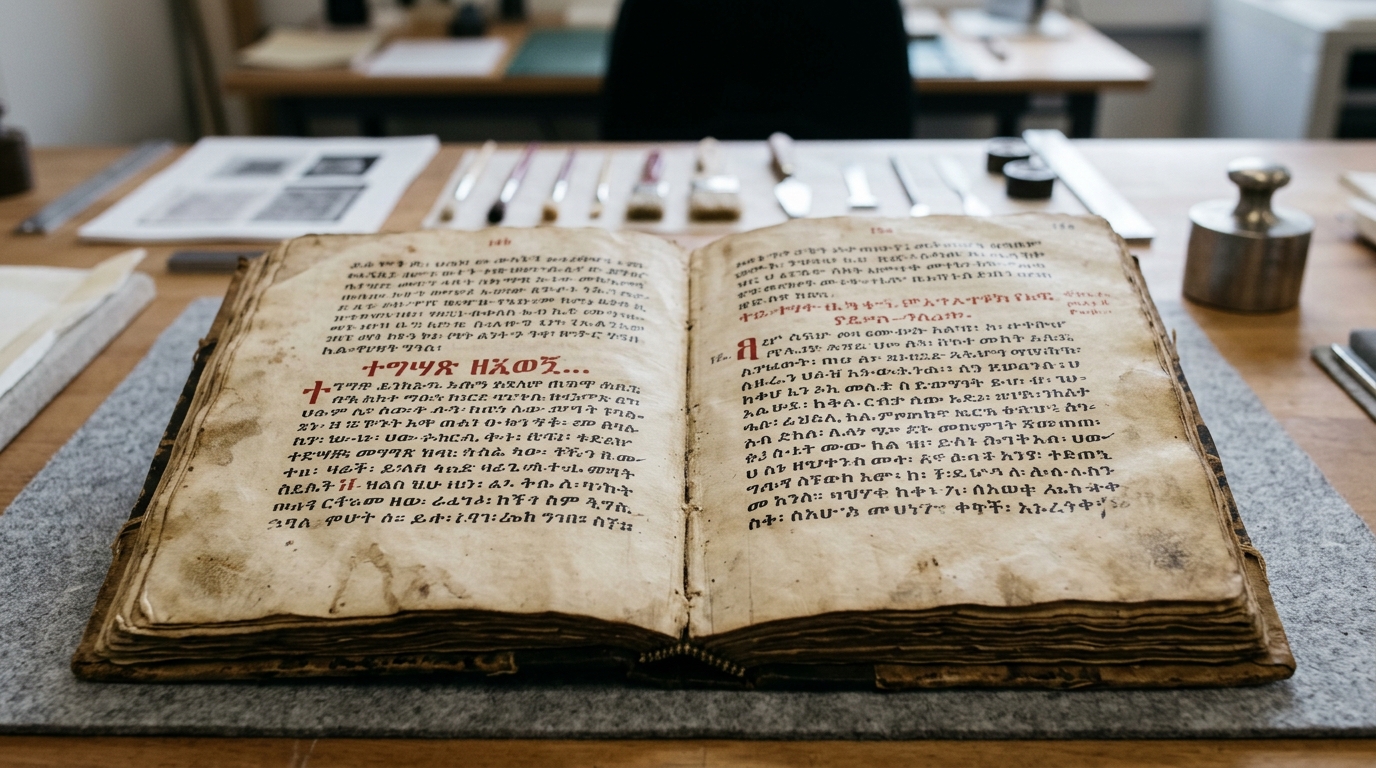
Researchers from Ethiopia have developed a deep convolutional neural network capable of recognizing characters in ancient Ethiopic Ge’ez manuscripts with an accuracy of 93.52%. Published in the journal Discover Imaging in May 2025, the study addresses the critical need to digitize historical religious texts that are currently difficult to access due to the physical degradation of the documents. The Ge’ez language, which serves as the liturgical language for the Ethiopian and Eritrean Orthodox Tewahedo Churches, is written in a script that presents significant challenges for automated recognition systems because of its complex morphology and the aging of the parchment materials.
Over centuries, these materials have suffered from torn parchment, faded ink, and ink bleed, creating noise that complicates the segmentation of individual characters. The Ge’ez script is an abugida system consisting of approximately 231 characters, including 182 basic letters, 20 labialized characters, 9 punctuation marks, and 20 numerals. Unlike many other scripts, Ge’ez characters share similar shapes, with differences often resulting from minor modifications such as added strokes or loops, which makes distinguishing between them a difficult task for both humans and machines.
To address these challenges, the research team, led by Kasaye Akanie Guangul, Dagne Walle Girmaw, and Million Meshesha, created a custom dataset of 20,200 character images representing 202 classes. These images were sourced from 296 pages of historical documents collected from the Ethiopian Orthodox Tewahedo Church, monasteries, and libraries in Gondar and the North Wollo zone. The specific texts included works such as Abushaker Bahire Hasab, Retua Haymanot, and Zena Eskindir, which were written approximately three to four centuries ago. The lack of publicly available standard datasets for ancient Ge’ez scripts necessitated the creation of this private dataset to train and evaluate the recognition models effectively.
The methodology involved a multi-stage optical character recognition process, beginning with image acquisition and preprocessing. The researchers tested four low-pass filtering algorithms for noise reduction and four thresholding algorithms for image binarization. Based on performance metrics, specifically the mean square error and peak signal-to-noise ratio, they selected bilateral filtering for noise reduction and Otsu’s thresholding for binarization. The bilateral filter was chosen for its ability to preserve edges while significantly decreasing noise, which is essential for maintaining the clarity of text in historical manuscripts. The Otsu method was selected because it exhibited the lowest mean square error and the highest peak signal-to-noise ratio among the tested thresholding techniques.
After preprocessing, the images underwent segmentation to detect lines and individual characters using a bounding box algorithm. Because the segmented characters varied in shape due to handwriting differences, they were normalized to a uniform size of 32 by 32 pixels. The researchers then developed four different recognition models: a sequentially developed deep convolutional neural network, two pretrained models (ResNet50 and VGG19), and a CNN-based support vector machine. The deep convolutional neural network was designed with 14 convolutional layers, batch normalization, and a dropout rate of 0.25 to prevent overfitting and ensure robust learning from the limited dataset.
The experimental results demonstrated that the sequentially developed deep convolutional neural network achieved the highest performance, with a validation accuracy of 93.52%. This model outperformed the pretrained ResNet50 model, which achieved a validation accuracy of 78.56%, and the VGG19 model, which reached 78.04%. The CNN-SVM model performed the least effectively, with a validation accuracy of 48.75%. The superior performance of the deep convolutional neural network is attributed to its convolutional and max pooling layers, which are adept at capturing high-level features from the character images, allowing it to distinguish between visually similar characters more effectively than the other architectures.
Despite the high accuracy, the study acknowledges that segmentation errors, often caused by the degradation of document images, negatively impact the performance of the recognition models. The confusion matrix revealed that some characters were incorrectly recognized due to their visual similarity; for instance, the character ሀ was sometimes mistaken for ዐ, and ሉ was confused with ሲ or ሱ. These errors occur because the characters share similar structural elements, such as vertical and horizontal strokes, with only subtle differences in shape or the connection of loops. The researchers noted that the model achieved a correct recognition rate of 91.11% on a random test dataset, highlighting the persistent challenge of distinguishing between characters with minor morphological variations.
The study also highlights the importance of using objective metrics for evaluating preprocessing techniques. The researchers demonstrated that the selection of noise reduction and binarization methods should be based on quantitative measures such as mean square error and peak signal-to-noise ratio rather than just visual assessment. This approach ensures that the preprocessing steps enhance the quality of the document images in a way that directly improves the accuracy of the subsequent recognition stages. The use of a counter-based bounding box for document image segmentation was also shown to improve model performance by more accurately isolating individual characters from the complex background of the vellum.
The contributions of this study include the creation of a dataset that will be made available on a GitHub repository, providing a resource for future researchers in the field of Ge’ez optical character recognition. The researchers also developed a deep learning model that incorporates convolutional layers for feature extraction and integrates a kernel approach for classification. By addressing both segmentation and recognition challenges, the model offers a more comprehensive solution for digitizing ancient manuscripts compared to previous studies that often focused only on base characters or relied on hand-crafted feature extraction methods.
However, the study identifies several areas for future research. The dataset used in this study was relatively small compared to the depth of the neural network, and the researchers recommend creating a larger and standardized dataset to improve classification accuracy. Additionally, further work is needed to develop shape-invariant feature extraction algorithms that can better differentiate between visually similar characters. The segmentation method, while effective, still struggles with characters that are closely spaced or connected due to inconsistent spacing in handwritten text. Future models should also aim to incorporate all 231 characters of the Ge’ez script, as the current model only segments 202 of them.
The digitization of Ge’ez manuscripts is crucial for preserving the historical, cultural, and religious information contained in these documents. By making these texts searchable and accessible, the research contributes to the broader goal of preserving Ethiopia’s ancient wisdom and civilization. The use of deep learning techniques in this field represents a significant step forward in overcoming the technical barriers associated with recognizing ancient scripts. As technology continues to advance, the potential for improving the accuracy and efficiency of optical character recognition systems for historical documents remains substantial.
The findings of this study underscore the complexity of working with ancient manuscripts and the need for sophisticated algorithms to handle the unique challenges posed by their physical condition and linguistic structure. The successful application of deep convolutional neural networks to Ge’ez character recognition provides a foundation for future research in this area. By combining advanced image processing techniques with deep learning, the researchers have developed a system that can effectively recognize and classify characters in ancient Ethiopic manuscripts, paving the way for greater access to these valuable historical resources.
Subject of Research: Character recognition of ancient ethiopic Ge'ez manuscripts using deep convolutional neural networks
Article Title: Character recognition of ancient ethiopic Ge'ez manuscripts using deep convolutional neural networks
Article References: Guangul, K. A., Girmaw, D. W., & Meshesha, M. (2025). Character recognition of ancient ethiopic Ge'ez manuscripts using deep convolutional neural networks. Discover Imaging, 2(1), Article 5. https://doi.org/10.1007/s44352-025-00009-y
Image Credits: AI Generated
DOI: 10.1007/s44352-025-00009-y
Keywords: Character, recognition, ancient, ethiopic, Ge'ez, manuscripts, deep, convolutional, neural, networks, scientific research
News Source: Blake Davidson. (November 7, 2026). Deep Learning Model Achieves 93.52% Accuracy in Ancient Ge’ez Manuscript Recognition. Scienmag.