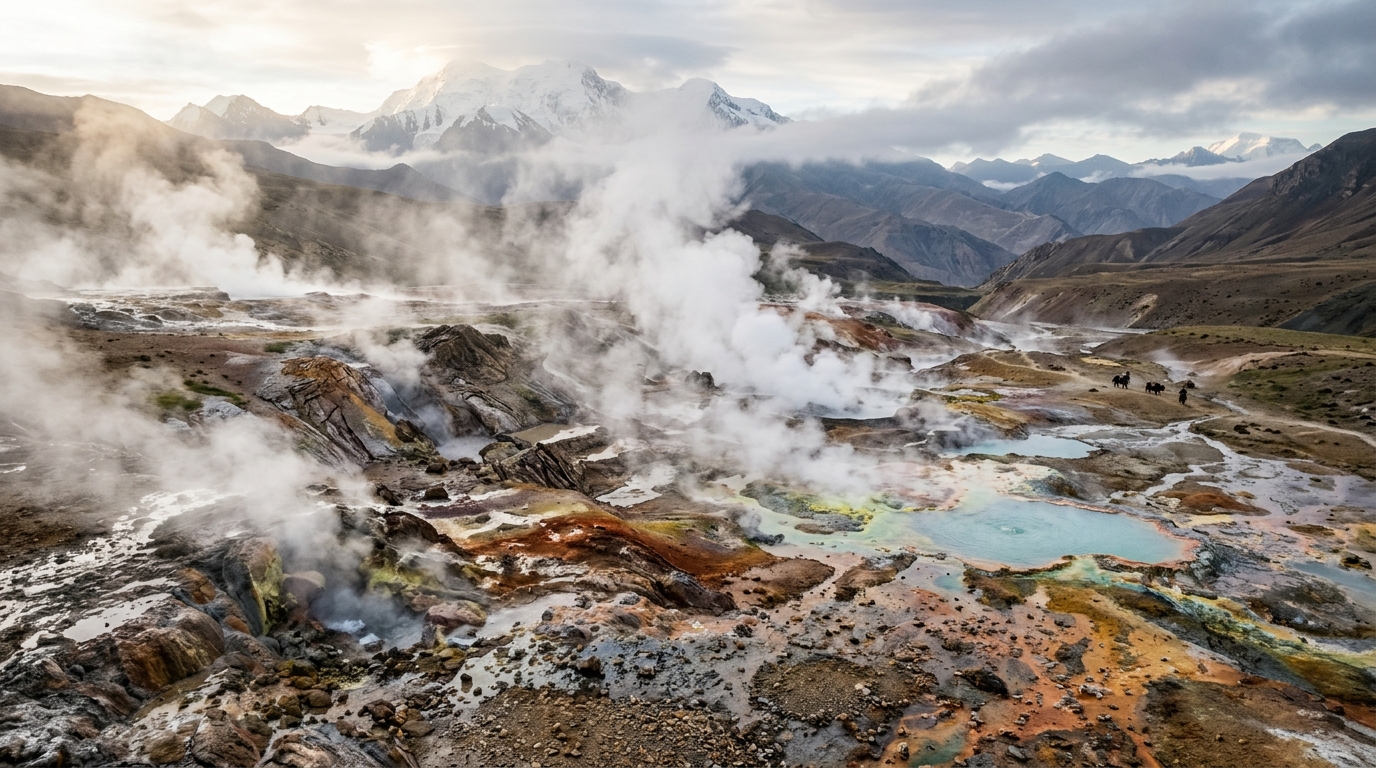
Published in the journal Geothermal Energy in June 2026, the study introduces a physics-guided clustered Gradient Boosting Regression Trees (GBRT) ensemble model. This approach addresses the significant gaps in direct geothermal heat flow measurements, which remain sparse and unevenly distributed due to the high costs and technical limitations of drilling. By integrating physical principles with advanced data-driven techniques, the team generated a high-resolution map of geothermal heat flow for the entire country, offering a more detailed representation of the region’s subsurface thermal conditions.
Geothermal heat flow serves as a comprehensive indicator of the deep thermal regime, encapsulating the combined effects of subsurface temperature distribution, thermal conductivity, radiogenic heat production, and mantle heat input. Unlike individual thermal properties, it reflects the integrated thermal structure of the lithosphere, providing critical constraints for geothermal exploration and studies of crust-mantle coupling. Despite its importance, measured data is dense in North America and Europe but exhibits significant gaps in Asia, Africa, and oceanic domains. The sparsity arises from strict requirements for steady-state borehole temperatures and laboratory-derived thermal conductivity tests, making the development of reliable prediction approaches essential for compensating these measurement deficiencies.
The study incorporated nineteen geological and geophysical features to predict geothermal heat flow, including two newly developed analytical features derived from thermal equilibrium and conduction principles. These physics-derived features were designed to constrain the model’s behavior to follow physical laws, enhancing consistency and interpretability. The research team utilized a clustered ensemble learning strategy, where K-means clustering was employed to stratify significant geological heterogeneity into distinct thermal regimes. This partitioning reduced spatial variance, allowing the model to handle complex regional heterogeneity more effectively than a single global model.
The core methodological advancement involved generating curated, sub-sampled feature sets to partition the study area into distinct thermal regimes. For each cluster, a GBRT model was trained using the training subset within that cluster. The predictions from these models were then aggregated to form a complete prediction for the test set. By altering the feature set used for K-means clustering and repeating the process, the researchers constructed multiple distinct model units. This strategy was designed to enhance the diversity and robustness of the model ensemble by applying different data partitioning and model training approaches from various perspectives.
The final ensemble model was constructed by averaging the predictions of these model units. The researchers determined that the optimal ensemble size was eight model units, as this configuration achieved the most favorable balance between predictive power, computational efficiency, and model stability. Performance gains plateaued once the number of ensembled units reached eight, indicating that including further units provided only marginal benefit. The ensemble model achieved a coefficient of determination (R2) of 92.01%, representing a 6.85% improvement over the baseline non-clustered GBRT model, which had an R2 of 86.11%.
In terms of error metrics, the clustered ensemble model demonstrated significant reductions in both mean absolute error and root mean square error. The mean absolute error decreased by 22.72% to 3.59 mW/m2, and the root mean square error reduced by 22.37% to 7.49 mW/m2, compared to the baseline model. These improvements highlight the superior accuracy of the ensemble approach in capturing the spatial variability of geothermal heat flow. The feature importance analysis revealed that the incorporated analytical solutions exhibited the highest predictive power, underscoring the critical influence of deep thermal structure and geological controls on regional heat flow distribution.
Using the optimized model, the researchers generated an updated, high-resolution geothermal heat flow map of China at a 0.1° × 0.1° grid resolution. This scale provides a significantly more detailed representation of localized thermal anomalies compared to previous regional studies that often relied on 0.25° to 1° grids. The map highlights high geothermal heat flow regions primarily located in the Tibet-Sanjiang Orogen, the Wuyi-Yunkai Orogen, and the Central China Orogen, where values generally exceed 70 mW/m2. Notably, in the Tibet-Sanjiang Orogen, most areas exhibit values exceeding 80 mW/m2, with an anomalously high distribution in the southwestern portion.
Conversely, the map identifies low geothermal heat flow regions, such as the Tarim Craton and Western Central Asian Orogen, where values typically fall below 50 mW/m2. The Yangtze Craton, Eastern Central Asian Orogen, and North China Craton generally exhibit values between 50 and 80 mW/m2. The model predicts higher geothermal heat flow in the eastern portions of the Yangtze and North China Cratons compared to their western parts. These regional variations correspond well with established tectonic histories, such as the intense radioactive heat generation from thick crust in the Tibet-Sanjiang Orogen and the long-term tectonic stability of the Tarim Craton.
To quantify the reliability of the predictions, the researchers calculated the pixel-wise standard deviation across the ensemble model units as a proxy for predictive uncertainty. Low uncertainty values were predominantly observed in stable eastern blocks, such as the North China Craton and Yangtze Craton, indicating robust predictive performance in data-rich regions. In contrast, elevated uncertainty was concentrated in the tectonically active Tibetan Plateau and the margins of the Tarim Craton. This spatial heterogeneity correlates strongly with data density and regional tectonic characteristics, reflecting the scarcity of direct geothermal heat flow constraints in remote high-altitude areas.
The study also compared the clustered GBRT ensemble model with traditional analytical and interpolation methods. Maps generated solely from analytical methods showed poor correspondence with observed geothermal heat flow, particularly for the map based on Analytical Solution 2. In contrast, the ensemble model demonstrated superior predictive accuracy, particularly in areas with known geothermal activity. The predictions aligned well with independent geothermal manifestations, such as high-temperature springs, which are primarily located in high geothermal heat flow regions. This alignment reinforces the effectiveness of the proposed framework in capturing the spatial variability of geothermal heat flow.
Despite the methodological advantages, inherent uncertainties remain in both the analytical and machine learning components of the framework. The analytical solutions carry uncertainties stemming from the spatial variability and measurement errors of key inputs such as Moho depth, Curie-point depth, thermal conductivity, and radiogenic heat production. The machine learning component involves predictive uncertainty arising from uneven data coverage and limited representation of extreme geothermal heat flow values. Although ensemble averaging and cross-validated calibration mitigate much of this variability, the study notes that a rigorous uncertainty evaluation would require comprehensive parameter-distribution datasets that are not yet available at the national scale.
The proposed framework advances the use of ensemble and physics-guided learning for robust geothermal heat flow estimation in data-scarce regions. By integrating analytical solutions into machine learning models, the study provides a more transparent basis for geothermal resource assessment, linking predicted anomalies to measurable geological and thermal processes. This approach ensures that the final predictions remain scientifically grounded even when numerical gains are modest. The high-resolution map generated by this study offers a valuable tool for geothermal exploration and development, providing a scientific basis for understanding geothermal resource potential and its spatial heterogeneity across China.
Subject of Research: A physics-guided clustered GBRT ensemble model for geothermal heat flow prediction and its application in China
Article Title: A physics-guided clustered GBRT ensemble model for geothermal heat flow prediction and its application in China
Article References: He, J., Yi, W., Wang, L., & Shi, Q. (2026). A physics-guided clustered GBRT ensemble model for geothermal heat flow prediction and its application in China. Geothermal Energy, 14(1), Article 25. https://doi.org/10.1186/s40517-026-00389-2
Image Credits: AI Generated
DOI: 10.1186/s40517-026-00389-2
Keywords: physics-guided, clustered, GBRT, ensemble, model, geothermal, heat, flow, prediction, application, China, scientific research
News Source: Katie Riggs. (November 7, 2026). Physics-Guided Model Maps China’s Geothermal Heat Flow. Scienmag.