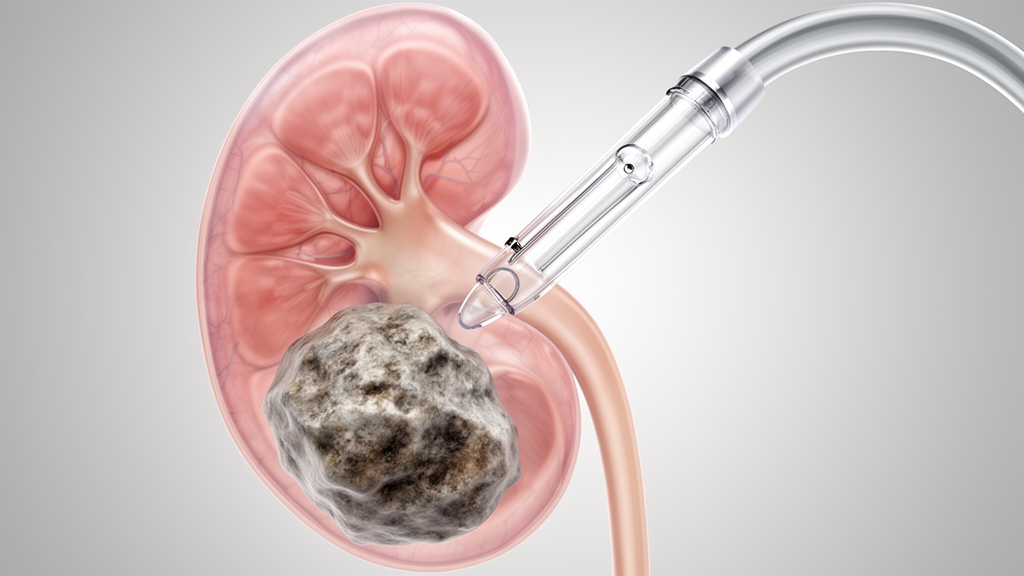
In a retrospective cohort study of adults undergoing retrograde intrarenal surgery (RIRS) for lower pole renal stones, the unadjusted non-contrast computed tomography (NCCT)–based primary stone-free endpoint (< 2-mm residual fragments) did not differ significantly between a flexible and navigable suction ureteral access sheath (FANS-UAS)–assisted strategy and a conventional ureteral access sheath (c-UAS)–based strategy (63.6% vs. 48.8%; p = 0.146). However, the secondary endpoint of complete stone clearance (0 mm) was significantly more frequent with the FANS-UAS approach (45.5% vs. 14.6%; p = 0.001). The investigation evaluated routine clinical practice from September 2022 through December 2025, addressing lower pole stones where dependent anatomy often restricts endoscopic maneuverability and fragment clearance.
The study reviewed adult patients undergoing RIRS, with the NCCT analysis cohort comprising 96 of 142 eligible patients, including 55 treated with the FANS-UAS strategy and 41 managed with the c-UAS strategy. Sensitivity analyses retained an additional 32 patients evaluated via kidney–ureter–bladder radiography (KUB) and 14 patients who lacked follow-up imaging. Because lithotripsy techniques and fragment management approaches differed between groups, investigators interpreted outcomes at the strategy level rather than isolating single device effects. Furthermore, calendar period was explicitly assessed because the two clinical strategies were implemented in largely non-contemporaneous intervals.
Surgical technique varied markedly between the groups, with dusting performed more frequently in the FANS-UAS cohort (87.3% vs. 4.9%) and stone basket retrieval used substantially less often (10.9% vs. 70.7%). Among patients evaluated with KUB radiography alone, no visible residual stone larger than 2 mm was observed in 6 of 10 FANS-UAS patients and 15 of 22 c-UAS patients. Incorporating these proxy outcomes narrowed the between-group difference in stone-free rates to 63.1% versus 55.6% (p = 0.386). An extreme-case sensitivity analysis assigning missing outcomes for the 14 patients without follow-up produced differences between FANS-UAS and c-UAS ranging from −1.5 to 17.5 percentage points. Exploratory safety comparisons remained inconclusive. In addition, the adjusted odds ratio from the primary multivariable model was statistically imprecise at 4.27 (95% CI 1.37–13.37), and an exploratory Firth logistic model incorporating calendar period was also highly imprecise (OR 2.89, 95% profile CI 0.51–17.02), leaving temporal confounding unresolved.
The authors concluded that while complete clearance (0 mm) was documented more frequently with FANS-assisted RIRS, unadjusted primary stone-free rates (< 2 mm) showed no statistically significant difference between the two strategies. Because the bundled clinical strategies were largely non-contemporaneous, an independent strategy or device effect could not be established. Moreover, differential NCCT ascertainment may have enlarged the apparent difference favoring FANS-UAS. The researchers noted that prospective contemporaneous comparisons with standardized lithotripsy, fragment management, and postoperative imaging are required to validate the clinical utility of the suction sheath strategy.
Subject of Research: Suction versus conventional ureteral access sheaths in retrograde intrarenal surgery for lower pole renal stones
Article Title: Flexible and navigable suction ureteral access sheath–assisted versus conventional ureteral access sheath–based strategies for retrograde intrarenal surgery of lower pole renal stones: a retrospective cohort study
Article References: Durak, H. M., Erkartal, A. S., Aghayev, A., & Çaviş, M. (2026). Flexible and navigable suction ureteral access sheath–assisted versus conventional ureteral access sheath–based strategies for retrograde intrarenal surgery of lower pole renal stones: a retrospective cohort study. BMC Urology. https://doi.org/10.1186/s12894-026-02462-1
Image Credits: AI Generated
DOI: 10.1186/s12894-026-02462-1
Keywords: retrograde intrarenal surgery, kidney stones, lower pole renal stones, ureteral access sheath, FANS-UAS, stone-free rate, retrospective cohort study, endourology, Flexible, navigable, suction, ureteral
News Source: Ophelia Keating. (November 7, 2026). Retrospective Study Evaluates Suction Sheaths for Lower Pole Kidney Stones. Scienmag.