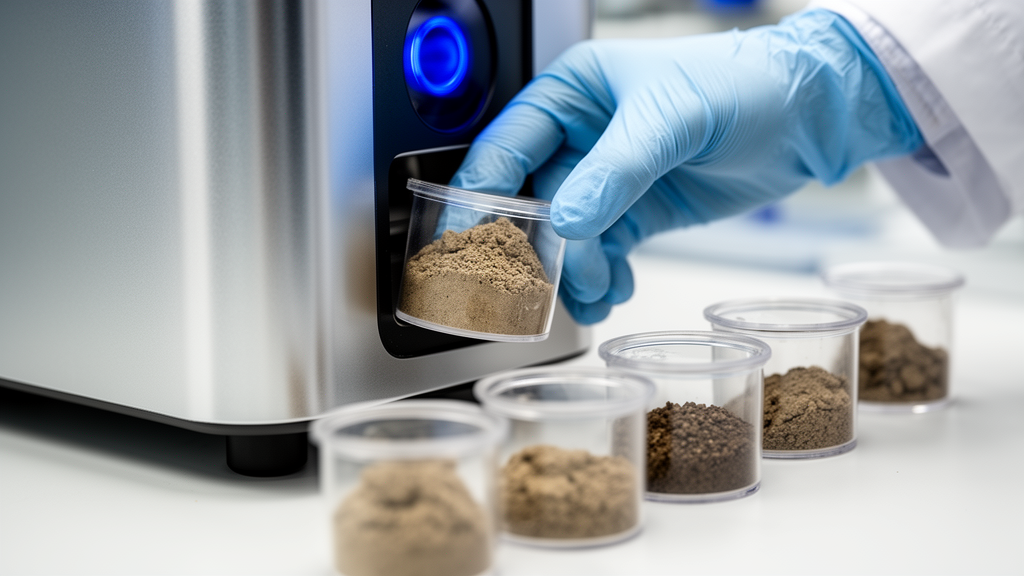
A systematic evaluation of mid-infrared diffuse reflectance spectroscopy has demonstrated that the necessity of labor-intensive soil sample grinding depends entirely on the specific soil chemical property being measured. Reporting on two hundred and twenty-six representative soil samples drawn from the Inceptisols order of the eastern Indo-Gangetic Plains, researchers found that fine grinding is essential for accurately estimating soil organic carbon, whereas simpler mechanical sieving without fine grinding yields comparable predictive performance for soil pH. Mid-infrared diffuse reflectance spectroscopy operates across the four thousand to four hundred inverse centimeter wavenumber range, capturing fundamental molecular vibrations of organic functional groups and soil minerals to deliver rapid, non-destructive, and simultaneous estimation of multiple soil attributes. However, while conventional reference wet-chemistry methods remain expensive, time-consuming, and labor-intensive, the operational deployment of mid-infrared spectroscopy has long faced a major procedural bottleneck due to the traditional requirement of intensive soil grinding. By comparing sieved soil passed through a fifty-three micrometer mesh against soil pulverized into a uniform fine powder below fifty micrometers, the investigation establishes clear, property-specific boundaries for high-throughput spectroscopic soil analysis.
The study addressed a fundamental knowledge gap regarding whether the predictive advantages of fine grinding remain consistent across diverse soil properties and chemometric modeling architectures, and whether advanced numerical preprocessing can compensate for simplified physical preparation. Healthy soils regulate nutrient cycling, carbon sequestration, water retention, and ecosystem functioning, making reliable and scalable soil health assessment vital for precision agriculture, long-term environmental monitoring, and emerging carbon monitoring, reporting, and verification frameworks. Standard laboratory testing relies on wet chemistry methods, such as Walkley-Black dichromate oxidation for soil organic carbon and aqueous suspensions for pH and electrical conductivity, but these protocols generate chemical waste and limit temporal and spatial monitoring resolution. Mid-infrared diffuse reflectance spectroscopy provides diagnostic absorption features superior to visible and near-infrared spectroscopy, yet soil particle size directly alters surface roughness, optical path length, and diffuse scattering. Fine grinding improves sample homogeneity and minimizes optical scattering, but the intensive milling step adds substantial processing time, equipment wear, labor costs, and potential contamination risks that hinder regional and national spectral library development.
To rigorously test whether less intensive preparation can maintain model accuracy, the research team randomly selected two hundred and twenty-six soil samples from the validated spectral library of the International Rice Research Institute South Asia Regional Centre, which houses more than three thousand and eighty-nine soil spectra. Each soil sample was partitioned into three distinct subsamples: one two-millimeter sieved subsample dedicated to triplicate reference wet-chemistry analyses, and two experimental subsamples assigned to mid-infrared spectroscopy under contrasting preparation conditions. The sieved treatment consisted of air-dried soil passed through a fifty-three micrometer sieve without additional grinding, while the fine-ground treatment involved air-dried soil passed through a two-millimeter sieve and subsequently homogenized using a Retsch RM 200 mortar grinder to achieve a particle size below fifty micrometers. The reference laboratory analyses confirmed substantial natural variability across the sample cohort, recording fine-ground electrical conductivity ranging from zero point twelve to zero point forty-six deciSiemens per meter with a mean of zero point twenty-seven, soil pH ranging from six point sixty-seven to seven point eighty-seven with a mean of seven point twelve, and soil organic carbon ranging from zero point thirty-five to zero point eighty percent with a mean of zero point fifty-nine percent.
Spectral data acquisition was conducted using a Bruker Alpha Fourier Transform Mid-Infrared spectrometer equipped with OPUS software, following a two-hour instrument stabilization period, automated calibration, and background correction. Each physical soil sample was scanned three independent times across the four thousand to four hundred inverse centimeter spectral range in reflectance mode, generating six hundred and seventy-eight raw spectra per preparation protocol. These triplicate measurements were averaged into a single representative spectrum per physical sample to improve the signal-to-noise ratio without treating repeat scans as independent statistical observations. The researchers systematically integrated six distinct mathematical preprocessing techniques: raw reflectance, absorbance transformation, multiplicative scatter correction, standard normal variate, and Savitzky-Golay first and second derivatives calculated with an eleven-point smoothing window and a second-order polynomial. Model development evaluated four chemometric and machine learning algorithms: partial least squares regression, random forests, artificial neural networks configured with a single hidden layer of five neurons and weight decay, and support vector machines utilizing a radial basis function kernel.
To prevent information leakage between model training and testing, the complete dataset was partitioned at the physical sample level into a calibration set of one hundred and fifty-eight samples, representing seventy percent of the data, and an independent validation set of sixty-eight samples, representing the remaining thirty percent. Principal component analysis was implemented both for exploratory visualization and as a dimensionality reduction step prior to running random forests, artificial neural networks, and support vector machines, retaining the minimum number of principal components that explained at least eighty-five percent of cumulative variance. Within each training fold of a five-fold cross-validation scheme, all data-dependent transformations and hyperparameter selections were computed exclusively on training observations before application to held-out folds. Partial least squares regression did not utilize principal component dimensionality reduction because the algorithm inherently extracts latent variables that maximize the covariance between spectral predictors and target reference values. Hyperparameters were tuned by minimizing five-fold cross-validated root mean square error, selecting random forest mtry values of thirty for pH, thirty-five for electrical conductivity, and forty for organic carbon alongside five hundred trees, while support vector machines used a penalty parameter of ten and a gamma parameter of zero point zero zero one.
Direct spectral comparison revealed marked qualitative and quantitative divergence between the two preparation protocols. Fine-ground samples generated smoother, sharper, and more distinct absorption peaks across the mid-infrared range, whereas sieved samples exhibited increased baseline variability and attenuated absorbance, particularly across the thirty-seven hundred to twenty-eight hundred inverse centimeter region and the eighteen hundred to six hundred inverse centimeter fingerprint zone. Diagnostic carbon-hydrogen stretching bands at twenty-nine hundred and fifty and twenty-eight hundred and fifty inverse centimeters, indicative of soil organic carbon, appeared sharper and less confounded by overlapping mineral signatures in fine-ground samples. In the fingerprint region, well-resolved peaks at approximately ten hundred and eighty and eight hundred inverse centimeters corresponding to silicon-oxygen stretching and bending vibrations in quartz showed improved clarity after fine grinding. Principal component analysis quantitatively confirmed this separation: the first two principal components accounted for eighty-five point fifty percent of total spectral variance, sixty-seven point four percent on the first component and eighteen point one percent on the second, with a Euclidean centroid distance of two point seventy-nine principal component units separating sieved and fine-ground clusters, accompanied by a mean root mean square spectral difference of zero point one hundred and fourteen absorbance units.
Independent validation demonstrated that model accuracy was highly property-dependent, with soil organic carbon showing the strongest sensitivity to sample preparation. For soil organic carbon, partial least squares regression coupled with absorbance preprocessing delivered the highest predictive performance on fine-ground samples, achieving a validation coefficient of determination of zero point eighty-four, a root mean square error of zero point zero five, and a ratio of performance to deviation of two point thirty-one, placing it firmly in the category of excellent prediction. In contrast, the identical model architecture applied to sieved soil samples achieved a validation coefficient of determination of only zero point forty-six, a root mean square error of zero point ten, and a ratio of performance to deviation of one point fifteen, denoting poor predictive capability. Compared to the baseline raw-reflectance model, absorbance preprocessing improved fine-ground organic carbon validation accuracy by thirty-six percent while reducing prediction error by twenty-three percent, demonstrating that minimizing diffuse scattering through grinding allows mid-infrared spectra to accurately capture fundamental organic functional group vibrations.
Conversely, the prediction of soil pH demonstrated that intensive sample grinding is unnecessary to achieve robust quantitative models. When applied to sieved soil samples, partial least squares regression using absorbance transformation achieved a validation coefficient of determination of zero point eighty-three, a root mean square error of zero point fifty, and a ratio of performance to deviation of one point eighty-eight, which represents fair to good predictive accuracy. For fine-ground soils, the corresponding best partial least squares model with absorbance yielded a validation coefficient of determination of zero point seventy-three, an error of zero point fifty-five, and a ratio of performance to deviation of one point seventy-one. Across other tested algorithms, validation coefficients of determination for pH ranged from zero point fifty-five to zero point sixty-seven for sieved soils and from zero point fifty-eight to zero point sixty-eight for fine-ground soils. Notably, support vector machines produced a constant prediction of six point eighty-five for sieved pH, reflecting severe model underfitting and excessive regularization rather than an inherent failure of mid-infrared spectroscopy, confirming that support vector machines were unsuitable for pH prediction under the evaluated experimental parameters.
Electrical conductivity proved substantially more challenging to estimate accurately across all evaluated modeling workflows, reflecting the indirect nature of its relationship with mid-infrared spectral features. Because electrical conductivity and pH lack unique mid-infrared absorption bands, their spectroscopic estimation depends on secondary covariance with mineralogical, textural, exchange-related, and organic characteristics present within the calibration soils. In the independent validation set, the highest electrical conductivity performance was obtained for sieved samples using random forests combined with absorbance preprocessing, which produced a coefficient of determination of zero point sixty-five, a root mean square error of zero point zero six deciSiemens per meter, and a ratio of performance to deviation of one point twenty-eight. For fine-ground samples, the best electrical conductivity validation reached a coefficient of determination of zero point fifty-six, an error of zero point zero eight, and a ratio of performance to deviation of one point zero six using partial least squares regression with absorbance. Because most validation ratios of performance to deviation remained below one point four, mid-infrared spectroscopy demonstrated only poor to moderate capacity for quantitative electrical conductivity determination regardless of preparation intensity.
Evaluating the mathematical transformations showed that spectral preprocessing plays a decisive role in governing model behavior, with absorbance emerging as the most consistent baseline technique. Absorbance linearizes Beer-Lambert relationships and preserves physically meaningful absorption bands associated with organic and mineral constituents, outperforming raw reflectance and scatter-correction methods such as standard normal variate and multiplicative scatter correction. Savitzky-Golay derivative filtering did not surpass absorbance preprocessing, indicating that derivative transformations may inadvertently suppress pertinent spectral information or amplify background noise in heterogeneous soil datasets. Statistical comparisons confirmed that absorbance yielded significantly lower prediction errors than raw reflectance for soil organic carbon at the five percent significance level, whereas differences among absorbance, standard normal variate, and multiplicative scatter correction remained statistically indistinguishable for pH and electrical conductivity. Paired bootstrap resampling across one thousand iterations on the sixty-eight independent validation samples confirmed that the performance advantage of fine grinding was statistically robust for soil organic carbon while confidence intervals for pH demonstrated overlapping predictive capacity between sieved and pulverized samples.
From an operational standpoint, omitting the mechanical grinding step provides substantial laboratory efficiency gains for large-scale soil testing facilities and environmental monitoring campaigns. Laboratory workflow calculations indicate that eliminating the mortar grinding stage reduces sample preparation time by approximately nine minutes per sample, which translates to a direct saving of seventy-five person-hours for every five hundred samples processed. In terms of resource consumption, operating a standard zero point twenty-five to zero point thirty kilowatt laboratory mortar grinder consumes approximately twenty-one to twenty-five kilowatt-hours of electricity per five hundred samples. Bypassing this step saves approximately three hundred and fifteen to three hundred and seventy-five Indian rupees in direct electricity costs and avoids fifteen to twenty-one kilograms of carbon dioxide equivalent emissions per five hundred samples. Additional operational savings derived from avoiding grinding include an estimated four thousand two hundred and fifty rupees in equipment depreciation, thirty-four hundred rupees in annual maintenance expenses, and twenty-five hundred rupees in cleaning consumables and contamination controls.
The authors emphasized several methodological boundaries that contextualize the findings and outline requirements for broader implementation. Because triplicate scans were averaged prior to statistical modeling, instrument measurement repeatability could not be partitioned separately from sample preparation variability. Furthermore, the nominal particle-size boundaries of sieved soil at fifty-three micrometers and fine-ground soil below fifty micrometers were relatively close, underscoring the need for quantitative particle-size distribution measurements in subsequent research. The dataset was composed predominantly of Inceptisols from the eastern Indo-Gangetic Plains, meaning that external validation across diverse soil orders, contrasting mineralogical assemblies, and wider geographic domains remains necessary before these specific preprocessing recommendations can be universally adopted. The researchers also noted that calibration transfer approaches, including direct standardization, external parameter orthogonalization, and representative spiking, were not experimentally evaluated, leaving open the question of how legacy libraries built entirely on fine-ground samples can seamlessly integrate newly acquired sieved spectral data.
Subject of Research: Optimization of soil sample preparation and mid-infrared spectroscopy for predicting soil physicochemical properties
Article Title: Optimizing soil preprocessing for scalable and robust prediction of soil properties using mid-infrared spectroscopy
Article References: Nath, D., Peramaiyan, P., Fulford, A., Kumari, V., Kumar, V., & Singh, S. (2026). Optimizing soil preprocessing for scalable and robust prediction of soil properties using mid-infrared spectroscopy. Results in Engineering, 32, Article 113509. https://doi.org/10.1016/j.rineng.2026.113509
Image Credits: AI Generated
DOI: 10.1016/j.rineng.2026.113509
Keywords: mid-infrared spectroscopy, soil organic carbon, soil pH, electrical conductivity, chemometrics, sample preparation, Inceptisols, partial least squares regression, Optimizing, soil, preprocessing, scalable
News Source: Denise Maddox. (November 7, 2026). Mid-Infrared Soil Analysis Accuracy Depends on Preparation Protocol and Target Property. Scienmag.