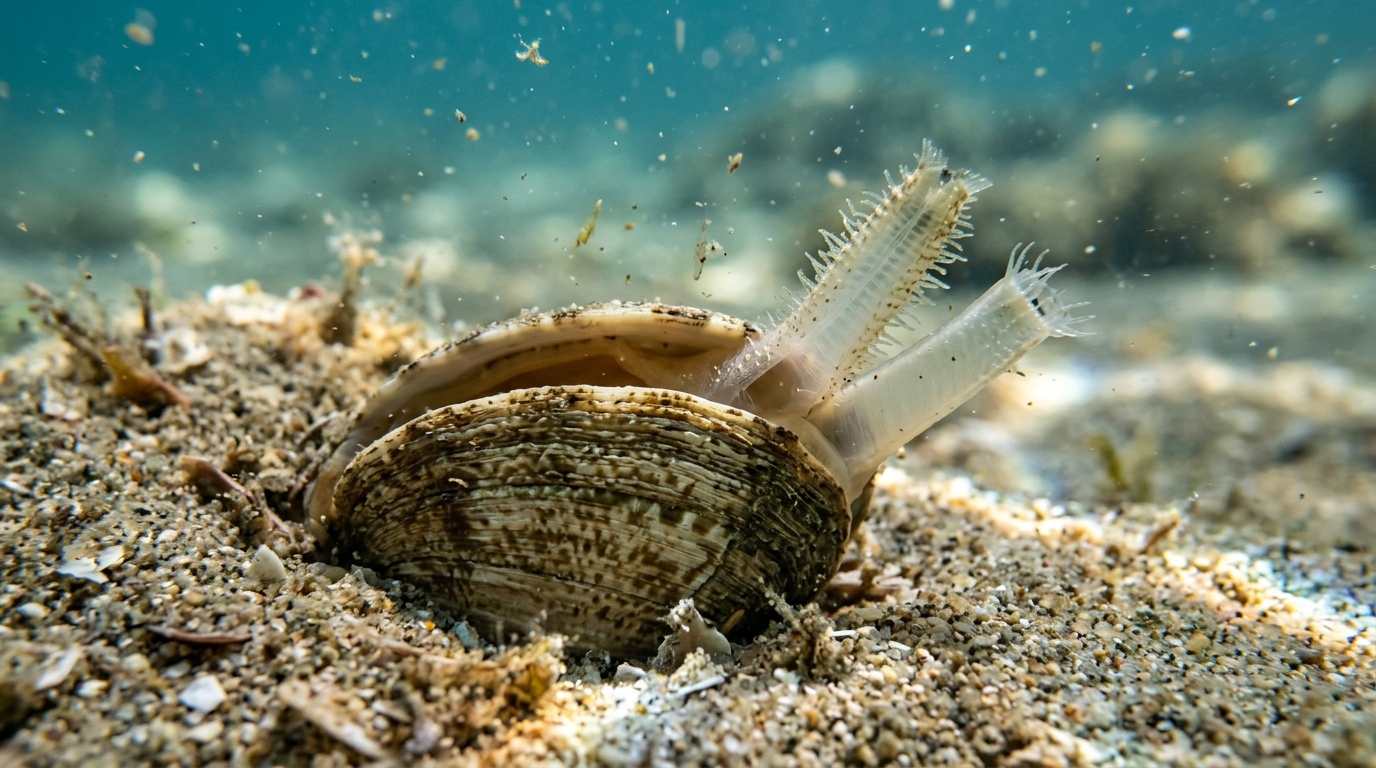
Mucosal lectin-carbohydrate interactions mediate feeding selection in the Manila clam, Ruditapes philippinarum, uncovering a sugar-code mechanism that governs bivalve feeding behavior. According to research published in BMC Biology by Weiwei Jiang, Lulu Geng, Meng Lv, Jinghui Fang, Yuze Mao, Jianguang Fang, and Zengjie Jiang, this molecular recognition system resolves how clams discriminate among suspended food particles. Published on November 5, 2026, the study reveals that pre-ingestive selection relies directly on mucosal lectin interactions with cell-surface carbohydrates displayed on microalgae.
Filter-feeding bivalves represent ecologically and economically crucial organisms in coastal ecosystems and mariculture systems. In these environments, their feeding behavior profoundly modulates nutrient biogeochemical cycling and aquaculture productivity. Despite the widespread recognition of particle selection in bivalves, the intrinsic mechanisms underlying this selective process have remained largely elusive. This investigation addresses that gap by uncovering a sugar-code mechanism governing particle selection in the Manila clam Ruditapes philippinarum via mucosal lectin-carbohydrate interactions.
In feeding experiments, the Manila clam exhibited strong feeding selectivity, showing a 100% sorting efficiency for the phytoplankton species Thalassiosira weissflogii over Platymonas subcordiformis. The researchers found that such preferential ingestion was tightly associated with distinct cell-surface glycosylation signatures between the two phytoplankton species. Specifically, Thalassiosira weissflogii was highly enriched in glucose and galactose residues. In comparison, Platymonas subcordiformis contained significantly lower abundances of these two monosaccharides, but exhibited higher levels of arabinose and xylose.
To evaluate the causal role of these surface sugars in guiding feeding choices, the research team conducted lectin-mediated blockade experiments targeting cell-surface glucose and galactose residues. Lectin-mediated blockade of glucose and galactose residues eliminated the feeding preference and reversed the clam’s ingestion bias. This experimental reversal demonstrated that mucosal lectin-glucose and lectin-galactose recognition mediates pre-ingestive selection, confirming that the Manila clam’s preference for Thalassiosira weissflogii over Platymonas subcordiformis directly depends upon detecting these specific carbohydrate signatures.
Furthermore, mucosal proteomics analysis of clam feeding tissues revealed abundant galectins and C-type lectins in Ruditapes philippinarum. In addition, the researchers identified a novel mucosal lectin gene, designated RpML, which was significantly downregulated upon glucose blockade. The authors concluded that mucosal lectin-glucose and lectin-galactose recognition mediates pre-ingestive selection. By establishing the molecular basis of particle sorting in bivalves, these results advance coastal biogeochemical theory and provide a molecular foundation for optimized bivalve aquaculture diets.
Subject of Research: Pre-ingestive feeding selection mechanisms in the Manila clam
Article Title: Lectin carbohydrate interactions mediate feeding selection in the Manila clam Ruditapes philippinarum
Article References: Jiang, W., Geng, L., Lv, M., Fang, J., Mao, Y., Fang, J., & Jiang, Z. (2026). Lectin carbohydrate interactions mediate feeding selection in the Manila clam Ruditapes philippinarum. BMC Biology. https://doi.org/10.1186/s12915-026-02781-7
Image Credits: AI Generated
DOI: 10.1186/s12915-026-02781-7
Keywords: Manila clam, Ruditapes philippinarum, lectins, filter feeding, bivalve aquaculture, particle selection, phytoplankton, galectins, Lectin, carbohydrate, interactions, mediate
News Source: Drew Townsend. (November 7, 2026). Mucosal Lectins Guide Feeding Selection in the Manila Clam. Scienmag.