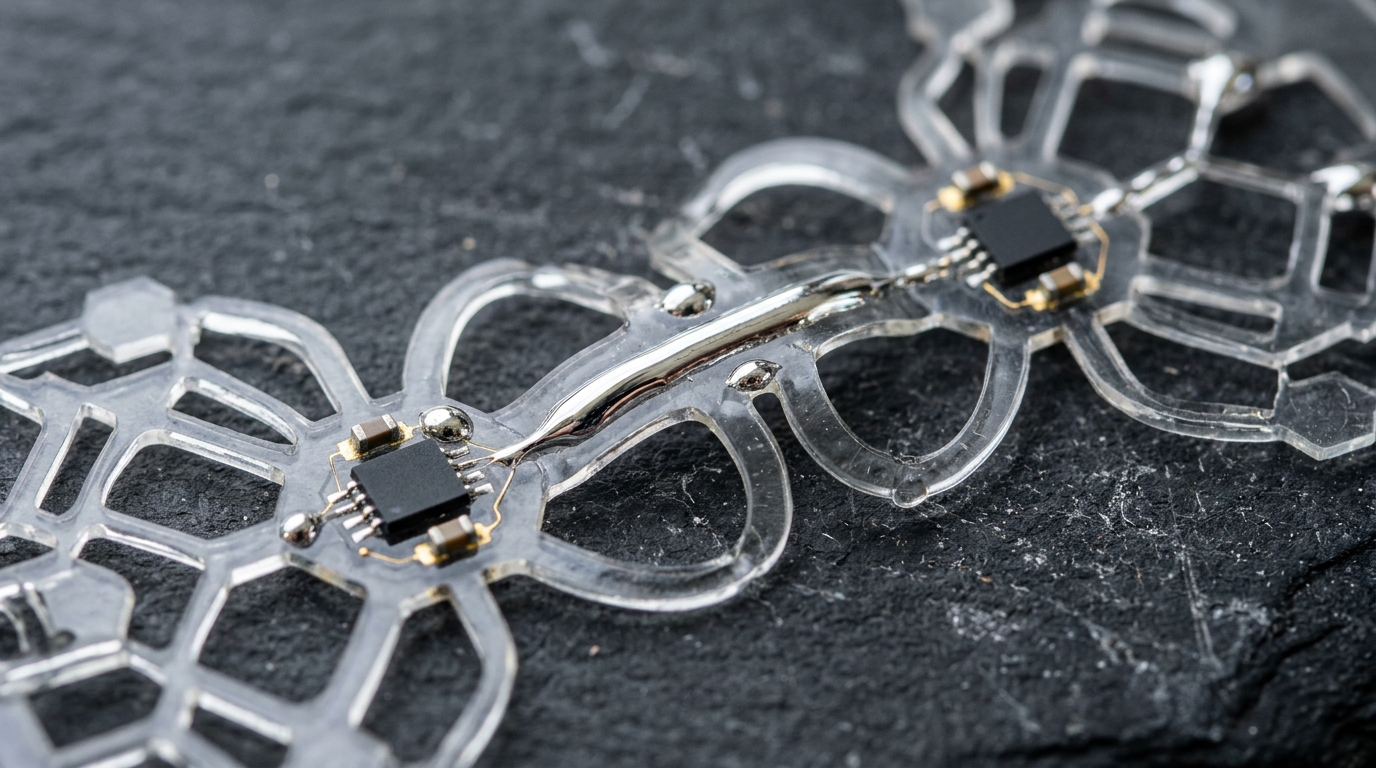
A research study published in npj Flexible Electronics demonstrates the use of liquid metal as an electrical interface material (LM-EIM) for mounting rigid electronic components on kirigami-based stretchable substrates. The researchers, Takashi Sato, Wataru Iwasaki, and Eiji Iwase, investigated methods to overcome a critical mechanical trade-off in stretchable electronics design. Kirigami structures typically impart high stretch tolerance to sheets composed of materials with low stretchability by accommodating applied mechanical loads through local bending and twisting. However, this inherent mechanical advantage is compromised when rigid electronic components are affixed to the sheet using traditional rigid electrical interface materials, such as solder or conductive adhesives. Because these rigid materials mechanically constrain the necessary local deformations of the kirigami pattern, the assembled devices experience structural failure and fracture at low strain levels.
To resolve these mechanical constraints, the investigation evaluated a liquid metal electrical interface material designed to withstand substantial deformation during physical extension. Material evaluations revealed that the liquid metal interface itself possesses remarkable mechanical compliance, exhibiting a stretch tolerance 24 times greater than solder and 35 times greater than conductive adhesive. By providing a highly deformable electrical connection, the liquid metal interface significantly reduced the localized mechanical constraints previously imposed on the kirigami structure. This reduction in physical constraint suppressed premature substrate fracture by allowing the patterned sheet to undergo its characteristic local bending and twisting motions without mechanical interference from the mounted components.
Quantitative comparisons demonstrated that the liquid metal interface preserved the full mechanical resilience of the underlying substrate under tensile deformation. In comparative tests, mounting rigid components with conventional solder reduced the substrate stretch tolerance to just 32 percent of that measured without any mounted components. Similarly, component attachment using conventional conductive adhesive reduced substrate stretch tolerance to 36 percent of the unmounted baseline. In contrast, mounting components with the liquid metal electrical interface material did not reduce the substrate stretch tolerance. Under mechanical testing, the fracture strain of the substrate mounted with the liquid metal interface reached 3.99, corresponding to 1.1 times the fracture strain achieved by the substrate without any mounted components.
The research team also verified the practical electrical stability of the liquid metal interface under active physical deformation using multi-component circuit arrays. In device tests, a resistor array mounted with the liquid metal interface successfully maintained continuous electrical connectivity up to a device strain of 2.0. Furthermore, an integrated light-emitting diode (LED) array operated stably up to a device strain of 1.5. This technical approach allows rigid, high-performance components to be integrated onto highly stretchable kirigami sheets without sacrificing substrate stretchability, supporting the development of high-performance, multifunctional stretchable electronic systems.
Subject of Research: Liquid metal electrical interface materials for kirigami-based stretchable electronics
Article Title: Liquid metal interfaces for component mounting on kirigami stretchable substrates
Article References: Sato, T., Iwasaki, W., & Iwase, E. (2026). Liquid metal interfaces for component mounting on kirigami stretchable substrates. npj Flexible Electronics. https://doi.org/10.1038/s41528-026-00662-1
Image Credits: AI Generated
DOI: 10.1038/s41528-026-00662-1
Keywords: liquid metal, kirigami substrates, stretchable electronics, electrical interface materials, flexible electronics, component mounting, strain tolerance, Liquid, metal, interfaces, component, mounting
News Source: Denise Maddox. (November 7, 2026). Liquid Metal Interfaces Preserve Stretchability for Rigid Components on Kirigami Substrates. Scienmag.