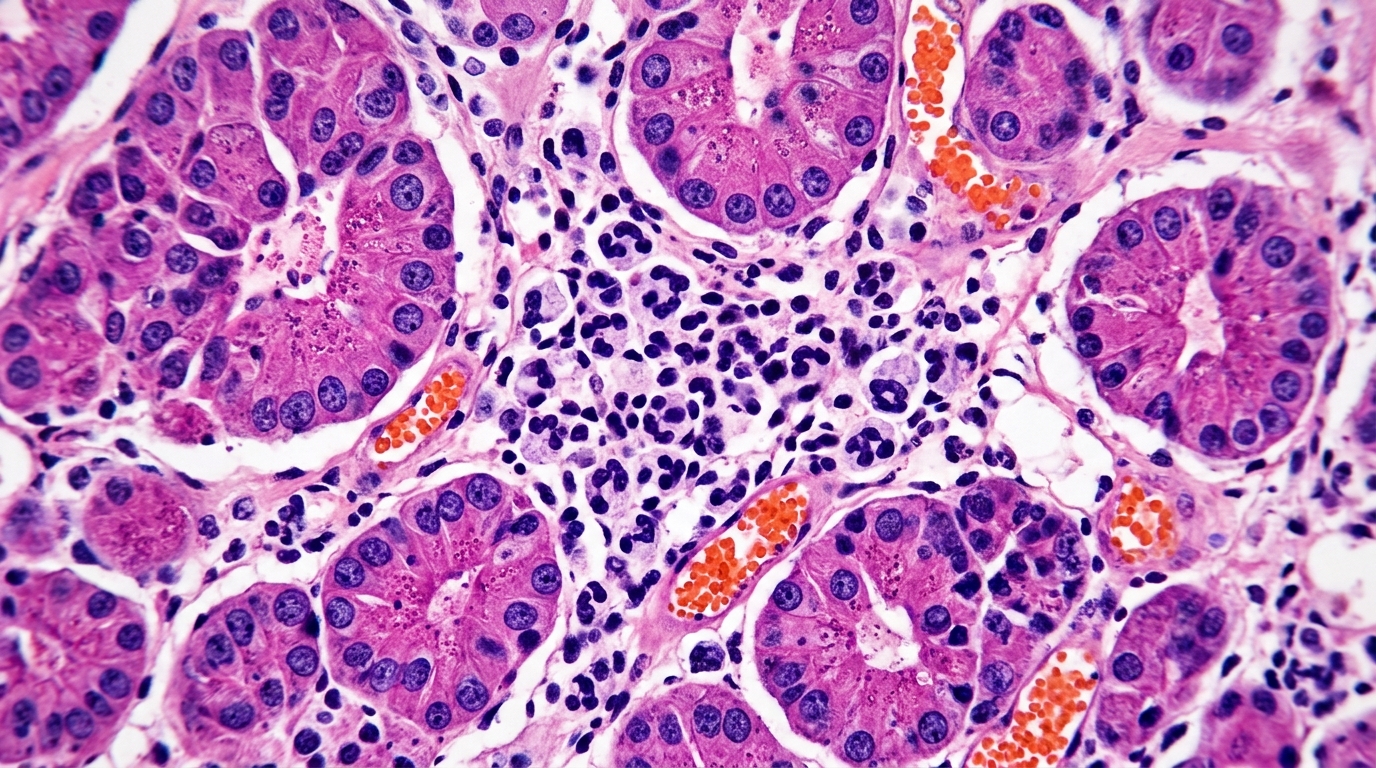
Exploratory machine learning models evaluated alongside plasma cytokine measurements demonstrated moderate discriminative ability for identifying severe acute pancreatitis, according to a retrospective study published in BMC Gastroenterology. The analysis revealed that while cytokine-based exploratory modeling provided complementary information for severity classification, cytokine distributions exhibited partial overlap across patient groups, limiting the ability to separate disease severity using single biomarkers alone.
The retrospective investigation evaluated 220 patients diagnosed with acute pancreatitis, categorized into mild, moderately severe, and severe disease groups. Researchers retrieved plasma measurements for eight inflammatory cytokines: interleukin-2 (IL-2), IL-4, IL-6, IL-10, IL-12p70, IL-17, interferon-gamma (IFN-γ), and tumor necrosis factor-alpha (TNF-α), aiming to characterize severity-associated correlation patterns and evaluate exploratory severity stratification.
Correlation network analysis demonstrated descriptive differences in cytokine correlation patterns across the three severity groups. However, following false discovery rate correction, no between-group difference in any individual cytokine–cytokine correlation remained statistically significant. Furthermore, the observed overlap in cytokine distributions across mild, moderately severe, and severe cases confirmed limited separability when relying on individual biomarkers.
To evaluate multivariable patterns, two exploratory machine learning strategies were applied to the patient data: LASSO-based multinomial logistic regression for cytokine feature selection, and random forest modeling for classifying severe versus non-severe acute pancreatitis. Model performance was evaluated using repeated nested cross-validation, receiver operating characteristic discrimination metrics, and variable importance analysis. Under repeated nested cross-validation, the random forest approach achieved moderate discriminative ability for identifying severe disease, characterized by high specificity but limited sensitivity.
Feature selection outcomes varied between the two analytical methods, but interleukin-6 and interleukin-10 were consistently highlighted as informative cytokines across the analyses. The authors concluded that cytokine-based exploratory modeling provides a preliminary framework for investigating severity stratification in acute pancreatitis, noting that these exploratory findings support future validation in larger prospective patient cohorts.
From a pathophysiological perspective, acute pancreatitis presents as an acute abdominal disease defined by local pancreatic inflammation alongside complex immune dysregulation. Because inflammatory cytokines represent central drivers in the pathophysiology of the condition and maintain a potential association with disease severity, investigators sought to compare plasma cytokine profiles across patients staged with mild, moderately severe, and severe illness.
Subject of Research: Machine learning and cytokine profiling for acute pancreatitis severity stratification
Article Title: Cytokine network analysis and machine learning-based stratification of disease severity in acute pancreatitis
Article References: E, J., Jiang, Y., Liu, H., Ji, C., Liao, Y., Pan, X., & Huang, W. (2026). Cytokine network analysis and machine learning-based stratification of disease severity in acute pancreatitis. BMC Gastroenterology. https://doi.org/10.1186/s12876-026-05498-7
Image Credits: AI Generated
DOI: 10.1186/s12876-026-05498-7
Keywords: acute pancreatitis, cytokines, machine learning, interleukin-6, interleukin-10, disease severity, random forest, biomarkers, Cytokine, network, analysis, machine
News Source: Teresa Odom. (November 7, 2026). Machine Learning Explores Cytokine Profiles to Stratify Acute Pancreatitis Severity. Scienmag.