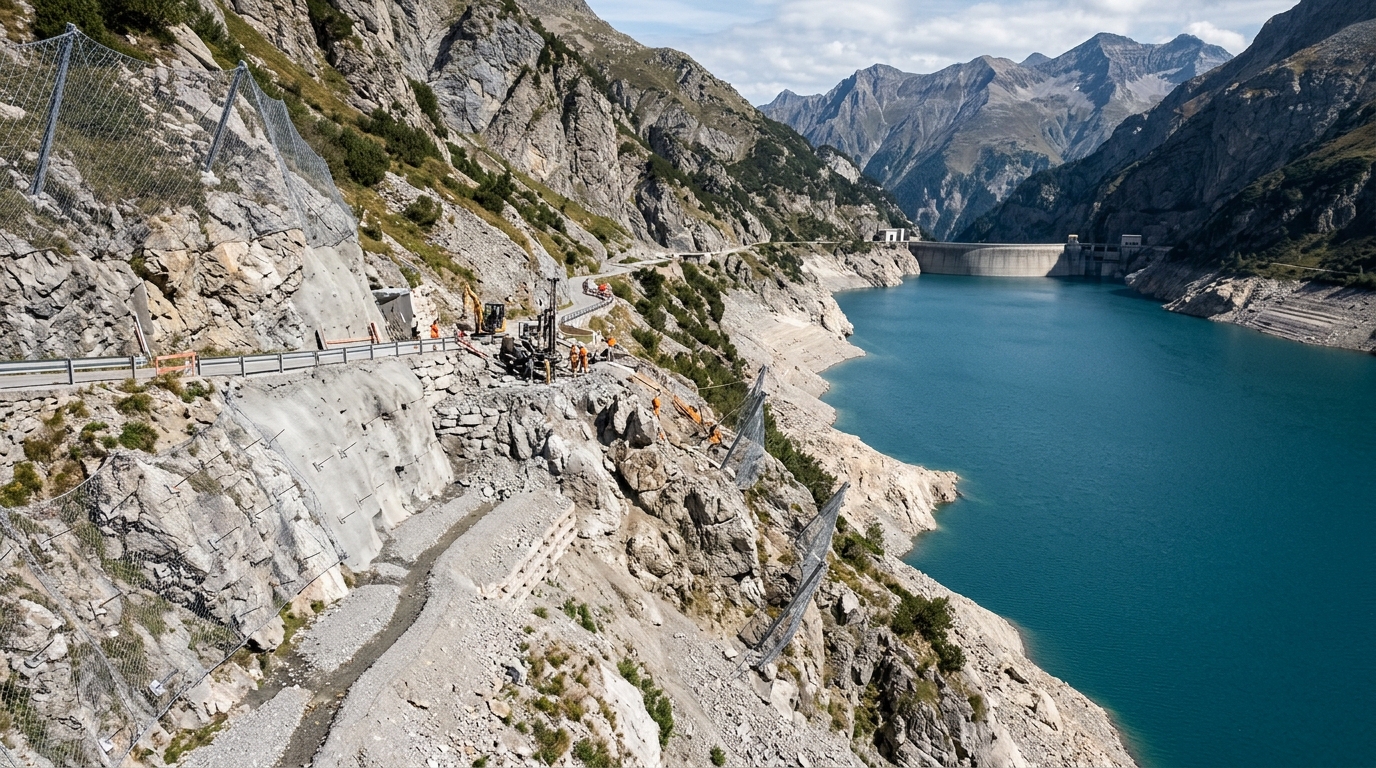
A systematic technical synthesis and bibliometric analysis has revealed that slope stability in hydropower reservoir systems is governed by a dynamic balance of forces rather than water level fluctuations alone. Examining numerical and hydro-mechanical modeling across operational scenarios, the study demonstrated that reservoir-level variations do not generate a single mechanical response in adjacent slopes. Instead, stability is determined by the transient equilibrium between external hydrostatic support and internal hydraulic processes.
The research evaluated the dispersed scientific literature linking operational hydraulic conditions to slope stability modeling approaches. To conduct the evaluation, the authors structured their methodology into three phases: an initial literature search and corpus construction, bibliometric analysis paired with science mapping, and a systematic review providing comparative technical synthesis. The primary search identified 479 records, which were subsequently refined to 420 records for bibliometric evaluation and 163 studies for detailed technical synthesis.
Bibliometric mapping of the corpus indicated recent academic growth and highlighted clear thematic clusters in the field. The analysis showed a strong research concentration on rapid-drawdown stability assessments and numerical simulations of reservoir-level fluctuations. These patterns reflect an ongoing effort to characterize how operational changes during hydropower activity alter the hydraulic and mechanical behavior of surrounding geological slopes.
The technical synthesis established that the internal hydraulic response of adjacent slopes is conditioned by permeability, drainage characteristics, geometry, geological structural controls, and prior hydraulic history. Among the 163 synthesized studies, hydraulic lag was identified in 77.9 percent of cases.
The evaluation also examined the capabilities and constraints of current numerical tools, finding that model applicability depends on the specific failure mechanism, material domain, deformation regime, and engineering output rather than any universal hierarchy of methods. A notable limitation across the literature was that formal geotechnical uncertainty analysis regarding model inputs and spatial variability appeared in only 9.2 percent of the evaluated studies. The authors concluded that reservoir elevation or drawdown rate alone cannot define slope condition, emphasizing that numerical model complexity must be matched directly to the physical process and engineering objectives under study.
Subject of Research: Numerical modeling of slope stability in hydropower reservoir systems
Article Title: Numerical modeling of slope stability in hydropower reservoir systems examined through a bibliometric and systematic review
Article References: Jaya-Montalvo, M., Brito-Matamoros, R., Berrezueta, E., Solórzano, J., Robles, J., Morante-Carballo, F., & Carrión-Mero, P. (2026). Numerical modeling of slope stability in hydropower reservoir systems examined through a bibliometric and systematic review. Discover Applied Sciences. https://doi.org/10.1007/s42452-026-09803-7
Image Credits: AI Generated
DOI: 10.1007/s42452-026-09803-7
Keywords: slope stability, hydropower reservoirs, numerical modeling, bibliometric review, systematic review, hydraulic lag, geotechnical engineering, Numerical, modeling, slope, stability, hydropower
News Source: Denise Maddox. (November 7, 2026). Systematic Review Examines Slope Stability Modeling Across Hydropower Reservoir Systems. Scienmag.