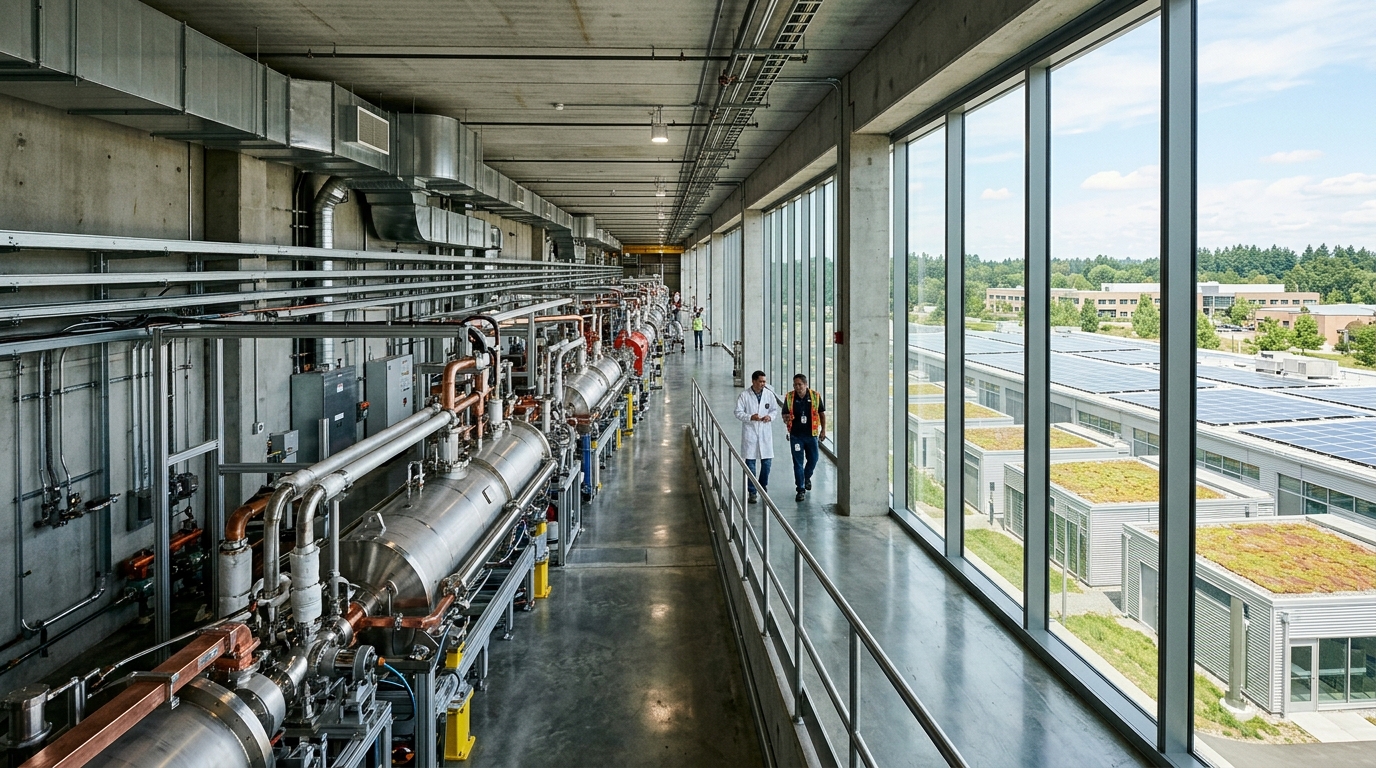
A new living guidelines framework published in EPJ Research Infrastructures outlines high-level strategies to embed environmental sustainability into the planning, design, construction, operation, and decommissioning of large particle accelerator facilities. Authored by Hannah Wakeling, Philip N. Burrows, Jim Clarke, Jo Colwell, Niko Neufeld, Ben Shepherd, Dwayne Spiteri, and John Thomason, the document establishes practical pathways for the international physics community to curb substantial ecological footprints. While accelerator facilities fundamentally advance modern medicine, materials science, and fundamental physics, their intense consumption of natural resources and high electrical power demands require systematic mitigation as major new research complexes and facility upgrades are planned over coming decades.
Large accelerators are intrinsically resource-intensive, with annual energy consumption at major installations reaching into terawatt-hours per year. For instance, the CERN laboratory consumes up to 1.3 terawatt-hours per year depending on its specific operating regime, while the European Spallation Source projects a maximum annual energy demand of 270 gigawatt-hours. The generation of electricity, whether from renewable, nuclear, or fossil sources, carries an inherent environmental footprint, and relying strictly on green tariff purchases often merely shifts fossil fuel consumption across the power grid to other consumers. Consequently, the guidelines stress that accelerator facilities must actively minimize overall power demand across all subsystems rather than assuming that regional grid decarbonization alone will eliminate their operational carbon footprint.
The guidelines prioritize sustainability interventions through a hierarchy of seven actions, ranking rethink, refuse, reduce, reuse, repair, repurpose, and recycle in order of preference to prevent environmental damage before it occurs. The authors identify organizational culture change as carrying the greatest overall potential for environmental impact reduction, while acknowledging it remains one of the hardest to measure and implement. Top-down institutional leadership must establish clear sustainability policies, allocate dedicated budgets and staff time for research and development into low-impact technologies, integrate environmental criteria into procurement decisions, and foster internal transparent tracking of environmental achievements across research teams.
Historically, research facilities prioritized scientific output over sustainability, but the authors emphasize that environmental considerations must now carry equal weight alongside financial budgets and technical capabilities. In major project evaluations, facilities must regularly examine whether environmental sustainability should outweigh incremental gains in scientific output, especially when energy or material demands increase disproportionately. Researchers are encouraged to evaluate more compact accelerator concepts, such as wakefield accelerators with higher gradients and stronger magnetic fields, to achieve scientific goals with fewer materials. Designers must also remain vigilant against the rebound effect, wherein efficiency gains inadvertently lead to extended machine operations and higher net resource consumption instead of absolute reductions.
Early decision-making holds the strongest leverage over the whole-life environmental footprint of an accelerator complex, with the greatest influence concentrated at the initial conception, optioneering, and design stages. The report advises implementing multi-criteria decision analysis, environmental social governance scoring, and cost-benefit analysis to transparently evaluate trade-offs when selecting machine layouts, operating frequencies, and tunnel dimensions. Systemic assessments must follow a cradle-to-grave lifecycle boundary, measuring full embodied carbon from initial raw material extraction to end-of-life disposal. When presenting baseline proposals to research funding agencies, facility planners are urged to put forward the most sustainable design options rather than presenting ecological stewardship as an optional or secondary upgrade.
Civil engineering and infrastructure represent major sources of embodied carbon, largely driven by tunnel excavation and the extensive concrete required for radiation shielding. Research at CLIC and the International Linear Collider demonstrates that optimizing segmental tunnel linings and utilizing excavated earthworks for radiation barriers can yield carbon reductions, including potential embodied carbon cuts of up to 40 percent through low-carbon concrete mixes. The guidelines also recommend modular shielding design, gabion construction, and the investigation of alternative radiation shielding materials such as iron shot, non-toxic tungsten, polymers, and water-based or biological layers. Furthermore, facility layouts should plan for extreme weather resilience, incorporating flood drainage, permeable pavements to counter urban heat islands, and contingency protocols for drought-related cooling restrictions.
Hardware systems within accelerator complexes offer substantial technical targets for power and material conservation, spanning radio-frequency systems, magnets, and cryogenic networks. Radio-frequency systems represent primary power consumers, where novel high-efficiency klystrons and thin-film superconducting cavities can cut energy loss, though engineers must guard against Jevons paradox where higher efficiencies encourage higher power draw. In magnet design, permanent magnets eliminate operational power and cooling needs, offering environmental break-even periods of roughly one year despite higher upfront embodied emissions than electromagnets. Facilities must also responsibly track critical materials including niobium, helium, and rare earth elements such as samarium and neodymium, which carry severe geopolitical supply risks and carbon-intensive extraction profiles.
Computing centers and data processing form another rapidly escalating source of resource consumption for high-energy physics, requiring systematic hardware and software interventions. The framework recommends adopting breathable computing centers that can dynamically scale power usage up or down, or time-shift computing workloads to match periods of high renewable power generation.
The guidelines explicitly urge facilities to report absolute greenhouse gas emissions openly and transparently, warning against greenwashing and sciencewashing where environmental performance is obscured by public assertions of scientific virtue. The authors stress that societal or environmental benefits generated by scientific research cannot mathematically cancel out a facility’s physical greenhouse gas emissions, which remain in the atmosphere across centuries unless actively captured. Carbon offset schemes must be treated strictly as an absolute last resort due to documented issues regarding carbon permanence and risks of reversal, with direct carbon abatement prioritized across all operational phases.
Looking ahead, this living document will be systematically updated as new operational data, case studies, and engineering benchmarks emerge across international laboratories. The authors intend to develop a tiered recommendation matrix that classifies proposed mitigation strategies by their anticipated environmental impact, implementation difficulty, and technology readiness level. By formalizing lifecycle reporting metrics, sharing case study data from operating accelerators, and fostering interdisciplinary collaboration across physics, engineering, and social sciences, the guidelines seek to establish a standardized framework for sustainable scientific infrastructure worldwide.
Beyond technical hardware and civil engineering considerations, the guidance highlights operational adaptations and institutional policy alignment as vital drivers of emissions reductions. The authors link facility sustainability directly to international targets, noting that 196 parties committed under the Paris Agreement to limit global temperature rises to well below two degrees Celsius above pre-industrial levels. Similarly, the European Strategy Group for Particle Physics recommended that major project approval processes incorporate detailed plans for environmental impact minimization and energy saving and reuse. The Heidelberg Agreement, published in October 2024 and endorsed by fourteen European funding bodies and research organizations, further underscores the necessity of embedding concrete environmental sustainability criteria directly into research grant mechanisms.
Operational travel patterns across the international research community represent another immediate target for carbon abatement. Air travel accounts for 96 percent of greenhouse gas emissions associated with research travel, making it the mobility sector with the largest mitigation potential. The document emphasizes that facilities should prioritize hybrid or remote access for user experiments and international conference participation to curb unnecessary journeys. While virtual conferencing has been shown to reduce carbon footprints by up to 94 percent and energy consumption by 90 percent compared to in-person events, the authors observe that conference attendance patterns experienced a 70 percent reversion to in-person gatherings between 2022 and 2024. Consequently, facilities are advised to implement flight quotas, lengthen essential in-person research stays, and organize regional conference hubs.
The guidelines also detail targeted resource recovery programs to reclaim high-value inputs and minimize broader ecological disturbances. For site management, the framework promotes low-impact landscaping initiatives, including permeable pavements to mitigate urban heat island effects, alongside green roofs, insect hotels, bird boxes, and native flora restoration around experimental halls. To prevent unintentional ecological harm, the authors note that supplying conventional beehives does not support many endangered wild bee species, urging sites to focus on broader biodiversity initiatives that genuinely protect surrounding natural ecosystems.
Finally, the document underscores the necessity of interdisciplinary collaboration and comprehensive education across research staffs. Upskilling programs must train researchers and technical engineers to conduct early lifecycle impact assessments and properly interpret environmental metrics. The authors also highlight how technical insights can be transferred from other fields, citing life cycle assessments of medical linear accelerators where standby electrical consumption was shown to account for 8 to 19 percent of the total operational carbon footprint. Bridging accelerator research with the environmental, social, and humanities disciplines is considered vital to ensure that new infrastructure proposals respect local community concerns and maintain public trust throughout each stage of facility planning and execution.
Subject of Research: Environmental sustainability guidelines and lifecycle impact reduction for large particle accelerator facilities
Article Title: High-Level Environmental Sustainability Guidelines for Large Accelerator Facilities
Article References: Wakeling, H., Burrows, P. N., Clarke, J., Colwell, J., Neufeld, N., Shepherd, B., Spiteri, D., & Thomason, J. (2026). High-Level Environmental Sustainability Guidelines for Large Accelerator Facilities. EPJ Research Infrastructures, 10(1), Article 12. https://doi.org/10.1007/s41781-026-00163-w
Image Credits: AI Generated
DOI: 10.1007/s41781-026-00163-w
Keywords: particle accelerators, environmental sustainability, greenhouse gas emissions, life cycle assessment, energy efficiency, sustainable computing, civil engineering, research infrastructure, High-Level, Environmental, Sustainability, Guidelines
News Source: Sloane Callahan. (November 7, 2026). Scientists Establish Environmental Sustainability Guidelines for Major Particle Accelerator Facilities. Scienmag.