In a retrospective observational study of older hospitalized patients who experienced a fall while receiving physical therapy, researchers found that higher basic movement ability was independently associated with falling outside rather than inside the patient room. The investigation, conducted at Hiroshima City North Medical Center Asa Citizens Hospital in Japan, evaluated 688 fall events among patients aged 65 years or older between May 2022 and February 2026. Rather than assessing overall fall incidence or attempting to predict which inpatients would suffer a fall, the authors specifically examined the spatial context of falls among individuals who had already fallen. Led by Kosuke Kobayashi and colleagues, the research demonstrated that patients with better preserved bed mobility, sitting balance, and standing capacity were significantly more likely to fall in ward corridors, toilets, or shared areas than at the bedside, shedding light on how physical performance relates to the immediate environment where an adverse event takes place.
Hospital falls represent a severe adverse event in acute-care settings, frequently contributing to delayed functional recovery, prolonged hospital stays, and increased safety concerns. Existing literature emphasizes that inpatient falls are multifactorial occurrences arising from complex interactions between intrinsic patient characteristics, treatments, and physical environments. Factors such as impaired gait and balance, general functional status, cognitive impairment, acute and chronic clinical conditions, medication exposure, and ward hazards all contribute to overall risk. While standard clinical tools such as the Morse Fall Scale and STRATIFY have long focused on predicting which patients in the general hospital population are likely to fall, the researchers noted that characterizing the specific circumstances of events among patients who have already fallen represents a distinct epidemiological question. Functional status, they hypothesized, might help distinguish the spatial context in which falls happen, even though the study design cannot predict the occurrence of falls across the broader inpatient census.
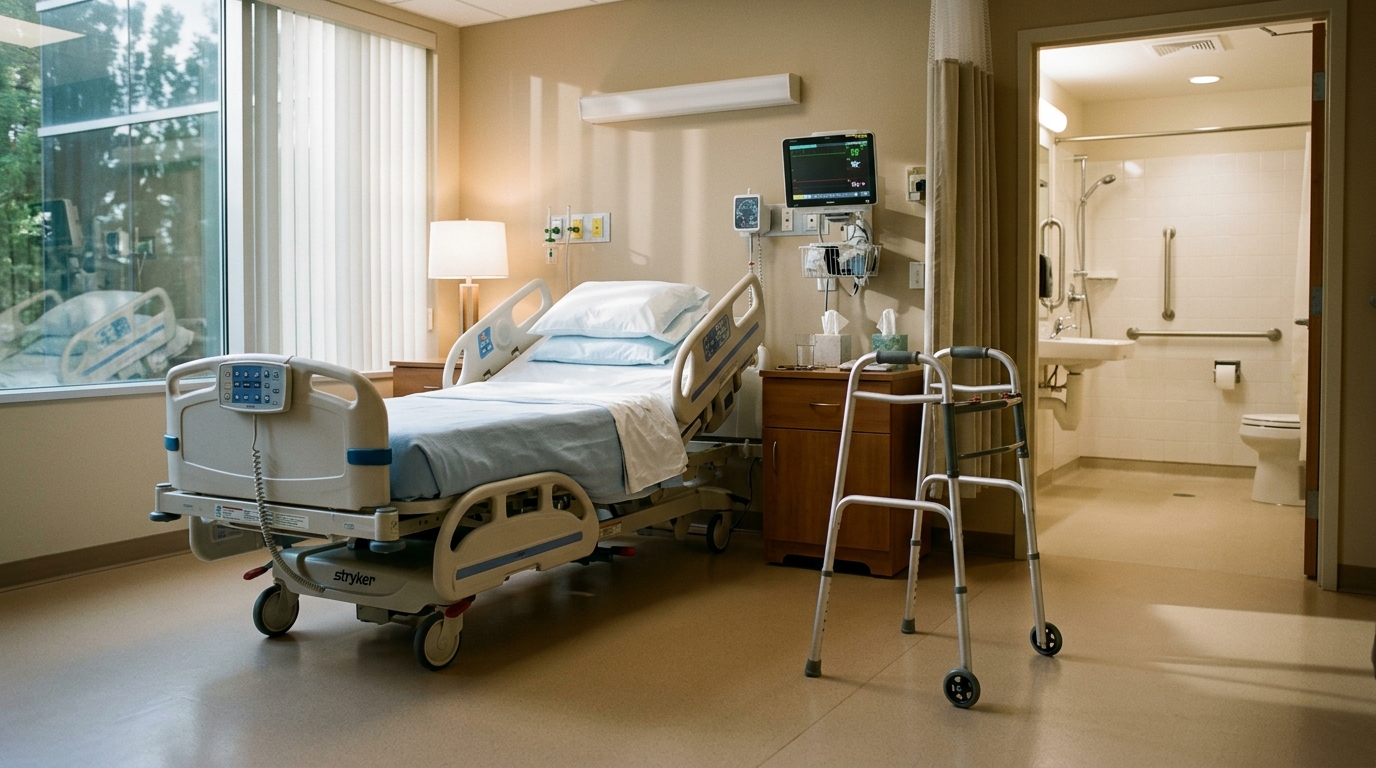
The physical layout of acute-care facilities makes fall location a clinically meaningful distinction because preventative strategies must align with the specific environment. Within patient rooms, falls commonly occur near the bedside, during repositioning, or during initial attempts to rise, making environmental adaptations such as room reconfiguration, bed or chair height adjustments, accessible nurse call buttons, and targeted transfer assistance particularly relevant. The investigators established the patient-room boundary as a pragmatic, first-level spatial classification for organizing context-sensitive prevention strategies, while explicitly noting that this spatial distinction does not directly measure or reveal the exact mechanical cause of any individual fall event.
To capture fundamental physical function at the bedside, the team utilized the Ability for Basic Movement Scale II (ABMS II), an instrument routinely completed by physical therapists during acute rehabilitation. The ABMS II evaluates five fundamental movement tasks: turning over from a supine position, sitting up, maintaining an unsupported sitting posture, standing up from a chair or bed, and maintaining an upright standing posture. Each of the five movement domains is scored on a six-point scale, yielding a cumulative total score ranging from 5 to 30 points, with higher values reflecting greater motor capability. Developed and validated primarily in Japan, the ABMS II shows strong correlations with established functional assessments such as the Functional Independence Measure and the Barthel Index, serving as an effective indicator of early motor recovery without requiring exhaustive ambulatory tests.
The study protocol drew upon institutional incident reports gathered across 33 clinical departments and 434 beds, including ten general wards, a psychiatric ward, an emergency and critical care ward, and an intensive care unit. During the nearly four-year screening period, hospital staff recorded 1,719 fall events. After excluding patients younger than 65 years, repeat falls within the same admission, patients not prescribed physical therapy, those under mandatory bed-rest orders, and cases with missing functional or cognitive records, the final cohort comprised 688 distinct fall events representing 668 unique patients. Eighteen individuals contributed fall events across separate hospitalizations. Physical therapy was provided as routine clinical care based on attending physician discretion for indications like postoperative conditioning, acute weakness, or stroke, typically consisting of 20-to-40-minute sessions five days weekly.
Among the 688 analyzed falls, 611 occurred inside patient rooms, representing 88.8 percent of all events, while 77 falls, or 11.2 percent, occurred outside the room. Of the out-of-room incidents, ward toilets accounted for 33 events, or 42.9 percent, ward corridors accounted for 29 events, or 37.7 percent, and the remaining 15 events took place in shared locations including dayrooms, examination rooms, bathing rooms, elevator lobbies, and the nurses station. Patients falling outside the room exhibited significantly higher median ABMS II total scores than those who fell inside, registering a median score of 27 points with an interquartile range of 24 to 29, compared to a median of 22 points with an interquartile range of 18 to 26 among in-room fallers. This difference yielded a substantial effect size, evidenced by a Cliff’s delta of negative 0.508, with particularly marked score separations observed on the standing and standing-maintenance items.
The authors evaluated the clinical importance of fall location by examining associated physical injuries, which hospital staff documented using standard severity levels. An injury level of two or higher was recorded in 19.5 percent of out-of-room falls, representing 15 of 77 events, compared to 11.0 percent of in-room falls, representing 67 of 611 events. A Fisher exact test indicated that out-of-room falls carried significantly higher odds of sustaining an injury of level two or greater, with an odds ratio of 1.96 and a 95 percent confidence interval spanning 1.06 to 3.65.
Multivariable logistic regression was executed using three sequential models to identify independent variables associated with out-of-room falls. Model 1 incorporated baseline demographics: patient age, days elapsed from hospital admission to the fall, and the work shift when the event occurred. In this initial model, age was modestly associated with lower odds of falling outside the room, exhibiting an odds ratio of 0.93 per additional year, yielding an area under the receiver operating characteristic curve of 0.651. Model 2 added the continuous ABMS II total score, which substantially enhanced model discrimination, raising the area under the curve to 0.777. In Model 2, each one-point increase in the basic movement score was associated with a 1.23-fold increase in the odds of experiencing an out-of-room fall, while age remained a statistically significant factor.
The fully adjusted primary model, Model 3, incorporated pre-admission cognitive function alongside the existing covariates and applied patient-level cluster-robust standard errors to account for individuals admitted more than once. Pre-admission cognitive capacity was evaluated via the Japanese Criteria for Determination of the Daily Life Independence Level of Older Adults with Dementia, classified into three rank-based categories: independent, Grades I to II, and Grade III or above. In Model 3, total ABMS II score remained independently associated with an out-of-room fall, showing an odds ratio of 1.20 per additional point with a 95 percent confidence interval between 1.12 and 1.29. Conversely, each one-grade decline in cognitive independence was associated with an odds ratio of 0.41, indicating that more cognitively impaired fallers were significantly more confined to in-room incidents. Model 3 achieved an overall area under the curve of 0.801, significantly outperforming Model 2.
In an exploratory analysis, the investigators evaluated an operational cutoff score on the ABMS II. Receiver operating characteristic curve analysis revealed that a score of 26 points optimally discriminated whether patients had been granted clinical permission by ward staff to perform independent activities, achieving a sensitivity of 0.84, a specificity of 0.79, and an area under the curve of 0.885. When this 26-point threshold was applied to fall location, patients scoring 26 or above exhibited markedly higher odds of falling outside the room, yielding a fully adjusted odds ratio of 3.39 with a 95 percent confidence interval from 2.01 to 5.72. The authors explicitly cautioned that because this cutoff was derived and evaluated within the same single-center dataset, it must be considered an exploratory, hypothesis-generating figure that requires prospective external validation rather than a prescriptive clinical decision rule.
Extensive sensitivity analyses confirmed the stability of the primary findings across varied clinical scenarios. Incorporating clinical permission for independent activity as a covariate in Model 4 demonstrated that ABMS II retained an independent odds ratio of 1.16, while permission itself had an odds ratio of 2.03. Restricting the out-of-room cohort strictly to ward corridors and toilets produced an adjusted odds ratio of 1.22 per ABMS II point. Adding six broad clinical department categories, previous fall history, and fall-risk medication use did not meaningfully alter the point estimates, nor did restricting the cohort strictly to each patient’s first eligible hospitalization.
The authors outlined multiple methodological limitations inherent in their retrospective study design. Because the dataset included only older patients who fell while actively receiving prescribed physical therapy, the findings cannot be generalized to the broader inpatient population or used to predict overall fall risk. A comparison with 495 fallers excluded due to lacking physical therapy demonstrated that the analyzed group was older, had a higher proportion of emergency admissions, experienced falls later during admission, and recorded fewer out-of-room falls, introducing potential selection bias. Furthermore, the exact time interval between physical therapy assessment and the fall event was unrecorded, allowing for potential unmeasured changes in mobility. The researchers emphasized that basic movement capability must be evaluated in concert with gait, cognition, and ward environment, calling for prospective multicenter studies before incorporating these insights into structured fall-prevention frameworks.
Subject of Research: Association between basic movement ability and hospital fall location in older acute-care inpatients
Article Title: Association between basic movement ability and fall location in older acute-care inpatients: a retrospective observational study
Article References: Kobayashi, K., Wakabayashi, S., Ushirogochi, J., Yamamoto, K., Taniguchi, R., Tamura, M., & Hihara, J. (2026). Association between basic movement ability and fall location in older acute-care inpatients: a retrospective observational study. Discover Aging, 1(1), Article 13. https://doi.org/10.1007/s44518-026-00013-2
Image Credits: AI Generated
DOI: 10.1007/s44518-026-00013-2
Keywords: accidental falls, acute care, basic movement ability, patient safety, physical therapy, geriatrics, inpatient mobility, fall prevention, Association, between, basic, movement
News Source: Ophelia Keating. (November 7, 2026). Basic Movement Ability Linked to Inpatient Fall Locations in Acute Care. Scienmag.