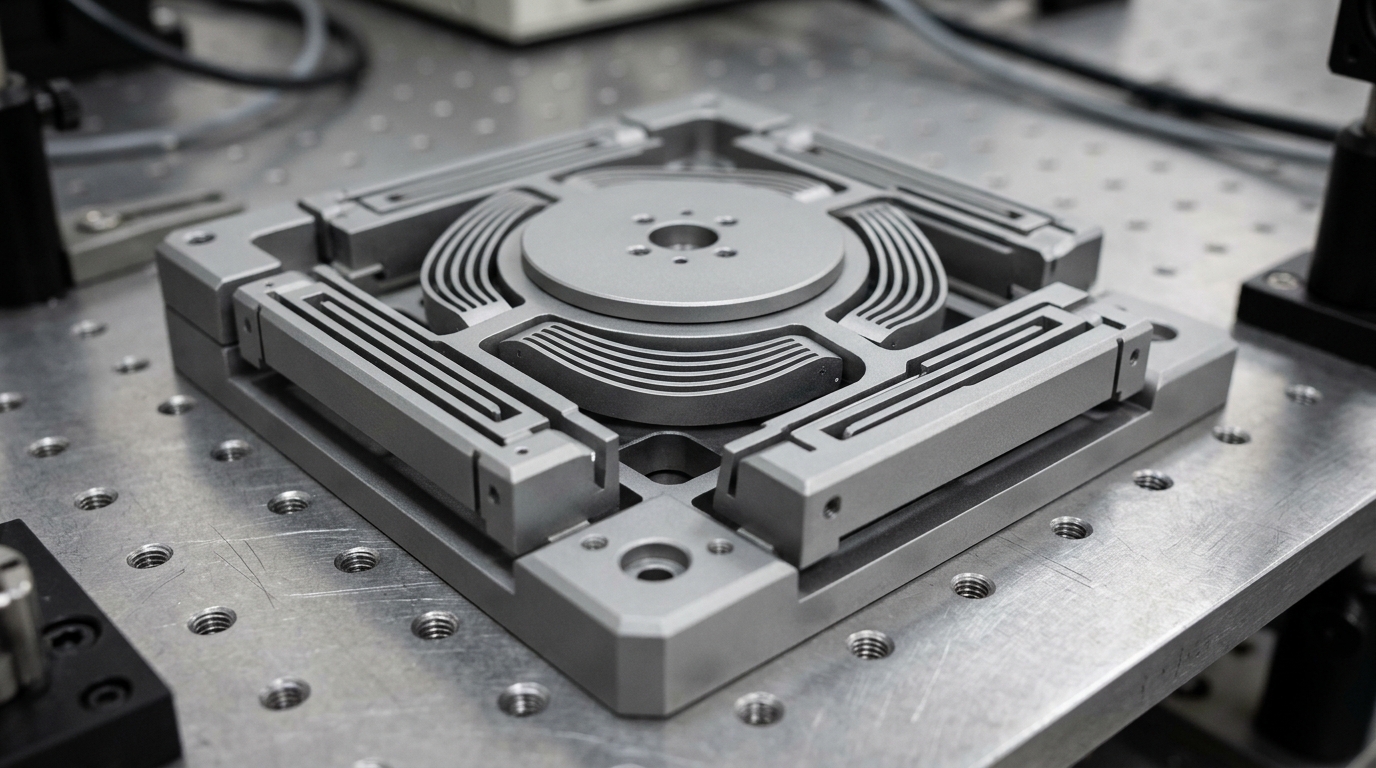
Mechanical engineers have designed a compact, single-layer rotational compliant positioning stage that incorporates an internal self-compensation mechanism to eliminate unwanted rotation center drift. In high-precision optical and micro-assembly systems, compliant mechanisms actuated by piezoelectric ceramics are widely preferred because they transmit motion entirely through elastic material deformation rather than conventional bearing assemblies. By eliminating traditional mechanical joints, compliant architectures avoid friction, mechanical wear, backlash, and contact clearance, enabling smooth and repeatable displacement resolution at the nanometer scale. However, converting linear actuator strokes into angular rotation frequently produces parasitic translational coupling and center-of-rotation drift, which destabilizes the optical axis during fine positioning. To address this structural challenge, researchers developed a single-actuator stage that combines a non-vertical inter-stage connecting beam with specialized flexure hinges to counteract parasitic lateral drift, achieving a rotational range of 3.12 milliradians while constraining maximum rotation center offset to just 0.424 micrometers.
Achieving stable rotation without rotational center deviation has historically presented a fundamental challenge in compliant mechanism design. Precision positioning platforms typically fall into two categories: multi-degree-of-freedom stages and single-degree-of-freedom rotational stages. Multi-degree-of-freedom systems, such as planar three-degree-of-freedom platforms providing in-plane translation and rotation, integrate multiple motion axes into serial or hybrid structures. Although versatile, these complex layouts experience severe dynamic and kinematic coupling between translational and rotational coordinates, leading to pronounced center drift when angular adjustments are commanded. Conversely, existing single-degree-of-freedom rotational stages designed to isolate pure rotation often suffer from severe performance trade-offs. Earlier single-layer compliant designs demonstrated relatively limited angular travel and modest normalized center-shift performance. Alternative configurations employing voice coil motors achieved larger strokes exceeding 41.6 milliradians, but the heavy magnetic actuators substantially increased overall device mass and volume, reduced structural resonance frequencies, and introduced unwanted electromagnetic interference and actuation redundancy.
Multi-layer rotational platforms have similarly been investigated to broaden rotational range, but stacking compliant levels introduces significant physical drawbacks. Double-layer architectures substantially increase physical volume, reduce overall structural stiffness, and compromise dynamic response bandwidth in exchange for larger rotational travel. In contrast, the newly reported stage utilizes an optimized single-layer, single-piezoelectric configuration occupying a compact footprint of 51 millimeters by 78 millimeters. When evaluated against previously reported double-layer compliant mechanisms, the proposed design reduces the physical installation footprint by approximately 50.3 percent while increasing the fundamental natural frequency from 192.45 hertz to 572 hertz. Simultaneously, the absolute center offset is reduced from 1.29 micrometers to 0.42 micrometers, representing a 67.4 percent reduction in unwanted center deviation. While multi-layer designs provide higher angular amplification ratios, the single-layer design preserves structural stiffness and dynamic stability while ensuring sufficient angular travel for target applications.
The stage also shows distinct performance enhancements when compared to structurally similar single-layer compliant mechanisms reported in earlier literature. In comparative assessments against a reference single-layer rotational stage, the new design delivers a 97.5 percent larger angular output alongside a 33.0 percent higher fundamental natural frequency. Concurrently, the overall physical footprint is contracted by 18.8 percent, and the normalized center shift per unit of rotation angle drops by 28.9 percent. These quantitative performance margins demonstrate that the principal mechanical merit of the architecture lies in its balanced synthesis of compact single-layer construction, high resonant frequency, adequate angular range, and minimal rotation center drift. The platform was specifically engineered for demanding precision scenarios, including the angular positioning of compact mirrors and optical lenses within laser alignment apparatuses, optical microscopy, and precision metrology instruments where maintaining optical-axis collinearity is paramount.
To overcome the limitations of uncompensated lever mechanisms, the engineers examined the kinematic roots of parasitic drift. In standard two-stage compliant lever systems, input displacement from an actuator is amplified through serial lever arms connected by orthogonal beams. In such initial layouts, a distinct geometric offset occurs between the actual rotation center at the output terminal of the secondary lever and the intended rotational center of the stage. As the rotational displacement increases, linear coupled displacement introduces unwanted internal reactive forces between the lever mechanism and the driven end effector, provoking parasitic out-of-plane deformations and axis deviation. To solve this problem at the structural level, the new stage incorporates a double-ended fixed flexure hinge into the joint of the secondary lever amplification stage and configures the inter-stage connecting beam at an inclined, non-vertical angle.
The non-vertical connecting beam acts as a directional force divider that actively counteracts center shift during actuation. When actuation loads are transmitted through the primary lever into the inclined connecting link, the applied force is geometrically decomposed into two mutually orthogonal components along the global Cartesian axes. The upward vertical force component directed along the positive y-axis drives the secondary lever arm to produce the primary angular positioning stroke. Concurrently, the horizontal force component directed along the negative x-axis acts directly upon the double-ended fixed flexure hinge, generating an intentional, controlled negative displacement along the x-axis. This induced lateral displacement directly counterbalances and cancels out the inherent positive lateral drift of the rotation center, maintaining the effective center of rotation in a nearly stationary spatial position throughout the entire operational stroke.
The overall stage layout is configured as a centrosymmetric architecture driven by a single piezoelectric ceramic actuator located centrally along the midline. The mechanism comprises two identical parallel branches arranged symmetrically around the central stage axis. Each branch integrates an initial flexural guidance mechanism, a primary lever amplification stage, the inclined connecting link, and the secondary lever amplification arm terminating at the rigid end effector. By nesting the piezoelectric actuator centrally between the opposing branches and employing leaf-spring flexural guidance instead of direct mechanical contact, the design acts as an elastic motion filter. This input guidance isolates off-axis errors, guarantees balanced force distribution across both branches, eliminates actuation redundancy, and significantly simplifies closed-loop drive electronics while providing an upgrade path to three or more stages if greater motion magnification is needed.
To rigorously predict the mechanical behavior of the mechanism, the investigators established an analytical compliance model based on matrix structural analysis and pseudo-rigid-body principles. The single-side kinematic chain was segmented into three sub-elements: the primary lever stage, the inclined inter-stage beam, and the secondary lever stage. The model incorporates five distinct flexure hinges labeled H1 through H5, comprising a circular notch flexure hinge and four thin leaf-spring hinges. Closed-form compliance equations were assigned to each flexure, with local coordinate transformations applied across the inclined link. Rigid-body kinematic compatibility and equilibrium conditions were then mapped between both branches and the rigid end effector to yield a unified closed-form model relating actuator input stroke to stage rotation.
Using the analytical compliance formulation, the researchers performed multi-objective dimensional optimization to resolve the intrinsic design trade-off between maximizing rotational travel and minimizing center offset. Implemented in MATLAB using the genetic algorithm solver gamultiobj, the optimization problem treated the negative output angle and the absolute spatial variation in the distance between the output point and the rotation center as competing objectives. Running with a population size of 300 across 1000 generations, a Pareto fraction of 0.1, and a stall limit of 500 generations, the solver mapped out a non-dominated Pareto front. From this front, geometric parameters governing hinge thicknesses, link lengths, circular notch radii, and beam angles were selected and rounded to one decimal place to respect real-world micro-machining tolerances, yielding an optimal compromise that maximized angular output while strictly suppressing center deviation.
The optimized mechanical structure was subsequently evaluated using three-dimensional finite element analysis in COMSOL Multiphysics 6.0 under the Solid Mechanics interface. Aluminum alloy AL7075-T651 was selected as the structural material due to its high yield strength of 503 megapascals and linear elastic response. The geometry was discretized using free tetrahedral elements with quadratic shape functions, featuring localized mesh refinement across the critical flexure notches. A rigorous mesh convergence study examined normal, fine, finer, and extra-fine mesh densities containing 14,685, 37,664, 141,989, and 325,031 elements, respectively. Tracking the predicted output angle under a 28-micrometer input stroke revealed convergence values of 3.061, 3.098, 3.116, and 3.120 milliradians. Because the finer mesh deviated by only 0.128 percent from the extra-fine baseline, the 141,989-element mesh was adopted to balance high computational accuracy against numerical processing cost.
Static numerical simulations confirmed excellent mechanical compliance, structural integrity, and positioning linearity. Applying a 1-newton-millimeter moment around the rotational axis generated an angular displacement of 15.91 multiplied by 10 to the negative third milliradians, corresponding to an output rotational compliance of 15.91 milliradians per newton-meter, which agreed within 9 percent of the analytical prediction. Simulating an input load of 10 newtons produced a 0.55-micrometer displacement, indicating an input stiffness of 18.05 newtons per micrometer, comfortably below the 60 newton-per-micrometer stiffness of the selected Core Tomorrow PST150/5×5/20 piezoelectric actuator. Under the maximum prescribed input displacement of 28 micrometers delivered at the actuator-stage interfaces, the stage achieved a maximum rotation of 3.12 milliradians with an extremely low maximum center offset of 0.424 micrometers. Peak von Mises stress reached 198 megapascals, well below the 503-megapascal material yield threshold, providing a robust structural factor of safety of 2.54.
Dynamic modal simulations demonstrated that the assembled positioning stage maintains substantial frequency margins above operational requirements. Modeling the end effector as a rigid body and representing the piezoelectric actuator with its physical mass and 60-newton-per-micrometer axial stiffness yielded the first three structural natural frequencies at 572 hertz, 1006 hertz, and 1457 hertz. The fundamental resonant mode at 572 hertz is approximately 11.44 times higher than the target operational bandwidth of 50 hertz, ensuring that structural resonances will not distort fine positioning control. Furthermore, a controlled simulation comparing the proposed stage to an uncompensated baseline mechanism under a 9-micrometer input displacement demonstrated that the self-compensating mechanism suppressed center offset by 63.1 percent, reduced parasitic x-axis displacement by 75.1 percent, and lowered parasitic y-axis displacement by 80.7 percent, while simultaneously increasing angular output by 27.0 percent from 0.795 to 1.010 milliradians. Although physical prototype fabrication and testing remain necessary to evaluate non-ideal effects such as machining tolerances, assembly errors, and piezoelectric hysteresis, these numerical findings confirm that passive geometric force decomposition provides an effective method for achieving high-precision, drift-free rotational positioning.
Subject of Research: Design and simulation of a self-compensating compact rotational compliant positioning stage
Article Title: Design of a compact rotational compliant stage with self-compensation for rotation center offset
Article References: Cai, B., Solihin, M. I., Chen, C., Wei, X., Lu, X., Lin, Z., Lin, H., & Zhao, Y. (2026). Design of a compact rotational compliant stage with self-compensation for rotation center offset. Mechanical Sciences, 17(2), 967-982. https://doi.org/10.5194/ms-17-967-2026
Image Credits: AI Generated
Keywords: compliant mechanisms, precision positioning, flexure hinges, piezoelectric actuators, finite element analysis, Pareto optimization, kinematic modeling, optical alignment, Design, compact, rotational, compliant
News Source: Denise Maddox. (November 7, 2026). Rotational Compliant Stage Achieves Self-Compensation for Center Offset in Precision Alignment. Scienmag.