• HOME
  • NEWS
  • EXPLORE
    • CAREER
      • Companies
      • Jobs
    • EVENTS
    • iGEM
      • News
      • Team
    • PHOTOS
    • VIDEO
    • WIKI
  • BLOG
  • COMMUNITY
    • FACEBOOK
    • INSTAGRAM
    • TWITTER
Saturday, November 7, 2026
BIOENGINEER.ORG
No Result
View All Result
  • Login
  • HOME
  • NEWS
  • EXPLORE
    • CAREER
      • Companies
      • Jobs
        • Lecturer
        • PhD Studentship
        • Postdoc
        • Research Assistant
    • EVENTS
    • iGEM
      • News
      • Team
    • PHOTOS
    • VIDEO
    • WIKI
  • BLOG
  • COMMUNITY
    • FACEBOOK
    • INSTAGRAM
    • TWITTER
No Result
View All Result
Bioengineer.org
No Result
View All Result
Home NEWS Science News Biology

Parallel Brain Pathways in Mice Separate Pain Sensation from Anxiety Modulation

by
November 7, 2026
in Biology
Reading Time: 2 mins read
0
Parallel Brain Pathways in Mice Separate Pain Sensation from Anxiety Modulation

Parallel Brain Pathways in Mice Separate Pain Sensation from Anxiety Modulation

Share on FacebookShare on TwitterShare on LinkedinShare on RedditShare on Telegram

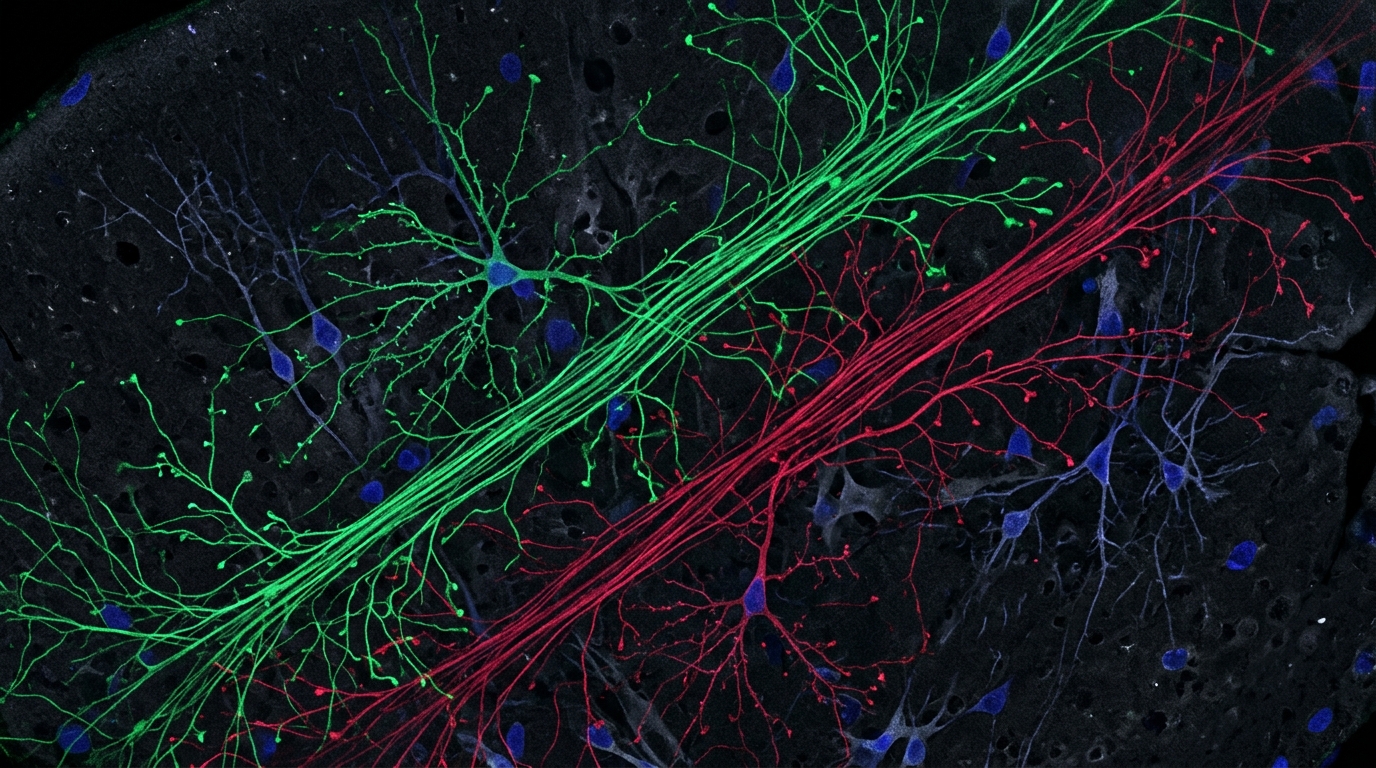
Researchers investigating neural circuits in male and female mice have identified two parallel GABAergic output pathways originating in the lateral hypothalamus that independently regulate pain and anxiety. The study, conducted by Yi-Ling Sun, Yi-Ting Peng, Xue Zhang, Cui Yin, Cheng Xiao, Junping Chen, and Chunyi Zhou, demonstrates that lateral hypothalamic GABAergic neurons project to two distinct processing hubs: the lateral parabrachial nucleus and the paraventricular nucleus of the thalamus. This circuit architecture provides new insight into how the brain segregates physical sensation from affective responses.

Although the lateral hypothalamus is fundamentally involved in motivated behaviors, the precise functional segregation of its GABAergic projections in modulating pain and its affective dimensions had remained poorly understood. To investigate terminal responses, the investigators utilized in vivo fiber photometry in the animal subjects. These recordings revealed that lateral hypothalamic GABAergic terminals located in both the paraventricular nucleus of the thalamus and the lateral parabrachial nucleus are robustly activated by noxious, aversive, and rewarding stimuli, indicating that both projections actively encode salient and affective information.

Critical functional testing uncovered a distinct operational divergence between the two pathways. When the researchers applied optogenetic activation to the projection connecting the lateral hypothalamus to the paraventricular nucleus of the thalamus, the stimulation exerted anxiogenic effects without altering pain sensitivity in either naïve or neuropathic pain mice. In contrast, optogenetic inhibition of this same pathway produced significant analgesic and anxiolytic effects specifically under neuropathic pain conditions, highlighting a context-dependent modulation of pain sensation and affective state in the murine model.

The parallel projection targeting the lateral parabrachial nucleus demonstrated an entirely different functional profile focused exclusively on sensory thresholds. Optogenetic activation of the pathway from the lateral hypothalamus to the lateral parabrachial nucleus induced contralateral pronociception without impacting affective behaviors in the mice. Conversely, optogenetic inhibition of this specific pathway significantly elevated contralateral pain thresholds across both physiological and neuropathic pain conditions, establishing its direct role in sensory transmission rather than emotional processing.

The authors also resolved the underlying synaptic mechanism within the lateral parabrachial nucleus. Circuit stimulation of the lateral hypothalamic projection acted via a disinhibitory mechanism that engaged local GABAergic interneurons within the lateral parabrachial nucleus to enhance the activity of local glutamatergic neurons. Collectively, these findings delineate two parallel and functionally segregated lateral hypothalamic GABAergic output pathways that differentially govern distinct aspects of the pain experience, highlighting novel circuit-specific targets for addressing chronic pain alongside its debilitating emotional comorbidities.

Subject of Research: Hypothalamic neural circuits modulating pain and anxiety in mice

Article Title: Two parallel lateral hypothalamic GABAergic projections differentially modulate pain and anxiety in mice

Article References: Sun, Y.-L., Peng, Y.-T., Zhang, X., Yin, C., Xiao, C., Chen, J., & Zhou, C. (2026). Two parallel lateral hypothalamic GABAergic projections differentially modulate pain and anxiety in mice. PLOS Biology, 24(11), e3004096. https://doi.org/10.1371/journal.pbio.3004096

Image Credits: AI Generated

DOI: 10.1371/journal.pbio.3004096

Keywords: lateral hypothalamus, pain modulation, anxiety, GABAergic neurons, optogenetics, neuroscience, fiber photometry, neuropathic pain, parallel, lateral, hypothalamic, GABAergic

News Source: Cassandra Pierce. (November 7, 2026). Parallel Brain Pathways in Mice Separate Pain Sensation from Anxiety Modulation. Scienmag.

Tags: Anxietyfiber photometryGABAergicGABAergic neuronshypothalamiclaterallateral hypothalamusneuropathic painNeuroscienceoptogeneticspain modulationparallel
Share12Tweet7Share2ShareShareShare1

Related Posts

Maternal Deprivation Model Links Hippocampal Senescence to ASD Pathways

Maternal Deprivation Model Links Hippocampal Senescence to ASD Pathways

November 7, 2026
Research report: Phytotoxic potential of Ranunculus testiculatus aqueous extract: physiological responses and molecular docking/putative ligand interactions with barley α-amylase

Research report: Phytotoxic potential of Ranunculus testiculatus aqueous extract: physiological responses and molecular docking/putative ligand interactions with barley α-amylase

November 7, 2026

Satellite Telemetry Reveals Expanded Home Ranges for Estuarine Turtles

November 7, 2026

Smurf1 Knockdown Drives Liver Failure via Ferroptosis

November 7, 2026

POPULAR NEWS

  • Tomographic Study Assesses Interzonal Toric Stability Across Different Corneal Zones

    Tomographic Study Assesses Interzonal Toric Stability Across Different Corneal Zones

    29 shares
    Share 12 Tweet 7
  • Research report: Phytotoxic potential of Ranunculus testiculatus aqueous extract: physiological responses and molecular docking/putative ligand interactions with barley α-amylase

    29 shares
    Share 12 Tweet 7
  • High-fibre, fermented-food diet trial will test gut-brain route to easing adult ADHD symptoms

    29 shares
    Share 12 Tweet 7
  • Research report: Effects of a game-based exergame intervention on motor competence and balance in children with autism spectrum disorder: a multiple-baseline single-case experimental study

    29 shares
    Share 12 Tweet 7

About

We bring you the latest biotechnology news from best research centers and universities around the world. Check our website.

Follow us

Recent News

Weight Management Program Boosted Caretakers’ Motivation, but Not Adolescents’, Trial Shows

Pandemic Care Barriers Explained Apparent Declines in Alberta Respiratory Illness Cases

Iranian Experts Identify Barriers to Oncology Palliative Case Management

Subscribe to Blog via Email

Enter your email address to subscribe to this blog and receive notifications of new posts by email.

Join 86 other subscribers
  • Contact Us

Bioengineer.org © Copyright 2023 All Rights Reserved.

Welcome Back!

Login to your account below

Forgotten Password?

Retrieve your password

Please enter your username or email address to reset your password.

Log In
No Result
View All Result
  • Homepages
    • Home Page 1
    • Home Page 2
  • News
  • National
  • Business
  • Health
  • Lifestyle
  • Science

Bioengineer.org © Copyright 2023 All Rights Reserved.