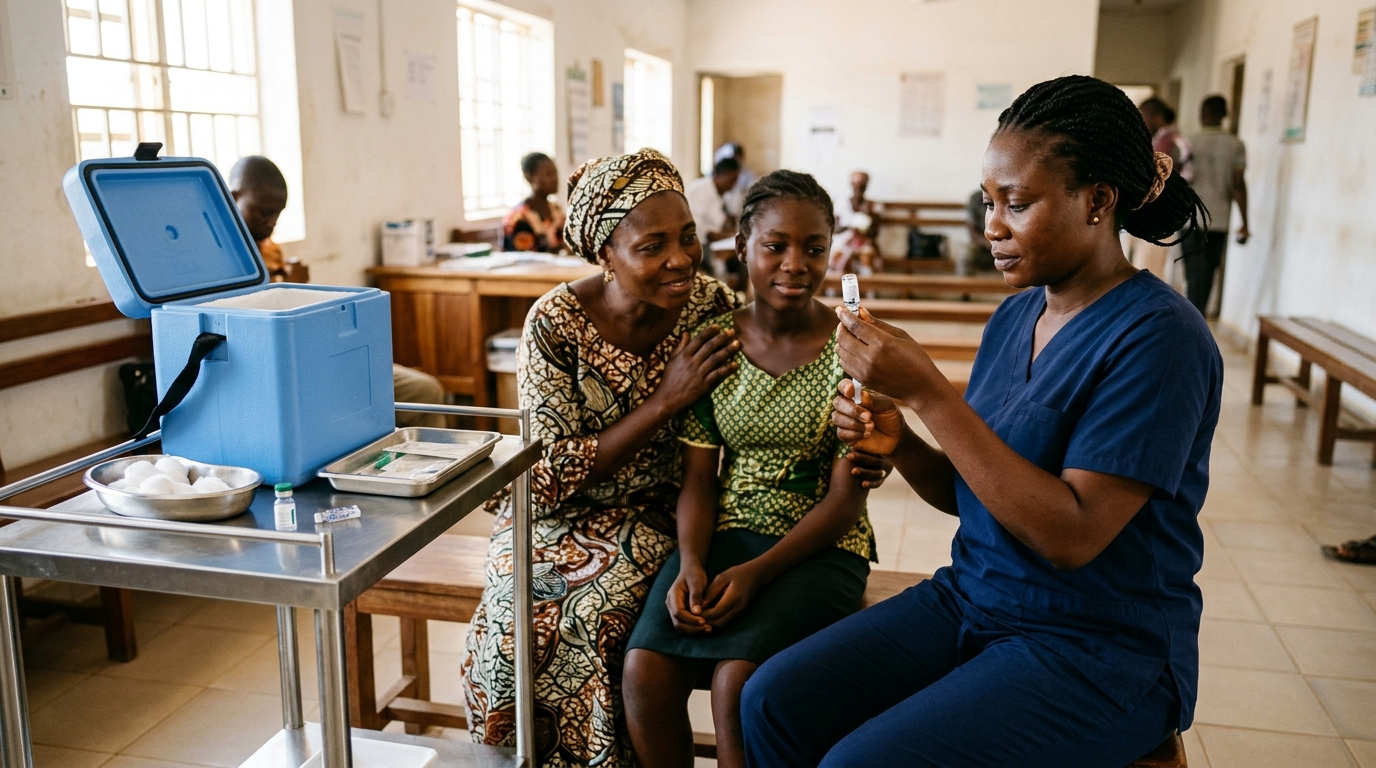
A transmission modeling study of human papillomavirus vaccination strategies in Nigeria projects that continuing the country’s current adolescent immunization program will avert 1.82 million cervical cancer cases between 2025 and 2100, while identifying cervical screening scale-up as the primary intervention for mitigating near-term disease. In the simulation, maintaining the status-quo single-dose delivery for adolescent girls achieves an estimated 53 percent reduction in cumulative cervical cancer cases relative to a scenario without vaccination, with an interquartile range of 51 to 55 percent and a 95 percent uncertainty interval spanning 46 to 58 percent. Across this seventy-five-year evaluation horizon, the projected number of averted cases corresponds to an interquartile range of 1.65 to 1.90 million and a 95 percent uncertainty interval of 1.39 to 2.02 million cases. Furthermore, the model estimates that under this continued adolescent strategy, age-standardized cervical cancer incidence will fall from 19.7 cases per 100,000 individuals in 2025 to 7.8 cases per 100,000 individuals by the year 2100.
Nigeria formally introduced single-dose prophylactic human papillomavirus vaccination for girls aged 9 to 14 in 2023, reaching approximately 60 percent aggregate coverage across the country by 2025. Although this rollout represents an important public health achievement, it remains substantially below the 90 percent coverage target established under the World Health Organization’s 90-70-90 cervical cancer elimination framework. The study notes that achieving further scale-up through the existing adolescent delivery mechanism relies heavily on reaching out-of-school girls, presenting operational challenges. Crucially, the model projects that 82 percent of Nigeria’s cervical cancer burden between 2025 and 2075 will occur among the pre-2015 birth cohort. Because individuals in this cohort have already passed the eligible age window for adolescent vaccination, prophylactic immunization cannot reach them, leaving an estimated 945,000 residual cases in this group, with an interquartile range of 905,000 to 1.00 million and a 95 percent uncertainty interval of 835,000 to 1.14 million cases.
To investigate how healthcare systems can address this extensive residual disease burden, the study modeled the impact of scaling up cervical cancer screening alongside existing vaccination efforts. Increasing screening coverage from an opportunistic baseline of 15 percent aggregate coverage to the World Health Organization target of 70 percent aggregate coverage was estimated to avert approximately 387,000 additional cervical cancer cases, with an interquartile range of 331,000 to 424,000 and an uncertainty interval of 269,000 to 515,000 cases. This intervention alone would avert roughly 25 percent of the projected residual burden among older cohorts. The researchers also examined equity parameters, assessing how primary school completion correlated with screening participation under odds ratios of 1 versus 3. The simulation demonstrated that when screening scale-up achieved equitable delivery across all women regardless of educational attainment, the resulting health benefits improved by approximately 6 to 8 percent compared to educational disparities.
The analytical findings were generated using HPVsim, an agent-based microsimulation framework calibrated specifically to Nigerian sexual behavior patterns, human papillomavirus prevalence, and cervical cancer incidence rates. The researchers utilized the model to project annual incident cases and age-standardized rates from 2025 through 2100 across varied delivery strategies, including status-quo adolescent delivery, the World Health Organization 90-70-90 adolescent expansion, and infant delivery programs configured at 60 percent, 75 percent, and 90 percent coverage levels. Equity in vaccination was similarly evaluated by testing correlations between primary school completion and vaccine uptake using odds ratios of 1 versus 5. To account for calibration and stochastic uncertainty, each scenario was simulated across 50 replicates, combining 10 distinct calibration parameter draws with 5 random simulation seeds, and outcomes were synthesized as median estimates accompanied by interquartile ranges and 95 percent uncertainty intervals.
The researchers noted that no human papillomavirus vaccine clinical trial to date has enrolled participants younger than 10 years of age, meaning no empirical efficacy data exist for infants. Consequently, the team tested hypothetical effective vaccine efficacy values at exposure of 50 percent, 70 percent, and 95 percent, intended as exploratory inputs to bracket the plausible range of waning immunity across the 15-to-25-year interval prior to sexual exposure. Under a hypothetical scenario combining 90 percent infant coverage with 95 percent effective efficacy at exposure—matching adolescent-grade protection—the infant approach yielded a 49 percent reduction in vaccine-targetable cohort cancers, comparable to the 54 percent reduction estimated under full adolescent scale-up. Conversely, under a scenario assuming 50 percent effective efficacy combined with 62 percent coverage, anchored to Nigeria’s third-dose diphtheria-tetanus-pertussis routine immunization rate, infant delivery averted only a fraction of those cancers.
In their conclusions, the authors emphasized that findings regarding infant human papillomavirus vaccination are purely exploratory and hypothesis-generating, cautioning that these simulation results must not be interpreted as a justification for health policy changes. Any future infant delivery strategy depends on resolving three unverified empirical prerequisites: confirming infant vaccine immunogenicity during the first months of life, demonstrating durable immune protection across the multi-decade interval leading to peak exposure, and verifying the real-world coverage achievable through Nigeria’s routine childhood immunization platform. Because the majority of cervical cancer cases over the next three decades will arise in cohorts that vaccination cannot protect, expanding screening programs represents the more consequential, evidence-based intervention lever available to decision-makers.
Subject of Research: Simulation modeling of HPV vaccination and cervical cancer screening strategies in Nigeria
Article Title: Model-based evaluation of an infant HPV prophylactic vaccination program in Nigeria
Article References: Stuart, R. M., Blessing, U. I., Gill, C., & Cohen, J. A. (2026). Model-based evaluation of an infant HPV prophylactic vaccination program in Nigeria. BMC Infectious Diseases. https://doi.org/10.1186/s12879-026-14586-8
Image Credits: AI Generated
DOI: 10.1186/s12879-026-14586-8
Keywords: HPV vaccination, cervical cancer, Nigeria, agent-based simulation, disease modeling, cancer screening, public health, immunization policy, Model-based, evaluation, infant, prophylactic
News Source: Harold Sullivan. (November 7, 2026). Modeling Evaluates Infant and Adolescent HPV Vaccination Programs in Nigeria. Scienmag.