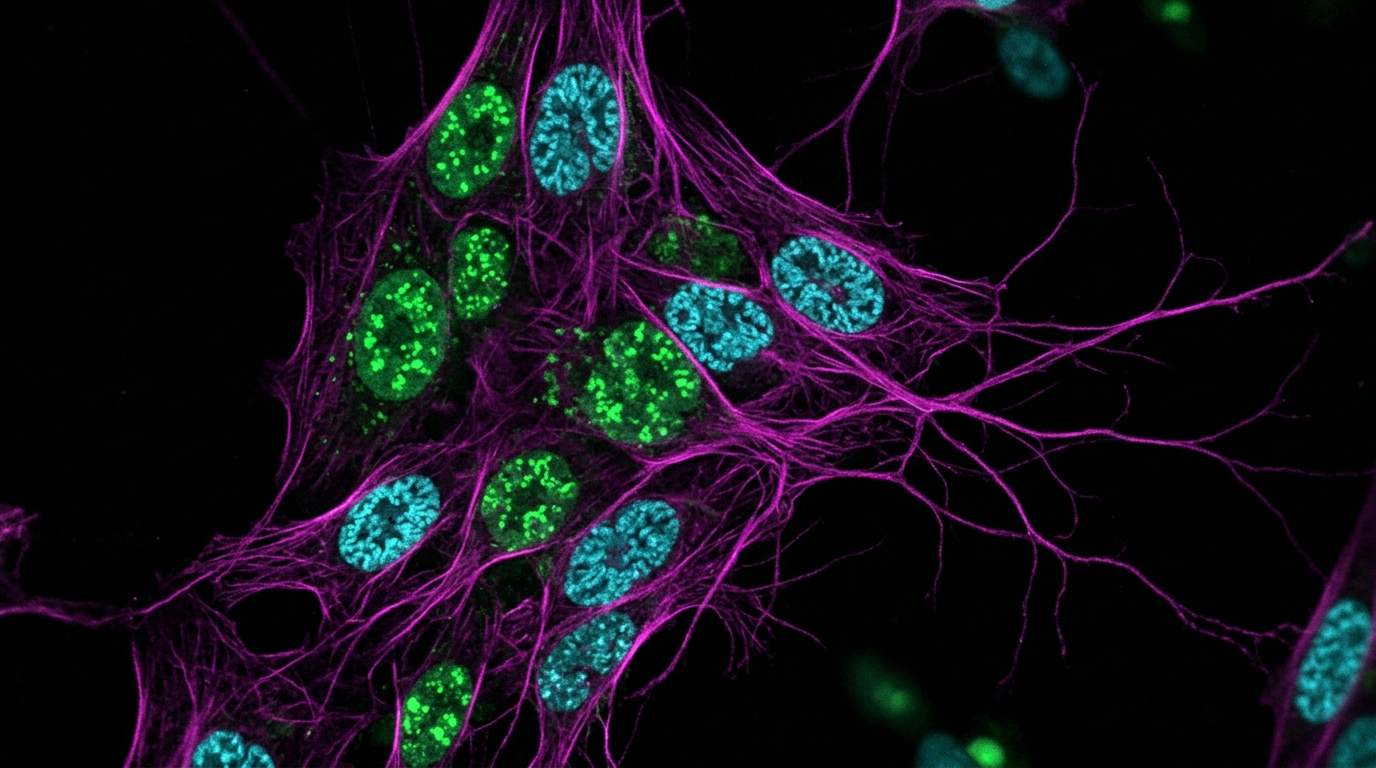
A scientific review published in Experimental & Molecular Medicine examines direct cell-fate engineering, tracing its transformation from descriptive developmental biology into a high-throughput, quantitative screening discipline. Authors Yeejin Jang, Muyoung Lee, and Jonghwan Kim analyze how large-scale overexpression screens centered on single transcription factors demonstrate that individual regulatory proteins act as master switches, overriding developmental hierarchies to rewire cell fate. Cellular identity is maintained by coordinated transcriptional programs integrating intrinsic gene regulatory networks with extrinsic signaling cues. At the core of these networks reside sequence-specific DNA-binding transcription factors that interact with cis-regulatory elements, including enhancers and promoters, to stabilize lineage states. While early research relied on candidate-based approaches and qualitative criteria, recent advances in inducible factor libraries, single-cell transcriptomics, and trajectory inference have transformed the field. Reviewing systematic single-factor perturbations, the authors evaluate early lineage transitions, quantify factor potency, and assess how chromatin competence, dosage thresholds, and cellular fitness govern direct reprogramming.
The conceptual foundation of single-factor lineage conversion arose from classic demonstrations of cellular plasticity, where enforced expression of specific regulatory proteins bypassed normal developmental trajectories. The seminal demonstration occurred in 1987 when Myod1 overexpression converted mouse fibroblasts into contractile myoblasts, proving that a single factor could activate a dominant myogenic program. In 1995, Gata1 expression redirected avian myelomonocytic cells into eosinophilic, thromboblastic, and erythroid lineages, showing that single factors can cross lineage boundaries. Ectopic expression of C/EBPalpha and C/EBPbeta subsequently reprogrammed differentiated B cells into functional macrophages by remodeling endogenous networks, modulating PU.1-associated myeloid programs, and silencing lymphoid markers. These discoveries were complemented in 2006 by the Yamanaka factors (Oct4, Sox2, Klf4, and c-Myc), which reverted somatic cells to pluripotency. Subsequent neural studies revealed that while Ascl1 initiates neuronal conversion, combining Ascl1 with Brn2 and Myt1l enhances electrophysiological maturation, demonstrating that single factors initiate lineage programs whose functional completion benefits from cooperative regulation.
Pluripotent stem cells, including embryonic stem cells and induced pluripotent stem cells, have become the primary scalable platform for systematically evaluating transcription factor potency across developmental trajectories. Because pluripotent stem cells possess broad developmental potential spanning all three germ layers and trophoblast lineages in vitro, they offer an experimentally tractable baseline for systematic perturbations. Their capacity for indefinite self-renewal yields the large cell quantities required for extensive library screening, while their accessible chromatin landscape provides a permissive environment for factor testing. The authors emphasize that transcription factor activity remains heavily dependent on baseline chromatin states and endogenous regulatory networks, meaning that pluripotent screens measure lineage-initiating capacity within a permissive context rather than universal reprogramming potency. To maintain analytical clarity, the review distinguishes general terms such as reprogramming, fate conversion, and fate transition—describing population shifts containing intermediate or off-target cell states—from functional reprogramming, which is strictly reserved for experimentally demonstrated, stable changes in cellular identity.
First-generation high-throughput screens shifted cell-fate engineering from qualitative marker tracking to quantitative transcriptomic frameworks using inducible expression platforms. Pioneering work by Minoru Ko’s group established doxycycline-inducible mouse embryonic stem cell models, demonstrating that transcriptional deviation from pluripotency quantitatively measures factor potency. For example, Cdx2 induction drove trophoblast-like fates, confirming the reciprocal Oct4 and Cdx2 regulatory axis. Expanding beyond exit from pluripotency, Ko and colleagues benchmarked engineered transcriptomes against comprehensive tissue atlases, including the GNF Mouse GeneAtlas V3. Using correlation matrices, they identified 63 master and ancillary regulators driving neural, hematopoietic, myogenic, and hepatic programs. This strategy culminated in profiling 2,135 doxycycline-inducible human embryonic stem cell lines across 714 genes, including 481 transcription factors. Pairing transcriptomic profiles with automated imaging of approximately 27,000 microscopic samples, the authors classified distinct morphologies—including compact colonies, flattened cells, and dispersed states—linking structural features to over 2,100 expression datasets, though bulk measurements obscured asynchronous dynamics and rare intermediate states.
To overcome the throughput constraints of establishing individual cell lines, pooled screening strategies were developed to evaluate extensive factor libraries simultaneously. Ng and colleagues established a pooled platform testing 1,564 human transcription factors and isoforms delivered through lentiviral, doxycycline-inducible systems into human induced pluripotent stem cells. Using exit from pluripotency as an initial selection criterion, researchers isolated TRA-1-60-low differentiated cells by fluorescence-activated cell sorting after four days, identifying enriched factors via genomic polymerase chain reaction. Across three cell lines, the screen revealed 290 factors promoting differentiation in at least two lines. PiggyBac transposon delivery confirmed that single factors drive specific lineages in neutral media without growth factors, including ATOH1 inducing functional neurons with action potentials, NKX3-1 generating fibroblasts capable of wound healing, SOX9 specifying oligodendrocytes, and ETV2 driving endothelial identities. Furthermore, the study demonstrated parallel programming, wherein distinct factor-expressing cells cocultured in a single dish simultaneously adopt their respective lineages, although shared paracrine cues represent an environmental consideration in pooled designs.
Single-cell RNA sequencing transformed cell-fate engineering by replacing population-averaged end points with dynamic cellular trajectories. Computational trajectory inference and pseudotime analysis order single cells along transcriptional continuums, demonstrating that factor-driven reprogramming progresses through continuous intermediate states rather than abrupt binary switches. Initial single-cell screens by Parekh and colleagues applied the SEUSS framework to model transcription factor responses as continuous deviations from pluripotency. Crucially, single-cell analysis revealed that lineage reprogramming is intrinsically coupled with cellular fitness effects. High-potency drivers, such as ETV2 in endothelial specification, robustly activated target programs but simultaneously induced cellular stress, causing factor-expressing cells to become progressively depleted over time. This insight proved that cell abundance in pooled screens reflects population survival dynamics rather than reprogramming efficiency alone, identifying survivor bias as an overlooked factor in high-throughput screening. Consequently, the absence of a lineage signal does not prove a factor lacks reprogramming capability, as differentiating cells may undergo selective elimination through growth arrest or apoptosis.
Atlas-scale single-cell mapping and time-resolved screens have further unraveled transcription factor potency distributions and temporal dynamics. Joung and colleagues constructed an expansive human Transcription Factor Atlas by profiling 3,548 human factor isoforms across more than 1.1 million embryonic stem cells following seven days of constitutive overexpression. Pseudotime metrics indicated that approximately 25 percent of tested factors promoted differentiation toward lineages representing all three germ layers and trophoblast states. Integrating SHARE-seq enabled simultaneous profiling of chromatin accessibility and gene expression, clarifying how factors like DYRK1A regulate neural progenitor proliferation versus neurogenesis. To capture early kinetics obscured by single-timepoint data, Lee and colleagues conducted a time-course screen at one, three, and five days, overexpressing 80 transcription factors in mouse embryonic stem cells via inducible Sleeping Beauty transposons. Their analysis revealed that 29 factors triggered substantial transcriptomic remodeling within 24 hours of induction, demonstrating that lineage departure occurs rapidly and is accompanied by slower proliferation and elevated apoptosis characteristic of differentiating cell populations.
Mechanistic investigations highlight that cell-fate conversion depends heavily on chromatin competence, lineage priming, and pioneer factor activity. During development, multipotent progenitors exhibit lineage priming, maintaining accessible chromatin across multiple lineage-associated regulatory elements before definitive commitment. As differentiation advances, chromatin landscapes progressively specialize through enhancer remodeling and repressive chromatin mechanisms, including Polycomb-mediated histone modifications, histone deacetylation, and localized compaction. Overcoming these repressive barriers requires pioneer transcription factors, which access closed nucleosomal DNA and recruit chromatin remodelers. Pioneer factors such as GATA3, FOXD3, and OCT4 recruit the remodeling factor BRG1 to open inaccessible target loci, facilitating subsequent binding by non-pioneer transcriptional regulators. Single-cell profiling via SHARE-seq confirms that increases in chromatin accessibility typically precede downstream gene activation. However, enhanced accessibility does not guarantee transcription, and the review emphasizes that pioneer capacity is not a universal property of all potent reprogramming factors, underscoring the need to map factor-specific cofactor dependencies to understand how diverse regulators initiate fate transitions.
Single-cell investigations demonstrate that transcription factor dosage acts as a critical determinant of lineage trajectory rather than a simple efficiency modifier. In hematopoietic progenitors, graded PU.1 expression establishes divergent fates: low levels promote B cell specification, whereas high levels enforce macrophage differentiation. Parallel dosage bifurcations occur in pluripotent systems: varying GATA6 expression in human embryoid models directs yolk sac endoderm, anterior hypoblast, or yolk sac mesoderm identities, while high Gata3 expression in mouse embryonic stem cells drives trophoblast-like fates and lower levels bias cells toward primitive endoderm. Baseline heterogeneity in starting populations, such as endogenous Myc variations separating cells into distinct conversion paths, further modulates reprogramming outcomes. These biological sensitivities, paired with differing delivery vectors, promoter types, induction timelines, and hit definitions, explain the discordance observed across major screens. Five prominent studies shared only nine hits across three screens and four hits across four screens, with no single factor identified across all five studies among ten commonly evaluated regulators, highlighting the necessity for standardized screening benchmarks.
A persistent fidelity gap separates transcriptomic resemblance from authentic physiological functionality in direct cell-fate engineering. Engineered cells frequently stall in hybrid or incompletely differentiated states, retaining epigenetic memory from the starting pluripotent state and failing to acquire mature electrophysiological, metabolic, or subtype-specific functions. To address these limitations, computational frameworks such as Mogrify, Geneformer, scGPT, AlphaGenome, and CellCartographer integrate transcriptomic and epigenomic datasets, reconstructing gene regulatory networks to prioritize candidate factors and guide combinatorial screening strategies. Future screening platforms must systematically compare open reading frame overexpression with endogenous CRISPR activation, which preserves native chromatin context and regulatory architecture. Clinical translation will also require safe, non-integrating delivery platforms, including synthetic modified mRNA and targeted nanoparticles, to minimize genomic integration risks while enabling in vitro cell replacement and in situ tissue repair. Ultimately, establishing rigorous validation benchmarks that evaluate long-term functional stability, chromatin organization, and physiological integration will prove essential for advancing transcription factor engineering into a reliable foundation for regenerative medicine.
Subject of Research: High-throughput single transcription factor screening and direct cell-fate engineering in pluripotent stem cells
Article Title: High-throughput single-transcription factor-mediated direct cell-fate engineering
Article References: Jang, Y., Lee, M., & Kim, J. (2026). High-throughput single-transcription factor-mediated direct cell-fate engineering. Experimental & Molecular Medicine. https://doi.org/10.1038/s12276-026-01884-z
Image Credits: AI Generated
DOI: 10.1038/s12276-026-01884-z
Keywords: transcription factors, cell-fate engineering, cellular reprogramming, pluripotent stem cells, single-cell RNA-seq, pioneer factors, gene regulatory networks, regenerative medicine, High-throughput, single-transcription, factor-mediated, direct
News Source: Ophelia Keating. (November 7, 2026). High-Throughput Screens Map How Single Transcription Factors Direct Cell Identity. Scienmag.