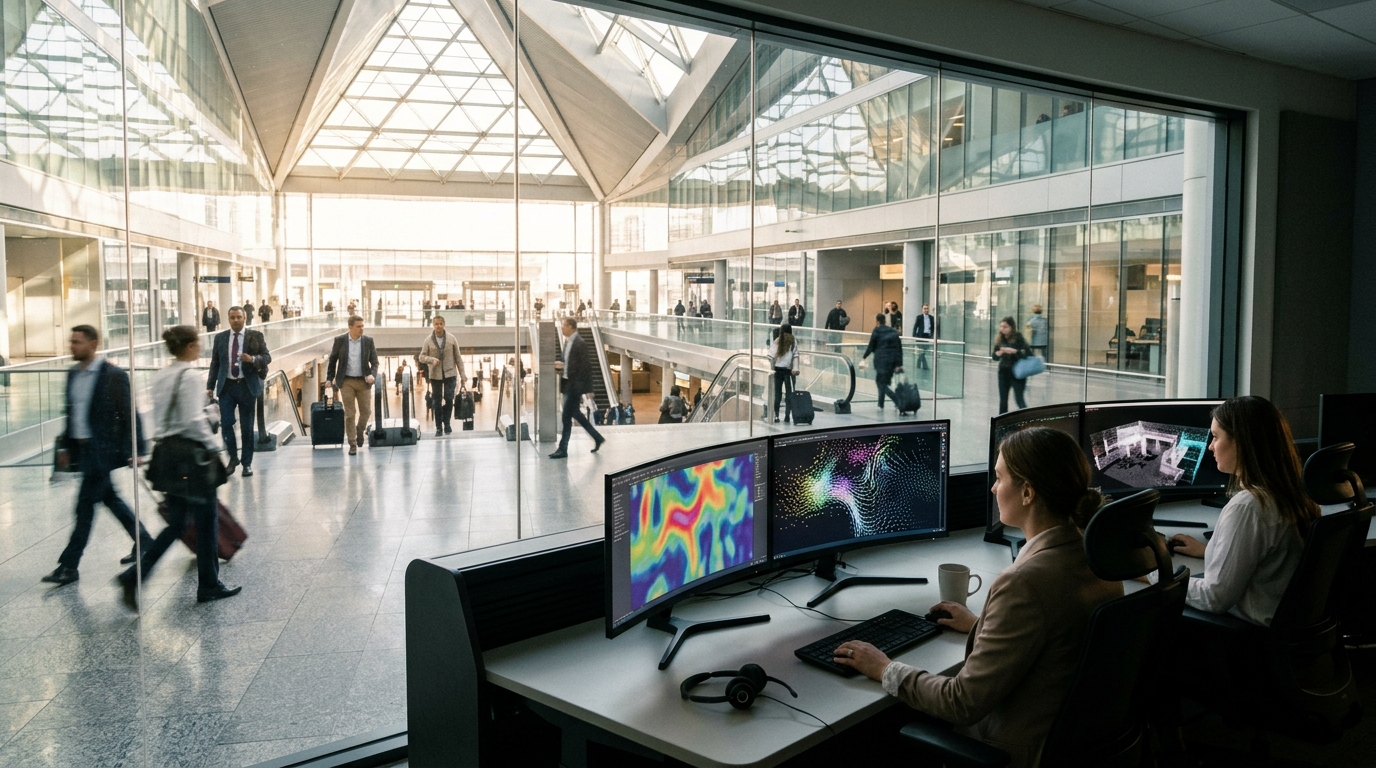
A research team from South Korea has designed and evaluated an integrated crowd management framework, designated 3DTCM, which links time-series passenger forecasting with three-dimensional virtual simulations and selective personal data anonymization. Documented in the journal SoftwareX, the system directly confronts recurring limitations in existing urban monitoring platforms, where real-time spatial fidelity, predictive machine learning, and privacy-preserving de-identification are rarely integrated into a single operational architecture. Motivated by catastrophic crowd crushes such as the October 2022 Itaewon disaster in Seoul that claimed 159 lives, as well as mass-casualty incidents in Yemen and India, the investigators formulated a platform capable of ingesting transit records, forecasting surges, modeling individual avatar dynamics across subdivided spatial grids, and protecting sensitive telecommunication identifiers before data leaves backend servers.
Contemporary public safety infrastructure and digital twin platforms frequently encounter structural bottlenecks when deployed for live crowd intervention. As the authors outline in their evaluation of existing technologies, many simulation platforms, such as UCrowds, SimCrowds, HyPedSim, and various multi-agent frameworks, rely heavily on artificial blueprints, pre-configured parameters, or post-hoc disaster assessments rather than live, real-world data pipelines. Conversely, public monitoring networks that process cellular base station transmissions or municipal surveillance camera feeds typically project aggregate pedestrian densities as coarse numeric summaries or two-dimensional geographical information system dashboards without fine-grained spatial modeling. Crucially, these municipal setups regularly fail to implement robust, multi-tiered de-identification pipelines to protect sensitive metadata, leaving individual records such as International Mobile Subscriber Identity numbers and mobile telephone digits susceptible to unauthorized exposure.
To overcome these collective deficiencies, the researchers constructed an architecture that decouples macroscopic crowd forecasting from microscopic spatial visualization while embedding privacy compliance directly into the transmission interface. The computational foundation relies on the Prophet algorithm, an additive regression-based time-series forecasting model designed to decompose non-linear trend trajectories, recurring seasonality, and distinct holiday anomalies without requiring elaborate data restructuring. The model was trained on historical hourly boarding and alighting transit figures retrieved from the Seoul Open Data Plaza across an extended training window spanning June 1, 2022, to December 31, 2024. These structured datasets registered specific timestamps, travel directions, station entry and exit points, and passenger counts, which enabled the algorithm to accurately capture recurring weekly dynamics, diurnal commuter flow rhythms, and seasonal deviations across metropolitan entertainment quarters.
Quantitative validation of the machine learning subsystem demonstrated reliable predictive precision across the entire test period covering January 1, 2025, to December 31, 2025. Evaluating model predictions against observed hourly passenger numbers using the scikit-learn library yielded a mean absolute error of 140.831 passengers and a root mean square error of 197.988 passengers for boarding counts. For alighting volumes, which reflect arriving crowds entering nearby public streets, the model recorded a mean absolute error of 228.256 passengers and a root mean square error of 283.611 passengers. The authors emphasized that these bounded variance margins provide a dependable macroscopic baseline for predicting upcoming passenger surges at busy metropolitan transit stations, specifically facilitating proactive decision support prior to physical crowd accumulation on surface corridors.
The complete software system runs on a Windows workstation and is engineered across four interoperable core components: a persistent storage engine using MongoDB, an asynchronous backend built with FastAPI, a time-series forecasting module executing pre-trained Prophet regression models, and an interactive 3D graphical client constructed in Unity 2022.3.28f1 LTS. Within the data handling pipeline, the architecture maintains two operational pathways designated as Monitoring Mode and Simulation Mode. Because direct municipal telecommunication base station links and live closed-circuit feeds were subject to administrative privacy restrictions during software development, the engineers validated the monitoring workflow using synthetic crowd datasets. These synthetic records mirror authentic telecommunication schemas by cataloging precise coordinates, movement vectors, speeds, unique device identifiers, and telephone numbers.
Spatial representation within the Unity client reproduces the approximately 200-square-meter sloped alley adjacent to the main exit of Itaewon Station, the specific site of the 2022 crowd tragedy. The digital twin subdivides this continuous geographic footprint into exactly 200 uniform discrete cells of one square meter each. Each cell dynamically monitors internal avatar occupancy and updates visual chromatic coding across four structured safety tiers: a safe stage indicated in green for densities of three or fewer people, a caution stage in yellow for four to five people, a risk stage in orange for six to seven people, and a high-risk stage rendered in red whenever density reaches eight or more people per square meter. In addition to cell-level color coding, the interface displays real-time operational metrics, including the average density per square meter and total active population counts across the monitored sector.
Privacy preservation is executed programmatically through a selective three-level de-identification mechanism handled by FastAPI backend routes whenever data is queried by the client. Level 1, designated the Identifiable Personal Information Level, retains full raw attributes including individual IDs, exact age data, motion characteristics, precise geographic locations, cellular phone numbers, and International Mobile Subscriber Identity codes to establish baseline crisis tracking. Level 2, or the Partially Masked Personal Information Level, enforces pseudonymization by grouping ages into ten-year brackets, obscuring the middle four digits of phone numbers, and completely purging device IMSI numbers. Level 3, the Fully Masked Personal Information Level, executes comprehensive anonymization by collapsing age profiles into broad categorical descriptors like youth, deleting phone numbers entirely, and stripping all network identity codes from JSON payloads.
Empirical performance benchmarks carried out on an 11th Generation Intel Core i7 workstation equipped with 16.0 gigabytes of memory verified that the system operates comfortably within interactive operational thresholds. The engineers quantified latency across three sequential intervals: backend API call processing, database record querying from MongoDB, and algorithm serialization output. Across varied scale benchmarks simulating 250, 1000, and 2500 active avatars, the system maintained total execution latencies well under a quarter of a second. Under the maximum tested scale of 2500 avatars, the complete execution duration required 0.1944 seconds at Level 1, 0.1791 seconds at Level 2, and dropped to 0.1670 seconds at Level 3. The accelerated performance observed under Level 3 anonymization occurs because the complete elimination of bulky device identifiers reduces total JSON payload volume and lightens downstream network serialization burdens.
In Simulation Mode, the platform operationalizes macroscopic transit predictions to model dynamic intervention strategies, specifically assessing the preventative impact of emergency subway non-stop train bypasses. When operators launch the simulation interface, they can select one of three operational trigger thresholds: Caution, triggered at an estimated overall population of 800 people; Warning, triggered at 1,200 people; and High Risk, triggered at 1,600 people. Once activated, the Unity engine simulates directional avatar flows moving from upper street boundaries and lower station approaches. If the pedestrian volume reaches the designated threshold, the system initiates simulated non-stop train bypasses based on the standard six-minute train headways observed on Seoul Subway Line 6, subsequently tracking the recovery duration and bypass counts required for the alleyway to return to safe baseline densities.
While the experimental findings confirm real-time computational viability, the authors acknowledge key technical and operational boundaries in the current version of the system. The spatial scope remains presently restricted to the immediate environment surrounding Itaewon Station, necessitating future architectural validation across broader metropolitan zones, complex multimodal transit interchanges, and diverse assembly scenarios like concerts or sporting events. Furthermore, the motion dynamics within the Unity environment operate on baseline avatar pathfinding rather than fully coupled microscopic pedestrian physics. To advance the platform, the research team plans to integrate dedicated microscopic crowd dynamics engines, incorporate Building Information Modeling and LiDAR point cloud geometries, and connect live de-identified mobile carrier streams to bridge predictive modeling with live operational urban management.
Subject of Research: 3D digital twin crowd management and privacy-preserving predictive simulation
Article Title: 3DTCM: A 3D digital twin-based crowd management system using AI for predictive and selective anonymization
Article References: Nam, S. M., Shin, Y. R., Kim, H. L., Lee, G. Y., Chae, J. H., & Kim, H.-J. (2026). 3DTCM: A 3D digital twin-based crowd management system using AI for predictive and selective anonymization. SoftwareX, 36, Article 103170. https://doi.org/10.1016/j.softx.2026.103170
Image Credits: AI Generated
DOI: 10.1016/j.softx.2026.103170
Keywords: digital twins, crowd management, predictive modeling, Prophet algorithm, data anonymization, urban safety, computer simulation, Unity3D, DTCM, digital, twin-based, crowd
News Source: Denise Maddox. (November 7, 2026). Digital Twin Crowd Management System Pairs Predictive AI With Selective Data Anonymization. Scienmag.