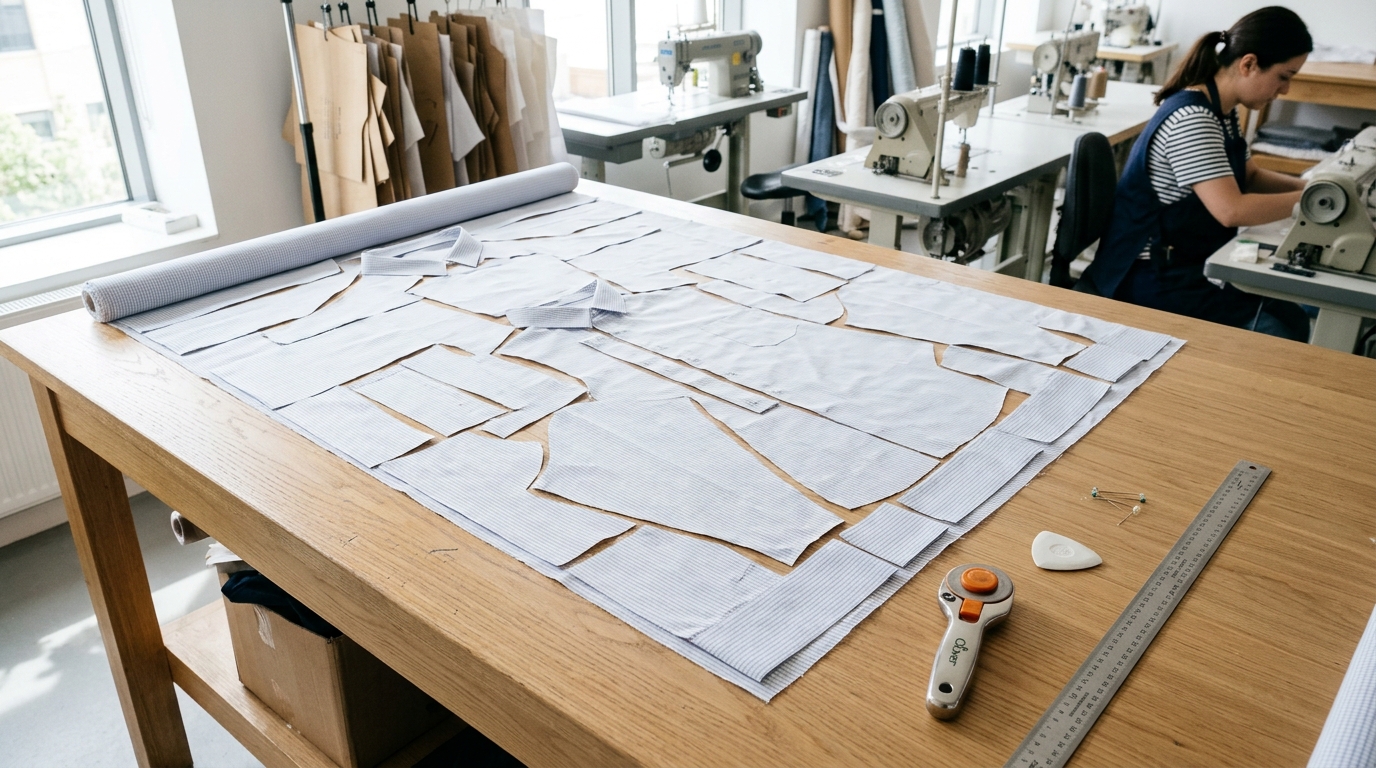
A research team evaluating sustainable apparel production has introduced a patternmaking and size development system that transforms conventional dress shirt patterns into rectangular layouts, cutting cutting-room fabric waste by approximately 80 to 90 percent across multiple garment sizes. In contemporary commercial clothing production, fabric waste generated during marking, cutting, and sewing is estimated to represent roughly 15 to 25 percent of the total textile material, meaning that an entire garment’s worth of fabric is discarded for every four to six garments manufactured. While post-production interventions such as mechanical recycling into thread or upcycling scraps into patchwork products have been explored, these strategies incur substantial collection and processing expenses without eliminating the initial environmental burden of textile manufacturing. Zero-waste fashion design seeks instead to prevent waste generation entirely by arranging garment patterns so that no scrap material is produced during the cutting phase. The newly evaluated method demonstrates that standard men’s dress shirt patterns can be scaled across small, medium, and large sizes using rectangular pattern geometries, achieving nearly complete fabric utilization while preserving overall visual acceptability.
Historically, zero-waste fashion design has remained largely confined to experimental fashion exhibitions, bespoke garments, or academic design exercises, facing substantial obstacles to widespread industrial commercialization. Earlier investigations into zero-waste apparel primarily explored aesthetic draping, creative cutting, transformational reconstruction, or three-dimensional design software simulations, but largely bypassed the technical demands of standard industrial size grading. When previous researchers attempted size development for zero-waste garments, they often relied on inserting additional strips of fabric into seams to alter dimensions, an intervention that introduced sewing complexity, increased labor costs, and altered the visible exterior lines of the garments. Furthermore, garments generated through non-standard pattern geometries frequently diverged from familiar consumer silhouettes, and the unconventional sewing procedures required to handle modified seams raised manufacturing costs. To bridge the gap between concept prototypes and mass-market feasibility, the current investigation focused on dress shirts, a structured and universally recognized wardrobe staple where consumer expectations for fit, comfort, and neatness are exceptionally rigid.
To establish a comparative baseline, the investigators drafted a conventional men’s medium shirt pattern using standard drafting guidelines based on the mean body measurements of Japanese men in their twenties, corresponding to a neck circumference of 37 centimeters, chest circumference of 93 centimeters, waist circumference of 76 centimeters, and back length of 43 centimeters. Using traditional grading techniques within apparel computer-aided design software, the authors generated small and large versions of the conventional shirt. They then developed corresponding zero-waste patterns for all three sizes by transforming the curved seam allowances and irregular outlines of the conventional shirt pattern into interlocking rectangular units. Under this geometry, sewing lines were drafted as internal guidelines to direct assembly, while straight cutting lines traced the outer rectangular boundaries. To eliminate waistline scrap generation entirely, the side seams were drafted as straight vertical edges, and smaller pattern elements, including the sleeve plackets, were systematically nested into the geometric voids adjacent to the neck and armhole cutouts.
Physical prototypes were constructed from a fall and winter weight poplin fabric composed of 65 percent cotton and 35 percent polyester with a thickness of 0.6 millimeters. A total of six shirts—three conventional shirts and three zero-waste shirts across small, medium, and large sizes—were assembled to directly compare layout efficiency, physical dimensions, and wearer experience. Marking evaluations demonstrated that holding the fabric roll width constant required modest adjustments to total layout length: relative to the conventional shirt layout, the zero-waste pattern required 4 centimeters more fabric length for size small and approximately 5 centimeters more for size medium, while requiring virtually identical length for size large. Across all three sizes, fabric usage efficiency—defined as the ratio of pattern area to total fabric area consumed—rose from approximately 80 percent in the conventional shirts to approximately 97 percent in the zero-waste shirts. The physical disposal area dropped from between 3,288 and 4,332 square centimeters per shirt in conventional cutting down to only 475 to 622 square centimeters in the zero-waste layouts, saving nearly one full shirt’s worth of material for every five to six garments assembled.
Reconfiguring the garment patterns into rectangular profiles produced measurable alterations in the finished dimensions of the shirts when measured flat across five anatomical markers: neck circumference, chest circumference, waist circumference, back neck point to wrist sleeve length, and armhole circumference. While neck, chest, and sleeve measurements remained consistent between the two designs, the zero-waste shirts exhibited an increase of approximately 9.5 centimeters in waist circumference across sizes due to the elimination of curved waist shaping in favor of straight side seams. In addition, the actual measured armhole circumference of the zero-waste shirts was 2 centimeters shorter than that of the conventional garments across all sizes. This dimensional contraction did not stem from pattern drafting omissions but occurred because the extensive rectangular seam allowances overlapped in curved regions during assembly, dramatically increasing the localized thickness and structural rigidity of the seam line and pulling the armhole inward.
Accommodating the substantial excess fabric inherent in rectangular seam allowances demanded specialized sewing and construction techniques, particularly along tightly contoured anatomical curves. In the zero-waste shirts, pronounced seam allowances accumulated around the collar, shoulders, and armholes, causing adjacent fabric layers to bunch together during stitching. To manage these accumulations without cutting away the excess material, the researchers developed folding protocols where seam allowances along the neck and armhole curves were systematically folded flat and topstitched into place. To relieve excessive structural bulk and tension where folded seam layers overlapped inside the armhole curves, technicians introduced controlled internal slits into the folded allowance before closing the seams. Despite these assembly adaptations, the layered 0.6-millimeter poplin generated stiff internal seam ridges that visibly influenced fabric drape, causing localized pulling and armhole wrinkling on dressed mannequins and human wearers.
To evaluate how these structural modifications affected wearer perception, the researchers conducted structured wearing trials and questionnaires with 26 male university students in their twenties. Each participant selected the appropriate size among small, medium, and large, and wore both the conventional shirt and the zero-waste shirt in randomized order while observing themselves in a full-length mirror. Evaluations assessed appearance across ten parameters—including wrinkling, overall fit, silhouette, five localized product regions, aesthetic preference, and general impression—under two distinct wearing configurations: first button open and first button closed. Across both button configurations, statistical testing revealed that the zero-waste shirts exhibited significantly more noticeable surface wrinkling than the conventional shirts at the five percent significance level. Nevertheless, both designs maintained positive average ratings for overall appearance, and participants reported no statistically significant differences in general aesthetic preference, product fit, or silhouette impression, though both models received slightly negative scores for torso width due to the relaxed bodice design.
Wearer comfort evaluations identified more pronounced physical trade-offs linked to the rigid folded seam allowances. When evaluated with the first button closed, the zero-waste shirts received significantly lower ratings for stitching stiffness, aesthetic liking, and overall comfort at the five percent significance level, and significantly poorer scores for ease of neck movement at the one percent significance level. With the first button unfastened, conventional shirts continued to score significantly higher than zero-waste shirts for overall comfort, liking, and general impression at the one percent level, alongside significant advantages in shoulder movement ease and seam softness at the five percent level. The trials demonstrated that the accumulated bulk around the armholes restricted arm and shoulder mobility, while the reinforced neckline pressed firmly against the neck. The researchers observed that these mechanical comfort deficits could be substantially alleviated in future iterations by utilizing lighter, thinner shirting textiles to soften folded allowances and by adding ease allowances to base patterns around complex curves.
Consumer acceptance and economic valuation exhibited a pronounced shift once the environmental rationale behind the garment construction was disclosed to participants. Prior to receiving an explanation of zero-waste fashion design principles, participants rated the conventional shirt significantly higher in overall satisfaction on a 10-point scale. However, following an explanation outlining the textile waste reduction achieved by the rectangular pattern method, participant satisfaction with the zero-waste shirt increased by an average of 0.81 points, reaching a mean rating of 6.08, which matched the conventional shirt mean rating of 6.04. Stated purchase intention for the zero-waste garment similarly rose from 42 percent before disclosure to 46 percent afterward, while the proportion of participants stating they would not purchase the shirt fell from 58 percent down to 46 percent. Furthermore, open-ended valuation revealed that following the explanation, 65 percent of participants assigned an identical upper price limit to both the conventional and zero-waste shirts, demonstrating that knowledge of sustainable manufacturing directly counterbalanced modest comfort and wrinkling disadvantages.
The authors emphasized that several experimental constraints define the current scope of their conclusions. The wearer evaluations were conducted exclusively with a cohort of 26 Japanese male university students in their twenties, limiting direct generalization across diverse demographic profiles, age brackets, genders, and cultural settings. The physical trials also utilized only a single medium-weight cotton-polyester poplin fabric, leaving the performance of more compliant, elastic, or lightweight textiles to future investigation. In addition, the pattern transformation was tested solely on men’s dress shirts, requiring further validation before application to structurally complex apparel such as trousers, tailored jackets, or dresses. Finally, the authors noted an industrial constraint: as zero-waste rectangular layouts widen to accommodate extended grading ranges, manufacturing more than ten distinct garment sizes may become limited by maximum commercially available fabric roll widths, highlighting the need for further studies integrating digital three-dimensional fitting and optimized industrial layout planning.
Subject of Research: Sustainable apparel engineering and zero-waste pattern grading
Article Title: Zero-waste shirt pattern creation with size development: evaluation of appearance, comfort, and purchase intention
Article References: Kim, K., Furuno, T., & Takatera, M. (2026). Zero-waste shirt pattern creation with size development: evaluation of appearance, comfort, and purchase intention. Fashion and Textiles, 13(1), Article 20. https://doi.org/10.1186/s40691-026-00458-x
Image Credits: AI Generated
DOI: 10.1186/s40691-026-00458-x
Keywords: Zero-waste fashion design, Sustainable apparel, Pattern grading, Textile waste reduction, Garment engineering, Consumer evaluation, Apparel manufacturing, Fashion sustainability, Zero-waste, shirt, pattern, creation
News Source: Denise Maddox. (November 7, 2026). Engineers Design Zero-Waste Dress Shirt Patterns Across Multiple Standard Sizes. Scienmag.