• HOME
  • NEWS
  • EXPLORE
    • CAREER
      • Companies
      • Jobs
    • EVENTS
    • iGEM
      • News
      • Team
    • PHOTOS
    • VIDEO
    • WIKI
  • BLOG
  • COMMUNITY
    • FACEBOOK
    • INSTAGRAM
    • TWITTER
Saturday, November 7, 2026
BIOENGINEER.ORG
No Result
View All Result
  • Login
  • HOME
  • NEWS
  • EXPLORE
    • CAREER
      • Companies
      • Jobs
        • Lecturer
        • PhD Studentship
        • Postdoc
        • Research Assistant
    • EVENTS
    • iGEM
      • News
      • Team
    • PHOTOS
    • VIDEO
    • WIKI
  • BLOG
  • COMMUNITY
    • FACEBOOK
    • INSTAGRAM
    • TWITTER
No Result
View All Result
Bioengineer.org
No Result
View All Result
Home NEWS Science News Chemistry

Complementary Spectroscopy Resolves Low-Frequency Vibrations in Amino Acid Crystals

by
November 7, 2026
in Chemistry
Reading Time: 2 mins read
0
Complementary Spectroscopy Resolves Low-Frequency Vibrations in Amino Acid Crystals

Complementary Spectroscopy Resolves Low-Frequency Vibrations in Amino Acid Crystals

Share on FacebookShare on TwitterShare on LinkedinShare on RedditShare on Telegram

A combined experimental and computational investigation has demonstrated that matching peak positions alone is insufficient to establish vibrational correspondence between low-wavenumber Raman and terahertz spectra of molecular crystals. Low-frequency lattice vibrations are known to provide sensitive markers of intermolecular interactions and crystal packing architectures. However, reliable interpretation of these vibrational modes requires rigorous analysis beyond superficial spectral comparisons. To achieve reliable interpretations of these spectra, researchers integrated low-wavenumber Raman spectroscopy, terahertz absorption spectroscopy, and periodic density functional theory calculations to analyze the low-frequency lattice dynamics of three distinct crystalline amino acids.

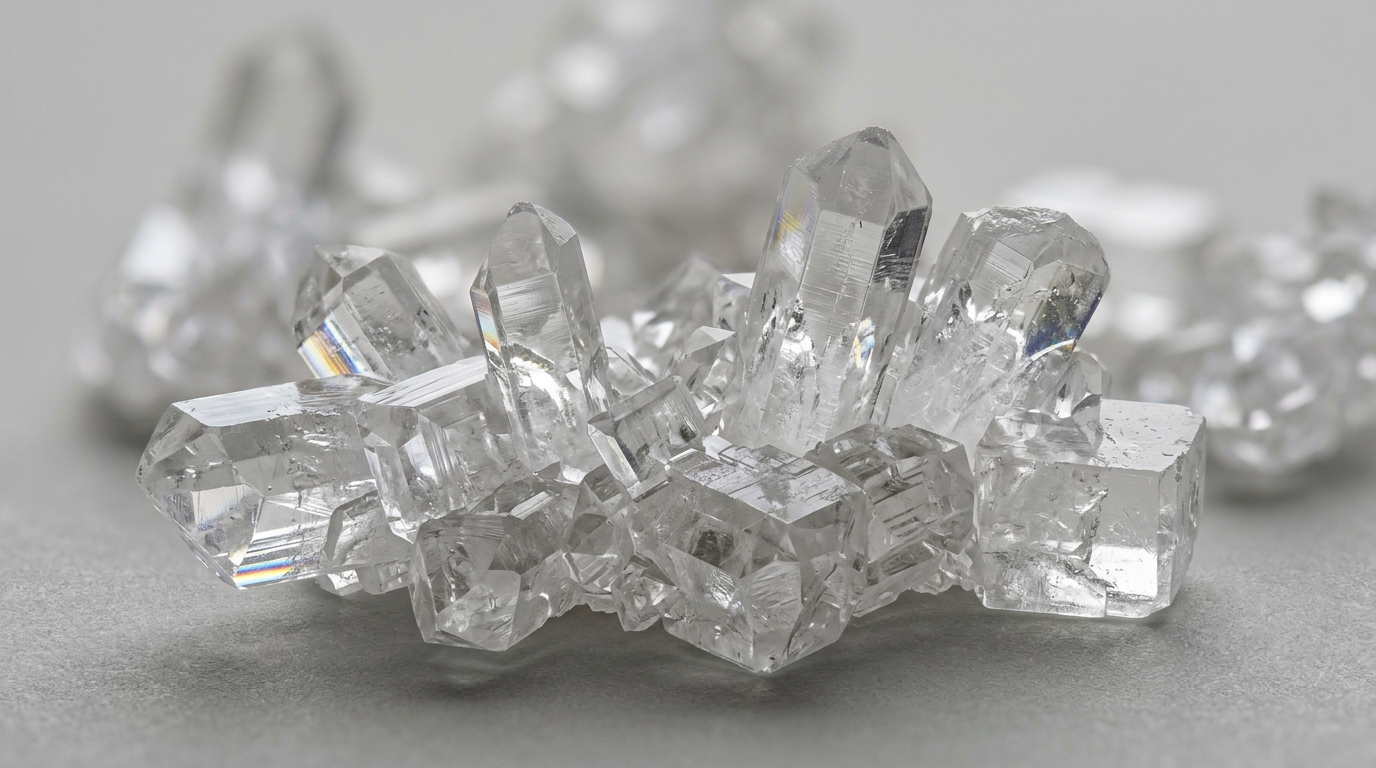
The study focused on L-alanine, L-glutamic acid, and L-glutamine, three molecular crystals that share an identical alpha-amino-acid backbone but differ substantially in their side-chain chemistry and crystal packing environments. Through complementary spectroscopic measurements, the researchers observed that each of the three crystalline materials exhibited distinct low-frequency spectral profiles across the measured ranges.

To understand the microscopic origins of the measured spectra, the authors carried out periodic density functional theory calculations utilizing the PBE-D3 dispersion-corrected functional. These calculations revealed a clear frequency-dependent distinction in the physical character of the lattice vibrations across the investigated systems. In the lower-frequency regime, the vibrational modes are dominated by collective rigid-molecule librations.

To establish unambiguous connections between the complementary spectroscopic techniques, the researchers implemented a selection-rule-aware comparison rather than relying strictly on spectral peak matching. This evaluative framework evaluated frequency proximity alongside calculated Raman activities, calculated infrared intensities, and detailed atomic displacement patterns derived from the periodic calculations. Using this comprehensive criteria, the authors successfully distinguished between Raman-selective modes, infrared-selective modes, cross-technique-compatible transitions, and spectral features that appear near-coincident in frequency yet remain vibrationally non-equivalent, preventing misassignments that arise when comparing different spectroscopic probes.

These findings establish that mere frequency coincidence between Raman and terahertz peaks is insufficient for determining true vibrational mode correspondence in molecular crystals. By accounting for selection rules, intensities, and atomic displacements, the study provides a robust, mode-resolved framework for interpreting complementary low-frequency Raman and terahertz absorption data.

Subject of Research: Low-frequency lattice dynamics of amino acid crystals

Article Title: Mode-resolved low-frequency lattice dynamics of L-amino acid crystals revealed by complementary low-wavenumber Raman–terahertz spectroscopy and periodic DFT

Article References: Ge, M., Wu, L., Xue, D., Wang, Y., & Qu, Y. (2026). Mode-resolved low-frequency lattice dynamics of L-amino acid crystals revealed by complementary low-wavenumber Raman–terahertz spectroscopy and periodic DFT. BMC Chemistry. https://doi.org/10.1186/s13065-026-01954-3

Image Credits: AI Generated

DOI: 10.1186/s13065-026-01954-3

Keywords: low-frequency lattice dynamics, Raman spectroscopy, terahertz spectroscopy, periodic DFT, amino acid crystals, molecular crystals, crystal packing, vibrational modes, Mode-resolved, low-frequency, lattice, dynamics

News Source: Bethany Barker. (November 7, 2026). Complementary Spectroscopy Resolves Low-Frequency Vibrations in Amino Acid Crystals. Scienmag.


Tags: amino acid crystalscrystal packingdynamicslatticelow-frequencylow-frequency lattice dynamicsMode-resolvedmolecular crystalsperiodic DFTRaman spectroscopyterahertz spectroscopyvibrational modes
Share12Tweet7Share2ShareShareShare1

Related Posts

Preclinical Evaluation Assesses [11C]Onalespib for Cancer and Brain PET Imaging

Preclinical Evaluation Assesses [11C]Onalespib for Cancer and Brain PET Imaging

November 7, 2026
Lycopene Protects Chicken Testes Against Zearalenone Damage by Suppressing Necroptosis and Inflammation

Lycopene Protects Chicken Testes Against Zearalenone Damage by Suppressing Necroptosis and Inflammation

November 7, 2026

Deep Eutectic Solvents Cut Amide Bond Waste by 91%

November 7, 2026

Vanadium-Substituted Heteropolytungstate Catalysts Enable Direct Oxidative Amination of Cyclohexenone with Aniline

November 7, 2026

POPULAR NEWS

  • Lycopene Protects Chicken Testes Against Zearalenone Damage by Suppressing Necroptosis and Inflammation

    Lycopene Protects Chicken Testes Against Zearalenone Damage by Suppressing Necroptosis and Inflammation

    29 shares
    Share 12 Tweet 7
  • Finnish Experts Reach Consensus on Medication Documentation Standards

    29 shares
    Share 12 Tweet 7
  • Borderline Symptoms Predict Lower Empathy and Decreased Acceptance of Fair Offers

    29 shares
    Share 12 Tweet 7
  • Terminal Domains Drive Rice OsYchF1-OsGAP1 Complex Formation and Guide Modeling

    29 shares
    Share 12 Tweet 7

About

We bring you the latest biotechnology news from best research centers and universities around the world. Check our website.

Follow us

Recent News

Scientists Review Liver Abscess Risks and Emerging Treatments Following Pancreatic Surgery

Study Assesses Metabolic Syndrome Rates and Clinical Features in Gout Patients

Flexible PVC Composites Doped With WO3 and Brine Sludge Shield Radiation

Subscribe to Blog via Email

Enter your email address to subscribe to this blog and receive notifications of new posts by email.

Join 86 other subscribers
  • Contact Us

Bioengineer.org © Copyright 2023 All Rights Reserved.

Welcome Back!

Login to your account below

Forgotten Password?

Retrieve your password

Please enter your username or email address to reset your password.

Log In
No Result
View All Result
  • Homepages
    • Home Page 1
    • Home Page 2
  • News
  • National
  • Business
  • Health
  • Lifestyle
  • Science

Bioengineer.org © Copyright 2023 All Rights Reserved.