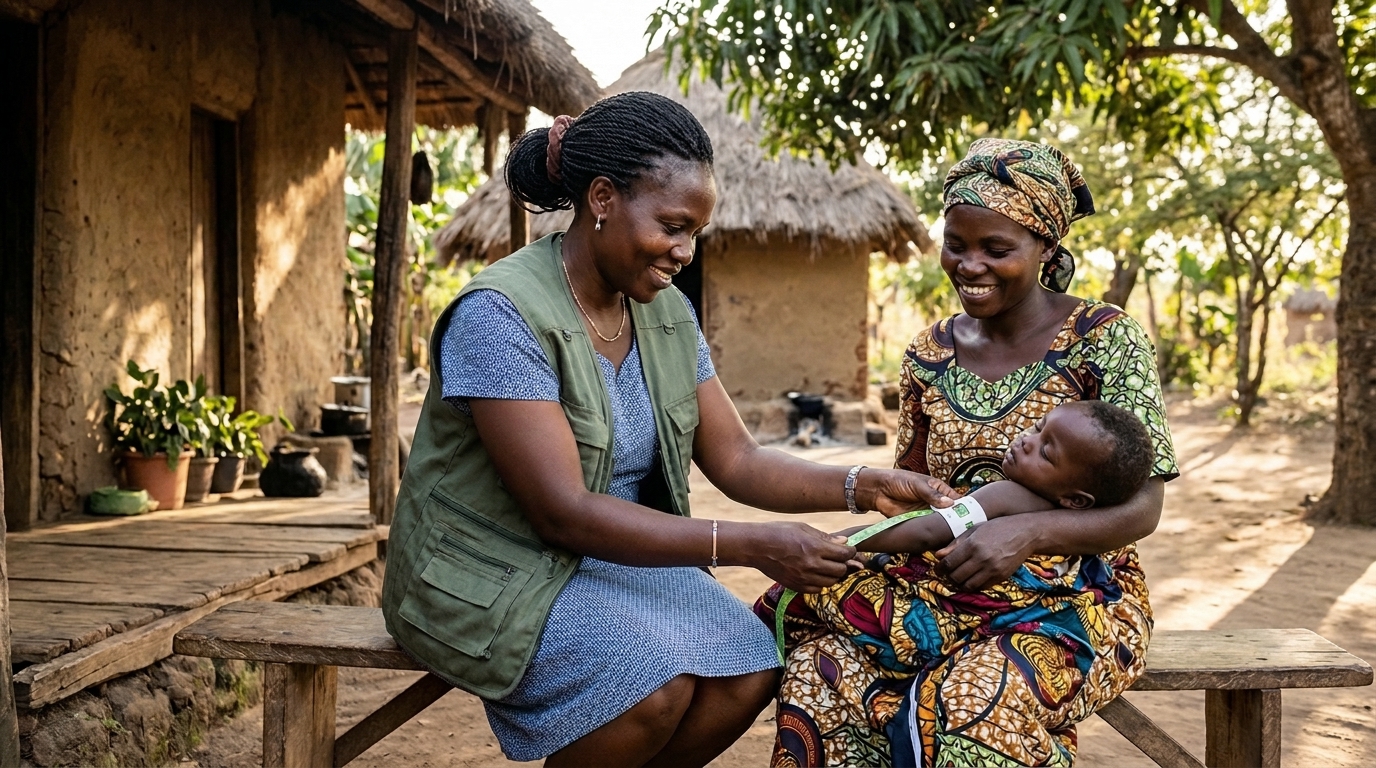
Strengthening community health worker programs provides the fastest and most cost-effective route for national health systems to achieve their full potential and expand essential medical care, according to an analysis by Henry B. Perry, Abhay Bang, Steve Hodgins, Madeleine Ballard, Jeffrey D. Sachs, and colleagues published in PLOS Global Public Health. The authors report that many health systems, particularly across low- and lower middle-income countries, continue to lag in their progress toward achieving Universal Health Coverage and delivering on the broader promise of Health for All. These national systems remain severely constrained by persistent health workforce shortages, rigid fiscal ceilings, and inadequate outreach to vulnerable populations who currently lack access to basic and essential services. As a consequence of these systemic barriers, stark inequities in service coverage and overall population health status continue to endure across these regions.
Drawing on evidence accumulated from more than a decade of national-scale implementation experience, the analysis demonstrates that community health workers can successfully extend high-quality essential services to the last mile while simultaneously improving the overall operational efficiency of the broader health system. To realize these gains, however, community health workers must be appropriately trained, adequately paid, reliably equipped, and systematically supervised. The authors emphasize that rather than serving as informal or marginal adjuncts, community health workers should be established as the central backbone of primary health care delivery and the fundamental cornerstone of resilient national health systems.
The analysis highlights that current international donor strategies and private sector investments are increasingly captivated by the technological promise of artificial intelligence and digital health innovations. Nevertheless, the researchers argue that the most dependable and proven approach to saving lives remains a paid, well-supported community health worker who is empowered with digital tools. At the same time, an ongoing contraction in Official Development Assistance creates both substantial risks and critical opportunities for global public health finance. To maximize impact under these tightening financial conditions, the authors urge Official Development Assistance to pivot away from directly subsidizing routine operational services toward providing catalytic capital in the form of time-bound, matching investments designed to accelerate recipient governments’ own domestic pro-community health worker policies.
Under this proposed next generation of community health worker programs in low- and lower middle-income nations, health workers would be systematically integrated into national health systems with adequate remuneration, comprehensive training, regular supervision, and robust logistical backing. This structured institutional support would empower community health workers to conduct monthly home visits to every household and deliver an expansive array of primary health care services directly within communities. According to the authors, establishing this next generation model is projected to yield highly favorable economic returns through tangible productivity gains stemming from improved population health, direct reductions in curative health-care expenditures, and strengthened pandemic-risk mitigation. Ultimately, the analysis concludes that establishing a next generation of community health worker programs provides the best opportunity for accelerating progress in achieving Universal Health Coverage and delivering Health for All sooner rather than later.
Subject of Research: Community health worker programs and universal health coverage in lower-income nations
Article Title: The potential of a “next generation” of community health workers to accelerate progress in reaching Universal Health Coverage and Health for All
Article References: Perry, H. B., Bang, A., Hodgins, S., Ballard, M., Sachs, J. D., Muluneh, A. Z., Chowdhury, M., Mwenda, M., & Panjabi, R. (2026). The potential of a “next generation” of community health workers to accelerate progress in reaching Universal Health Coverage and Health for All. PLOS Global Public Health, 6(10), e0007545. https://doi.org/10.1371/journal.pgph.0007545
Image Credits: AI Generated
DOI: 10.1371/journal.pgph.0007545
Keywords: community health workers, universal health coverage, primary health care, global public health, health systems, health equity, catalytic capital, official development assistance, potential, next, generation, community
News Source: Phoebe Ingram. (November 7, 2026). Strengthening Community Health Worker Programs Accelerates Universal Healthcare Access in Developing Nations. Scienmag.