Optical physicists have demonstrated that superimposing propagating structured light fields with controlled angular twists produces reconfigurable, nondiffracting topological textures in free space. The experimental and theoretical investigation, reported by Vasu Dev and Yijie Shen in Light: Science and Applications, extends the physical concept of twistronics beyond solid materials and two-dimensional surfaces. In conventional condensed matter physics, twistronics relies on stacking atomically thin layers, such as graphene sheets or van der Waals heterostructures, at precise magic angles to induce emergent phenomena including unconventional superconductivity, correlated insulation, and altered photonic band dispersion. However, these conventional implementations remain constrained by static material boundaries, interfacial fabrication tolerances, and localized near-field interactions. The newly demonstrated platform overcomes these physical boundaries by encoding rotational twists directly into propagating three-dimensional optical beams, establishing a class of light fields designated as optical supertopologies.
The physical framework developed by the researchers constructs freespace moiré superlattices from the coherent superposition of two constituent topological optical lattice fields. Rather than employing physical solid lattices, the method generates elementary optical lattices through the mathematical principle of N-wave interference. In this formulation, structured light fields characterized by binary phase distributions, helical phase distributions, and orthogonal polarization components undergo mutual interference. In the Fourier spatial frequency domain, such periodic fields can theoretically be described as arrays of discrete point sources. To render these fields physically realizable in laboratory experiments, the researchers approximated the point sources as Gaussian beamlets having identical beam waists and uniform radial displacement. When these beamlets are coherently combined with orthogonal right-circularly polarized and left-circularly polarized components carrying defined orbital angular momentum, they produce stable polarization vector textures exhibiting characteristic spatial rotational symmetries.
By tuning the number of interfering spatial wavevectors and the discrete helical phases within the left-circularly polarized field, the authors synthesized baseline topological lattices carrying distinct crystal symmetries. These include hexagonal skyrmionium lattices possessing sixfold rotational symmetry, square skyrmion lattices possessing fourfold rotational symmetry, and triangular meron lattices exhibiting threefold rotational symmetry. Within each hexagonal unit cell of the unperturbed sixfold skyrmionium lattice, the local polarization Stokes vectors construct two radially nested skyrmionic structures of opposite polarity, yielding a net integer skyrmion number of zero. These fundamental topological beams propagate coaxially along the longitudinal axis without diffraction. Because their constituent spatial frequency components lie on a shared ring of constant radial spatial frequency in the Fourier plane, they share identical longitudinal wavevectors, maintaining both their transverse geometric dimensions and their spatial polarization textures across long propagation distances.
When two identical topological lattice volumes are superimposed with a non-zero relative twist angle about their shared propagation axis, their mutual spatial interference establishes a freespace moiré field. This rotational displacement couples the intrinsic discrete rotational symmetry of each constituent optical lattice to an continuous spatial degree of freedom, forming moiré superlattices characterized by altered spatial periods and modified field topologies. The geometric nature of the resulting moiré superlattice is dictated by the twist angle. When the primitive lattice vectors of the two rotated lattices satisfy specific commensurability conditions, the intersecting beamlets generate strictly periodic supercells in the transverse plane. Conversely, at incommensurate twist angles, the moiré light field loses discrete spatial translational periodicity while retaining rotational symmetry, organizing the propagating electromagnetic field into ordered topological quasicrystals.
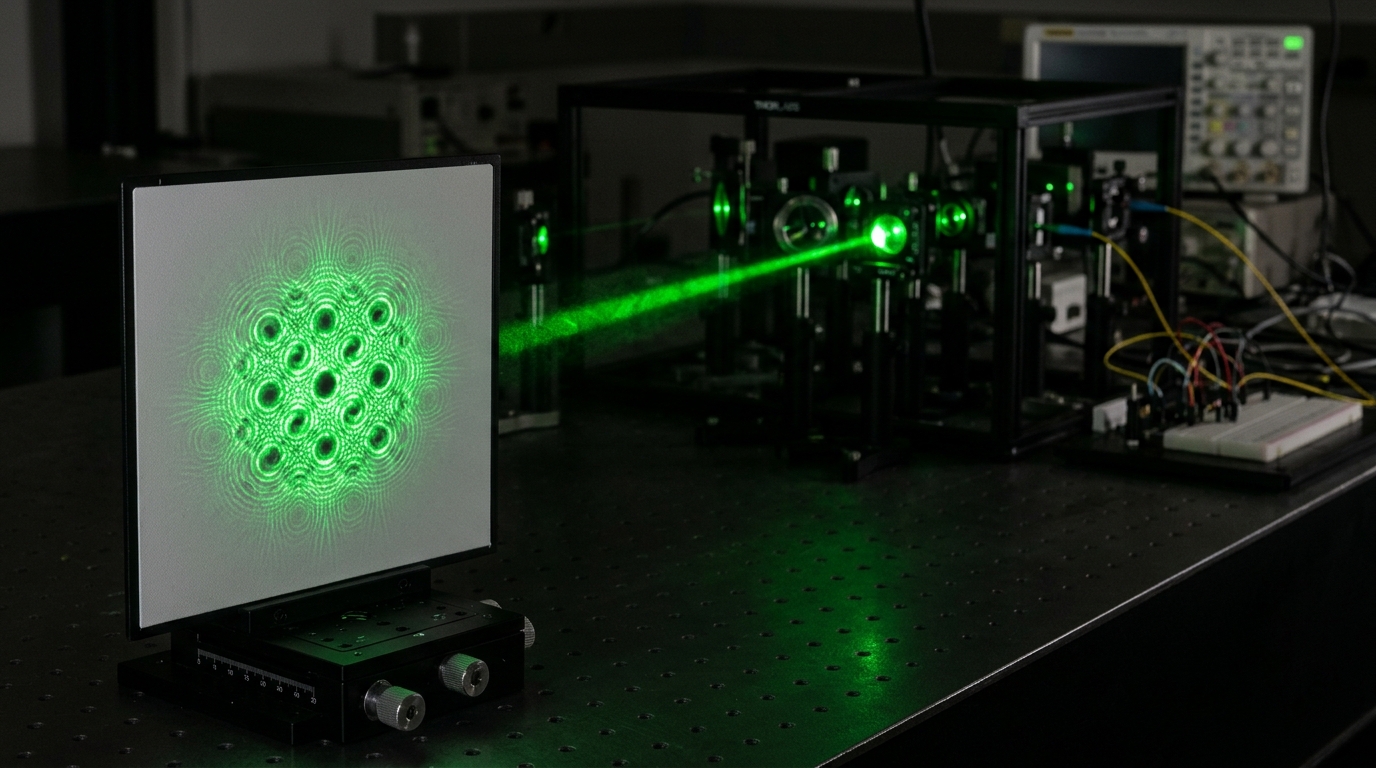
To experimentally realize and verify these optical supertopologies, the researchers implemented a reconfigurable computer-generated holographic platform utilizing a spatial light modulator. The complex spatial-frequency spectra, polarization states, and mutual twist angles of the interacting optical lattices were digitally mapped onto phase holograms, permitting rapid digital switching between diverse topological regimes without physical component realignment. Stokes polarimetry was then deployed to measure the spatially resolved Stokes vector distributions across the transverse beam cross-sections. From these measured polarization parameters, the researchers reconstructed the spatial distribution of the out-of-plane Stokes component, the local polarization orientations, and the normalized topological skyrmion charge density distributions across multiple unit cells and extended supercells.
In experimental demonstrations utilizing twisted hexagonal skyrmionium lattices, distinct commensurate angles yielded entirely previously unobserved topological configurations. At a twist angle of 13.2 degrees, the interference pattern organized into a periodic superlattice of skyrmionium bags arranged in a long-range hexagonal geometry. In this state, an inner cluster of seven elementary skyrmioniums is fully enclosed within an expanded outer bag skyrmionium of opposite polarity. Because the individual skyrmion components inside possess opposite polarities that balance each other, the measured total skyrmion number across the complete skyrmionium bag remained near zero, whereas each protected baby skyrmion embedded within the core cluster exhibited an experimental topological charge exceeding 0.9. Adjusting the twist angle to 16.4 degrees preserved the central skyrmionium bag core while expanding the overall superlattice period.
Further increasing the mutual twist angle induced fundamental topological phase transformations within the propagating beam. At a twist angle of 21.8 degrees, the hexagonal moiré field transitioned into a skyrmion-cluster superlattice possessing a petal-like architecture, wherein six surrounding skyrmion clusters enveloped a structurally stable central skyrmionium. At a twist angle of 27.8 degrees, the light field established a nested-topology superlattice. In this configuration, the central supercell hosted a multi-pi target skyrmion composed of radially nested skyrmionic boundaries surrounded by peripheral skyrmioniums that were shared with adjacent supercells. Applying freespace twistronics to fourfold symmetric skyrmion lattices similarly generated skyrmion-cluster superlattices whose constituent baby skyrmion counts per supercell varied predictably with twist angle, yielding discrete stable supercells containing twenty-five skyrmions at 10.35 degrees, thirteen skyrmions at 12.66 and 16.26 degrees, and five skyrmions at 22.61 degrees.
The researchers also established an optical decomposition framework based on the spatial Fourier spectrum of the transverse Stokes parameters. Because the Stokes vector distribution of the moiré superlattice exhibits well-defined spatial periodicity, its Fourier transform separates into distinct concentric rings of spatial frequency components. By selectively isolating specific rings of spatial wavevectors, the complex supertopologies were systematically decomposed into constituent sub-lattices of lower topological order. In the case of the skyrmionium-bag pattern generated at 16.4 degrees, spatial frequency groupings comprising six spots yielded elementary hexagonal skyrmion lattices with different lattice constants. Meanwhile, rings containing twelve or eighteen discrete wavevector spots reconstructed higher-order bilayer and trilayer skyrmion bag textures, demonstrating that higher-dimensional moiré topologies naturally encode hierarchical superpositions of simpler topological fields.
A critical operational attribute demonstrated in the study is the high topological and geometric resilience of these freespace moiré light fields during long-range propagation. Because the experimental Gaussian beamlets closely approximate the constant longitudinal propagation constants of ideal non-diffracting beams, the generated supertopologies maintained their transverse sizes and complex internal topological textures across a laboratory propagation distance of 50 centimeters. In comparative propagation tests from zero to forty centimeters, the measured topological skyrmion numbers for both skyrmionium bags and dense skyrmion clusters remained invariant, confirming stability against longitudinal propagation and small angular misalignments. The study noted that this propagation invariance strictly applies to coaxial beam alignment; introducing a transverse displacement between the Fourier spectra of the two constituent lattices tilted their propagation axes, causing the transverse moiré textures to deform continuously along the longitudinal path.
The study further verified the self-healing capacity of optical supertopologies when subjected to opaque physical obstructions placed directly within the beam path. When solid circular disks were introduced at the origin to block one or two elementary skyrmioniums within an active skyrmionium bag, the surrounding unobstructed angular spectrum components continued propagating and interfering downstream. Through this wave-optical reconstruction mechanism, the obstructed regions progressively restored their original transverse field amplitude and phase profiles. Consequently, the local polarization textures and their associated integer skyrmion numbers fully recovered their initial values during subsequent propagation. The authors emphasized that the observed self-healing arises from the broad angular-spectrum structure of the nondiffracting optical lattice rather than from the polarization topology itself. Because the topological charge is mathematically mapped onto the normalized Stokes field, it remains invariant under continuous and non-singular field perturbations, allowing the reconstructed optical field to faithfully restore its original topological properties.
Subject of Research: Freespace twistronics and optical supertopologies in structured light
Article Title: Freespace “twistronics”: moiré structured light for optical supertopologies
Article References: Dev, V., & Shen, Y. (2026). Freespace “twistronics”: moiré structured light for optical supertopologies. Light: Science & Applications, 15(1), Article 396. https://doi.org/10.1038/s41377-026-02533-w
Image Credits: AI Generated
DOI: 10.1038/s41377-026-02533-w
Keywords: Optics, Twistronics, Structured Light, Optical Supertopologies, Moiré Superlattices, Skyrmions, Stokes Parameters, Nondiffracting Beams, Freespace, moir, structured, light
News Source: Denise Maddox. (November 7, 2026). Twisted Structured Light Fields Form Nondiffracting Topological Superlattices in Free Space. Scienmag.