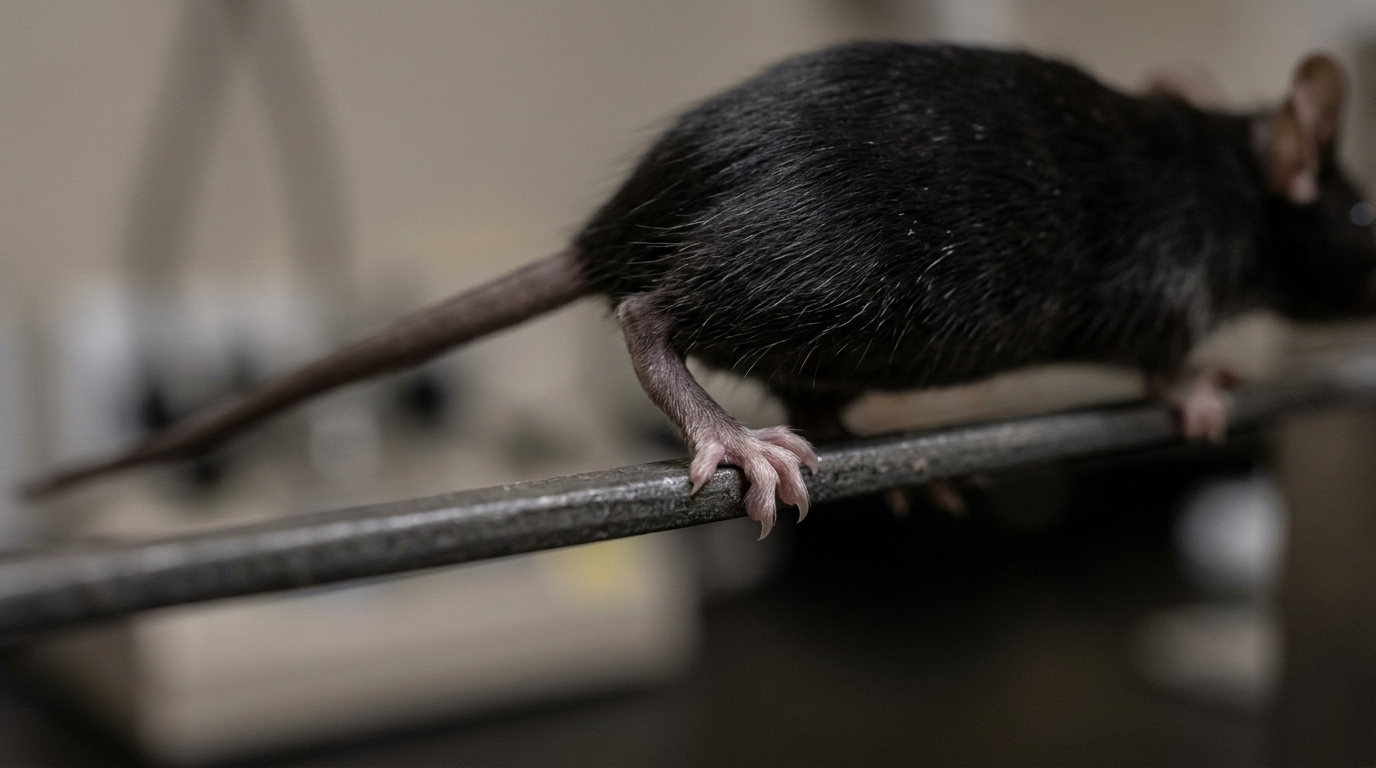
Mice with damage to dopamine-producing neurons in the ventral tegmental area stumble over obstacles in a strikingly specific way: their forelimbs clear the hurdle just as cleanly as healthy animals, but their leading hindlimbs repeatedly stomp or graze the obstacle they can no longer see. The finding, published in Frontiers in Behavioral Neuroscience, points to a population of midbrain dopamine neurons best known for reward and cognition as a key player in the memory-guided control of the hind legs during visually guided walking.
The study, led by Akira Konosu, Susumu Setogawa, Tetsuro Funato and Dai Yanagihara, addressed a long-standing gap in the neuroscience of gait. Midbrain dopamine neurons cluster in two main regions: the substantia nigra pars compacta, whose degeneration is the classic pathological hallmark of Parkinson’s disease, and the ventral tegmental area, or VTA, which is more often associated with non-motor functions such as cognition and memory. Gait instability and falls are common in Parkinson’s disease, and human studies of obstacle negotiation show that successful avoidance depends not only on motor control but also on cognitive and memory processes. Yet whether dopamine loss specifically in the VTA could impair adaptive foot control during obstacle crossing had remained untested.
To find out, the researchers injected 12 male C57BL/6J mice bilaterally with either 6-hydroxydopamine, a neurotoxin that selectively kills dopamine neurons, or saline as a control, targeting the VTA at stereotaxic coordinates relative to bregma. Six mice received the toxin and six received saline. After allowing more than three weeks, between 22 and 50 days, for the lesion to develop, the team tested the animals on a transparent acrylic runway 40 centimeters long and 5 centimeters wide, with a black plate-shaped obstacle 6 millimeters high and 2 millimeters thick placed at the midpoint. Mice traversed the runway toward a food dish, completing repeated sessions over two to four consecutive days until 100 successful obstacle-negotiation trials per animal were recorded. High-speed cameras filming at 200 hertz captured every step from the right side, and trials interrupted by grooming or rearing were excluded.
Post-mortem immunohistochemistry confirmed that the toxin had done its intended work. Tyrosine hydroxylase-positive neurons, the standard marker for dopamine production, were reduced by roughly 41 percent in the VTA of the lesioned group compared with controls, a statistically significant difference. In the substantia nigra, by contrast, the reduction was only about 4 percent and not statistically significant, indicating that the lesion was largely confined to the VTA. The authors note that because local injection cannot fully prevent diffusion, a small unintended contribution from nigral damage cannot be completely excluded, but rotarod performance and overground locomotion showed no deficits, suggesting any such contribution was limited.
The behavioral results were sharply lateralized to the hindquarters. Stomping, defined as the foot landing directly on the obstacle during touchdown, was no more frequent in the leading forelimbs of lesioned mice than in controls. But stomping by the leading hindlimb rose significantly in the lesion group. Grazing, in which the toe clips the upper edge of the obstacle, followed the same pattern: forelimb grazing was unchanged, while leading-hindlimb grazing increased and trailing-hindlimb grazing decreased in the lesioned animals. Trailing-limb stomps were so rare they occurred only in the trailing forelimb of the lesion group, at a mean frequency of 0.2 percent.
Kinematic analysis revealed what was going wrong. In healthy mice, the distance from takeoff to the obstacle strongly predicts stride length, allowing the animal to place its foot precisely on the far side. The lesioned mice retained this correlation during the final step of the trailing limb and during the leading step, but their landing positions became unreliable. Using logistic regression with stomping as the outcome, the researchers found that the landing-to-obstacle distance showed a strong negative association with stomp occurrence, meaning shorter landing distances made stomps more likely. Stride length also showed a significant negative association, though with a smaller effect size. Locomotor velocity, notably, was not significantly associated with stomping, ruling out simple speed as the culprit.
Toe trajectory analysis added a temporal dimension to the deficit. During obstacle negotiation, the leading hindlimb in lesioned mice initiated toe elevation earlier than controls: the normalized horizontal distance from takeoff to the point where the toe exceeded 80 percent of obstacle height was significantly shorter in the lesion group. Crucially, this change was absent during overground locomotion without an obstacle, where stride length, peak toe height and trajectory timing were all comparable between groups. The deficit was therefore specific to obstacle negotiation, not a general impairment of hindlimb movement.
The researchers also examined forelimb-hindlimb coordination, a factor previously implicated in successful obstacle avoidance in quadrupeds. In both groups, the horizontal distance between the mean forelimb and hindlimb toe positions transiently decreased before the forelimbs crossed the obstacle, then increased as the forelimbs traversed it. In control mice, this transient approximation was more pronounced and was associated with temporary slowing of the forelimbs while the hindlimbs advanced. In the lesion group, the local minimum interlimb distance immediately before forelimb crossing was significantly greater, indicating that the coordinated gathering of hindlimbs toward the forelimbs had been disrupted.
Why would VTA damage affect the hindlimbs but not the forelimbs? The authors point to the anatomy of dopaminergic projections. In rodents, dopaminergic innervation is particularly dense in the medial prefrontal cortex, whereas motor and parietal cortices receive relatively sparse input, and projections to the medial prefrontal cortex and primary motor cortex arise predominantly from the VTA rather than the substantia nigra. The medial prefrontal cortex, in turn, projects to the dorsomedial striatum, a region implicated in sensory-guided action selection, short-term memory and the modulation of limb movement. Large dorsal striatal lesions in rodents are known to alter toe placement before obstacle crossing and increase stomping frequency, consistent with the pattern seen here. Previous work has also shown that loss of VTA dopamine neurons does not impair forelimb reaching or rotarod tasks, which aligns with the preserved forelimb performance in this study.
The authors frame the hindlimb deficit as a failure of memory-guided feedforward control. In quadrupedal animals, once the forelimbs have crossed an obstacle, the hindlimbs and the obstacle can no longer be monitored visually, so hindlimb stepping must rely on working memory of the obstacle’s location. The lesioned mice appeared to retain obstacle-related information, since their takeoff positions did not differ between graze and no-contact trials during the leading step, but they failed to use that information to adjust hindlimb trajectory and landing position appropriately. The team suggests that VTA projections to the medial prefrontal cortex and the dorsomedial striatum may support the maintenance and utilization of obstacle-related information during the delay between forelimb and hindlimb crossing. Because dopaminergic degeneration in Parkinson’s disease extends beyond the substantia nigra to involve the VTA, and because patients with Parkinson’s disease show shortened landing distances after obstacle clearance despite preserved toe clearance, the authors propose that VTA dysfunction may partially contribute to the gait abnormalities and increased fall risk observed in aging and neurological disorders, while cautioning that reductions in landing distance in humans likely reflect multiple interacting factors and that future studies using more selective approaches will be needed to disentangle the respective contributions of VTA and substantia nigra dopamine neurons.
Subject of Research: The role of ventral tegmental area dopaminergic neurons in memory-guided hindlimb control during obstacle-avoidance locomotion in mice
Article Title: Ventral tegmental area dopaminergic neurons contribute to hindlimb control during obstacle-avoidance locomotion in mice
Article References: Konosu, A., Setogawa, S., Funato, T., & Yanagihara, D. (2026). Ventral tegmental area dopaminergic neurons contribute to hindlimb control during obstacle-avoidance locomotion in mice. Frontiers in Behavioral Neuroscience, 20, Article 1925799. https://doi.org/10.3389/fnbeh.2026.1925799
Image Credits: AI Generated
DOI: 10.3389/fnbeh.2026.1925799
Keywords: ventral tegmental area, dopamine neurons, obstacle avoidance, hindlimb control, working memory, mice, Parkinson's disease, gait, 6-hydroxydopamine, interlimb coordination, locomotion, prefrontal cortex
News Source: Ophelia Keating. (November 7, 2026). VTA dopamine loss disrupts memory-guided hindlimb control in mice. Scienmag.