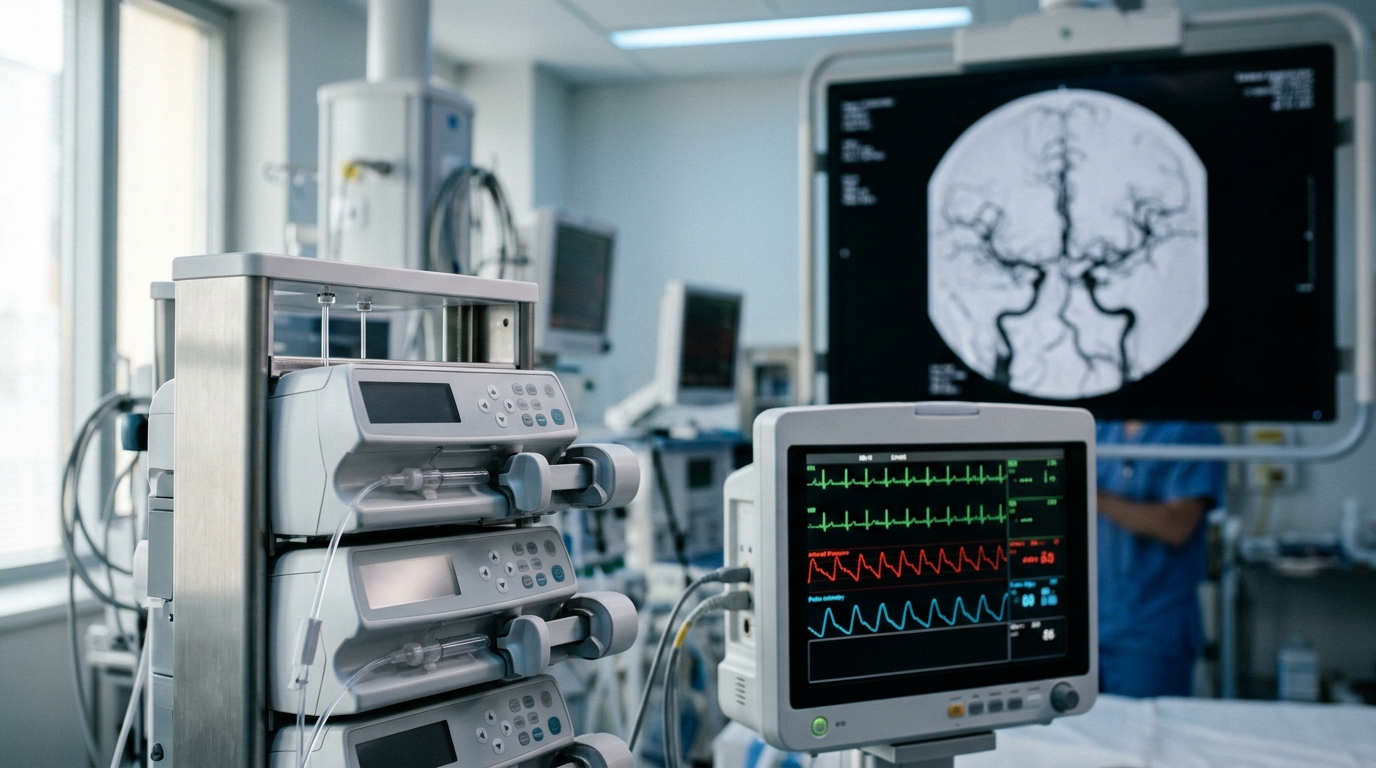
A retrospective two-center study evaluated a support vector machine model developed to predict overt or endoscopically confirmed gastrointestinal bleeding occurring within 72 hours after endovascular thrombectomy for acute ischemic stroke. In primary discrimination assessments, the support vector machine achieved an area under the receiver operating characteristic curve of 0.931 with a 95 percent confidence interval of 0.902 to 0.961 in the training cohort, 0.916 with a 95 percent confidence interval of 0.857 to 0.974 in the internal test cohort, and 0.865 with a 95 percent confidence interval of 0.780 to 0.951 in the external validation cohort.
The study analyzed a development cohort of 485 patients treated between May 2021 and June 2025 at the First Affiliated Hospital of Guilin Medical University alongside an external validation cohort of 72 patients treated between January 2024 and June 2025 at Guilin People’s Hospital. Across the development cohort, the primary outcome of overt or endoscopically confirmed gastrointestinal bleeding was observed in 142 of 485 patients, representing an incidence rate of 29.3 percent. Additionally, 20 patients, or 4.1 percent of the development cohort, experienced severe or fatal gastrointestinal bleeding events.
All candidate predictors were restricted to clinical data available at or before the completion of endovascular thrombectomy, matching the intended point of post-procedure evaluation. Researchers selected predictor variables using least absolute shrinkage and selection operator regression together with the Boruta algorithm. The final model retained nine clinical variables: the National Institutes of Health Stroke Scale score, the Glasgow Coma Scale score, the modified Rankin Scale score, the Alberta Stroke Program Early CT Score, the anatomical location of vessel occlusion, the total number of thrombectomy passes, the modified Thrombolysis in Cerebral Infarction grade, pre-admission anticoagulant therapy, and the patient neutrophil count.
The development protocol evaluated and compared seven supervised machine learning algorithms. In calibration testing, the primary support vector machine recorded Brier scores of 0.094 in the internal test cohort and 0.136 in the external validation cohort, while logistic regression demonstrated comparable discrimination performance across both validation datasets. The investigators applied SHapley Additive exPlanations to quantify and interpret individual predictor contributions, incorporating the nine retained features into an online calculator designed for post-procedure risk estimation.
The authors reported that integrating the nine clinical factors available at procedure completion yielded effective discrimination for estimating gastrointestinal bleeding probability across the subsequent 72-hour window. Given the retrospective design across two medical centers, the investigators concluded that prospective multicenter validation across geographically diverse regions and varied practice settings remains necessary before the model is introduced into clinical practice.
Subject of Research: Machine learning prediction of post-thrombectomy gastrointestinal bleeding in acute stroke
Article Title: Development and Validation of a machine learning model for predicting gastrointestinal bleeding after endovascular thrombectomy in acute ischemic stroke: a two-center study
Article References: Chen, P., Suo, L., Liu, Y., Huang, Y., Li, M., Ren, Y., Tang, Y., & Li, H. (2026). Development and Validation of a machine learning model for predicting gastrointestinal bleeding after endovascular thrombectomy in acute ischemic stroke: a two-center study. BMC Medical Informatics and Decision Making. https://doi.org/10.1186/s12911-026-03957-5
Image Credits: AI Generated
DOI: 10.1186/s12911-026-03957-5
Keywords: acute ischemic stroke, endovascular thrombectomy, gastrointestinal bleeding, machine learning, support vector machine, risk prediction, clinical decision support, retrospective study, Development, Validation, machine, learning
News Source: Cassandra Pierce. (November 6, 2026). Machine Learning Predicts Gastrointestinal Bleeding Risk After Endovascular Stroke Thrombectomy. Scienmag.