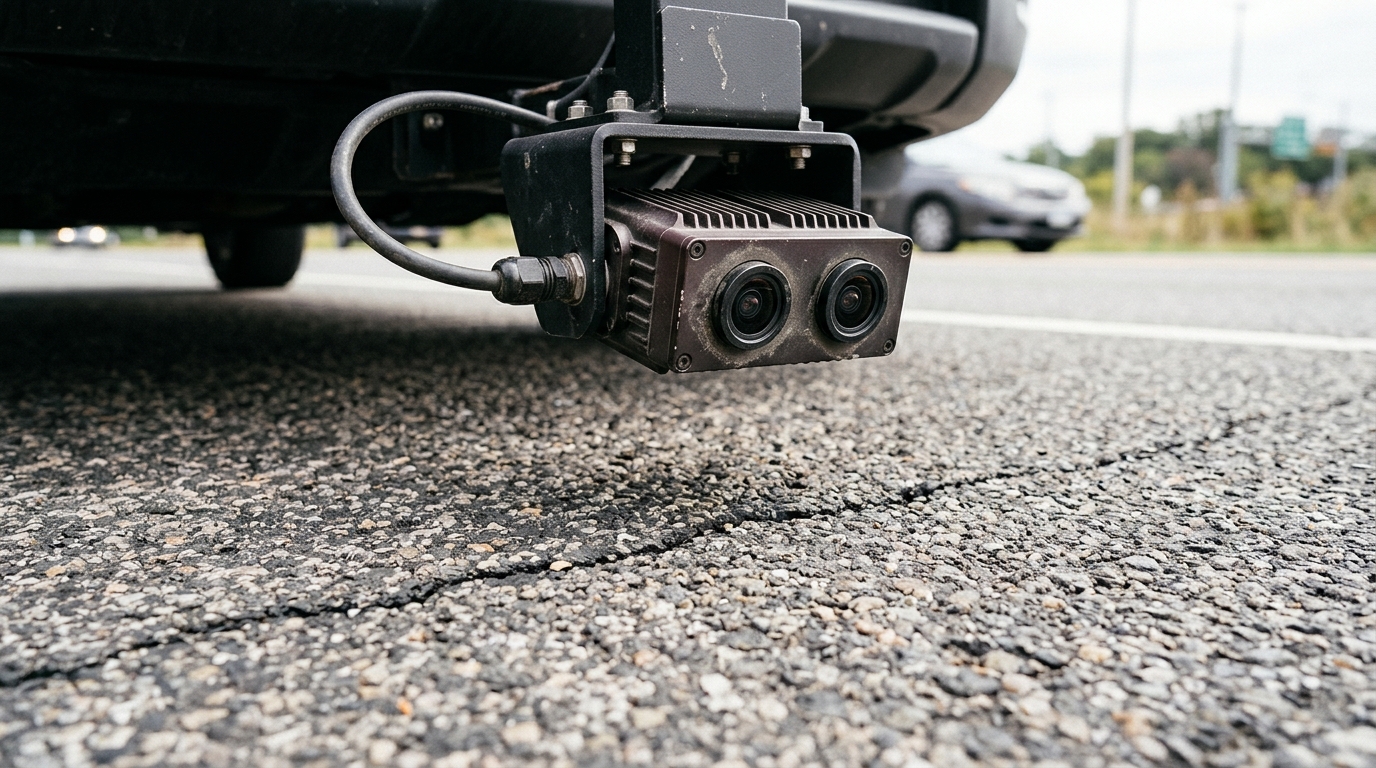
Civil infrastructure engineers and computer vision researchers have developed an edge-oriented, dual-modal detection architecture termed WTC-Net that significantly improves automated road crack identification under challenging real-world lighting conditions while reducing computational overhead. Developed upon the YOLOv11-RGBT framework by researchers Qiule Li, Hao Yang, Xiangyang Xu, and Yunyun Hao, the network integrates a reconstructed lightweight dual-stream backbone, a wavelet-based cross-modal frequency-domain fusion module called WTCFusion, and an offline channel-wise knowledge distillation training scheme. In benchmark evaluations on a public road dataset, the resulting model achieved a mean average precision at an intersection-over-union threshold of 0.50 of 0.6012 and a strict mean average precision across thresholds from 0.50 to 0.95 of 0.3626, outperforming the dual-modal baseline by 2.27 and 0.60 percentage points, respectively. Simultaneously, the framework reduced total network parameters from 14.22 million to 9.05 million and cut computational complexity from 33.3 to 16.9 gigafloating-point operations. Operating on desktop test hardware, WTC-Net reached an inference speed of 152.54 frames per second, demonstrating that targeted structural modeling in the frequency domain can overcome the representational losses typically incurred when compressing deep neural networks for field-ready inspection systems.
The engineering challenge addressed by the study stems from the progressive deterioration of highway pavements under repetitive vehicular loading and environmental weathering. Unchecked surface cracks facilitate rainwater penetration and material loosening, accelerating broader pavement destruction if maintenance crews fail to detect and treat fissures in their early development stages. While traditional manual walking inspections remain common in operational maintenance, they suffer from subjectivity, operational safety hazards, and low scanning efficiency that cannot satisfy large-scale municipal road monitoring demands. Automated optical detection has consequently emerged as a primary alternative, yet standard inspection systems depend almost entirely on single visible-spectrum cameras. Visible imaging offers sharp spatial resolution and fine surface texture, but it remains notoriously vulnerable to non-uniform ambient illumination, tree canopy shadows, vehicular occlusions, pavement staining, and nighttime conditions. Conversely, thermal infrared sensors record radiation differences driven by temperature differentials between crack voids and intact asphalt, maintaining stability across varying lighting conditions. However, thermal images lack fine geometric resolution and spatial boundary sharpness, making standalone infrared crack delineation difficult and motivating hybrid visible-thermal sensing.
To exploit the complementary physical properties of both imaging modalities without incurring excessive computational penalties, the researchers redesigned the underlying feature extraction architecture. In typical dual-stream convolutional networks, running two simultaneous backbone pathways accounts for the vast majority of mathematical operations, presenting an intractable barrier for vehicle-mounted edge processors and mobile inspection rigs. WTC-Net addresses this limitation by deploying MobileNetV4-Small backbones across both the visible and thermal processing branches. Rather than sharing convolutional weights, each modality utilizes an independent MobileNetV4-Small structure, allowing the visible branch to extract color textures while the thermal stream specializes in thermal radiation differentials. The engineering team adapted the architecture for dense target detection by removing the original global average pooling and fully connected classification layers, extracting intermediate multi-scale feature maps designated as P3, P4, and P5 at downsampling factors of 8, 16, and 32 with channel capacities of 64, 96, and 128, respectively. Replacing the original cross-stage partial backbone lowered parameters from 14.22 million to 7.97 million and halved floating-point operations to 15.9 GFLOPs, albeit with a temporary decline in detection accuracy that required dedicated compensation.
To counteract the structural degradation of thin, continuous, and low-contrast fissures caused by aggressive backbone compression, the authors introduced WTCFusion, a cross-modal module that operates directly within the spatial frequency domain. Conventional multimodal approaches typically rely on spatial concatenation, point-wise addition, or spatial attention mechanisms, which treat feature components uniformly and struggle to separate background illumination noise from fine crack contours. WTCFusion explicitly decouples these signals by applying two-dimensional Haar wavelet transforms to matching visible and thermal feature maps across scales P3, P4, and P5. Two-dimensional Haar wavelet decomposition separates incoming feature tensors into low-frequency approximation sub-bands and high-frequency directional sub-bands corresponding to horizontal, vertical, and diagonal spatial gradients. The low-frequency components encapsulate broad scene luminance, macroscopic background variations, and ambient surface temperature trends, whereas high-frequency sub-bands capture sharp structural discontinuities, fine fissure boundaries, bifurcation points, and localized material textures. The authors selected Haar wavelets specifically because their compact filter structure allows rapid forward decomposition and reconstruction without imposing heavy computational loads on resource-constrained embedded computing devices.
Within the decomposed frequency sub-bands, WTCFusion applies differentiated fusion rules designed around sensor physics rather than uniform weighting. Because ambient thermal emissions remain largely unaffected by direct sunlight, cast shadows, or vehicle reflections, the low-frequency fusion branch employs a thermal-guided weighting mechanism that leverages the stable infrared distribution to suppress irregular lighting noise and shadow artifacts present in visible images. In parallel, the high-frequency fusion branch identifies and prioritizes regions exhibiting prominent crack responses, applying cross-modal feature interaction so that visible boundary sharpness reinforces subtle thermal edges and vice versa. An inverse two-dimensional Haar wavelet transform subsequently converts the synthesized frequency sub-bands back into standard spatial-domain feature representations for subsequent processing in the detection neck and head. To provide flexible deployment configurations for hardware with varying processing budgets, the researchers formulated three distinct WTCFusion configurations: a Minimal configuration limited to fundamental sub-band blending, a Lite configuration incorporating cross-modal sub-band interaction, and a Full configuration featuring adaptive frequency enhancement that delivered the highest structural representation fidelity.
The third foundational component of WTC-Net is an offline feature-level knowledge distillation training strategy that enhances student model discriminative power without adding runtime execution overhead. Although WTCFusion substantially restores structural boundary details, the restricted parameter capacity of the lightweight MobileNetV4-Small backbone can still hinder detection of fine and faint fissures under complex backgrounds. To overcome this limitation during training, the authors employed a pre-trained, frozen YOLOv11x-RGBT network as a high-capacity teacher model, feeding identical visible-thermal image pairs to both teacher and student. Instead of enforcing rigid point-wise feature regression that can overconstrain lightweight layers, the framework applies Channel-wise Distillation across the intermediate P3, P4, and P5 representations prior to their entry into WTCFusion. Channel-wise Distillation normalizes the spatial activation maps within each individual feature channel using a Softmax function with temperature scaling, converting spatial feature activations into probability distributions. Kullback-Leibler divergence is then computed between corresponding teacher and student probability distributions, guiding the student network to replicate the channel-wise spatial attention patterns of the larger teacher while discarding the teacher completely prior to deployment.
Rigorous experimental evaluation of the framework was conducted using Python and PyTorch 2.0.1 on a dedicated workstation equipped with an Intel Core i7-11700 central processor, 16 gigabytes of system memory, and an NVIDIA GeForce RTX 3060 graphics card with 12 gigabytes of video memory. Training was standardized across all baseline models using stochastic gradient descent over 300 epochs with an image input resolution of 640 by 640 pixels, a batch size of 16, and an equal 5-to-5 visible-to-thermal input weighting. Before selecting their core architecture, the authors benchmarked six dual-modal object detectors, comparing YOLOv7-RGBT, YOLOv8-RGBT, YOLOv9-RGBT, YOLOv10-RGBT, YOLOv11-RGBT, and YOLOv12-RGBT. YOLOv11-RGBT demonstrated the most practical baseline compromise, delivering 130.39 frames per second with 14.22 million parameters, 33.3 GFLOPs, an mAP@0.5 of 0.5785, and a recall of 0.5631, establishing the foundation for subsequent lightweight optimization.
Validation on a standardized public benchmark dataset released by Liu and colleagues, consisting of 3,027 quality-screened visible-infrared image pairs captured with a FLUKE TiX580 dual-lens thermal imaging camera, highlighted the progressive impact of each architectural modification. Initial single-modality baselines confirmed that multimodal input is essential: visible-only detection yielded an mAP@0.5 of 0.5528, while thermal-only detection achieved 0.3721, compared to 0.5785 for dual-modal visible-infrared input. Transitioning the dual-stream backbone to MobileNetV4-Small decreased parameters to 7.97 million and increased inference speed to 173.64 frames per second, but reduced mAP@0.5 to 0.5487. Integrating the complete WTCFusion module recovered performance, lifting mAP@0.5 to 0.5815 and strict mAP@0.5:0.95 to 0.3513 while maintaining 152.54 frames per second at 16.9 GFLOPs. Introducing offline Channel-wise Distillation from the YOLOv11x-RGBT teacher further elevated the final student network to 0.6012 mAP@0.5, 0.3626 mAP@0.5:0.95, and a precision of 0.6661 with an F1-score of 0.6042. These public benchmark metrics verified that the combined framework surpassed the heavier baseline while consuming roughly half the computational budget.
To evaluate performance under unstructured field conditions, the authors assembled an independent real-scene dataset using Hikvision HM-TP23-10VF/W and UNI-T UTi320E handheld thermal imagers, retaining 1,786 valid image pairs across urban thoroughfares and university campus roads. This self-built dataset presented challenging operational conditions, including severe shadow occlusion, surface wear, oil contamination, pavement aging, and localized puddles. On this dataset, the base dual-modal model recorded an mAP@0.5 of 0.5567, which initially dropped to 0.5263 upon switching to the lightweight MobileNetV4 backbone before rebounding to 0.5482 following the integration of WTCFusion-Full. Applying channel-wise knowledge distillation raised the final mAP@0.5 to 0.5815, surpassing the baseline by 2.48 percentage points and lifting detection precision from 0.5187 to 0.6278. However, the researchers documented notable trade-offs on the self-built imagery: distillation produced a 6.97 percentage point reduction in recall from 0.6083 to 0.5386, alongside a 2.84 percentage point decline in strict mAP@0.5:0.95 from 0.3462 to 0.3178, underscoring that gains in false-positive suppression were accompanied by reduced completeness on faint fissure boundaries.
Practical edge-execution viability was confirmed by compiling the trained PyTorch network into an optimized TensorRT 10.7 engine running in half-precision floating-point format on an embedded NVIDIA Jetson Orin computing platform. Pure model inference on a six-channel 640 by 640 input achieved an average latency of 31.81 milliseconds per frame, corresponding to 31.43 frames per second and demonstrating a 30.23-fold speedup over unoptimized 32-bit floating-point PyTorch execution on the same edge device. However, profiling the complete end-to-end processing pipeline across 304 image pairs revealed that full-system throughput reached 12.60 frames per second with a cumulative latency of 79.35 milliseconds. Dual-modal preprocessing and tensor construction consumed 47.25 milliseconds or 59.54 percent of the processing pipeline, while pure inference represented 40.09 percent and post-processing required 0.29 milliseconds. The authors emphasized that while the neural network achieves real-time execution exceeding 30 frames per second, end-to-end deployment remains constrained by data handling. They noted that the findings reflect single-run evaluations without cross-seasonal transfer testing, establishing that pipeline acceleration and asynchronous memory handling represent critical requirements for mobile roadway inspection platforms.
Subject of Research: Lightweight dual-modal road crack detection network for edge deployment
Article Title: WTC-Net: A lightweight RGB-T road crack detection network with wavelet cross-modal fusion for edge deployment
Article References: Li, Q., Yang, H., Xu, X., & Hao, Y. (2026). WTC-Net: A lightweight RGB-T road crack detection network with wavelet cross-modal fusion for edge deployment. Results in Engineering, 32, Article 113888. https://doi.org/10.1016/j.rineng.2026.113888
Image Credits: AI Generated
DOI: 10.1016/j.rineng.2026.113888
Keywords: road crack detection, RGB-T sensing, wavelet transform, edge computing, deep learning, knowledge distillation, YOLOv11, pavement inspection, WTC-Net, lightweight, RGB-T, road
News Source: Blake Davidson. (November 6, 2026). Dual-Modal Neural Network Accelerates Automated Road Crack Detection for Edge Hardware. Scienmag.