Biphasic cuirass ventilation, a form of negative pressure ventilation delivered through a rigid shell strapped to the chest, has earned a reputation for helping the heart without invading the airway. Now a team at Copenhagen University Hospital has put that reputation to a new test, asking whether the technique also protects the body’s peripheral lymphatic vessels, the tiny pumps that drain fluid from our tissues. The answer, reported in an experimental interventional study of 19 healthy young adults, is a cautious no: during cuirass ventilation, lymphatic contraction frequency and microvascular fluid filtration both stayed essentially unchanged.
The study, published in Physiological Reports, recruited twenty cardio-pulmonary and lymphatically healthy adults aged 18 to 40 with a body mass index of 30 or below, screening out anyone with a history of cancer, heart, lung, lymphatic or venous disease, lymphedema, edema, or previous thoracic surgery. One participant’s data were later discarded because of image quality problems, leaving 19 people with a mean age of 25.5 years, 47 percent of them women. Each volunteer gave written informed consent, and the Scientific Ethics Committees for the Capital Region of Denmark approved the protocol.
The motivation comes from an earlier finding by the same group. During positive pressure ventilation, the standard mode used in operating theatres and intensive care units, raised intrathoracic pressure pushes up both central venous pressure and the pressure inside the thoracic duct, the main vessel that returns lymph to the bloodstream. The team had previously shown that peripheral lymphatic activity drops under positive pressure ventilation in healthy young adults undergoing anesthesia for elective corrective jaw surgery. Since fluid retention and edema are a significant source of morbidity and mortality in ICU patients, the researchers hypothesized that lowering intrathoracic pressure with negative pressure ventilation might do the opposite and improve lymphatic drainage.
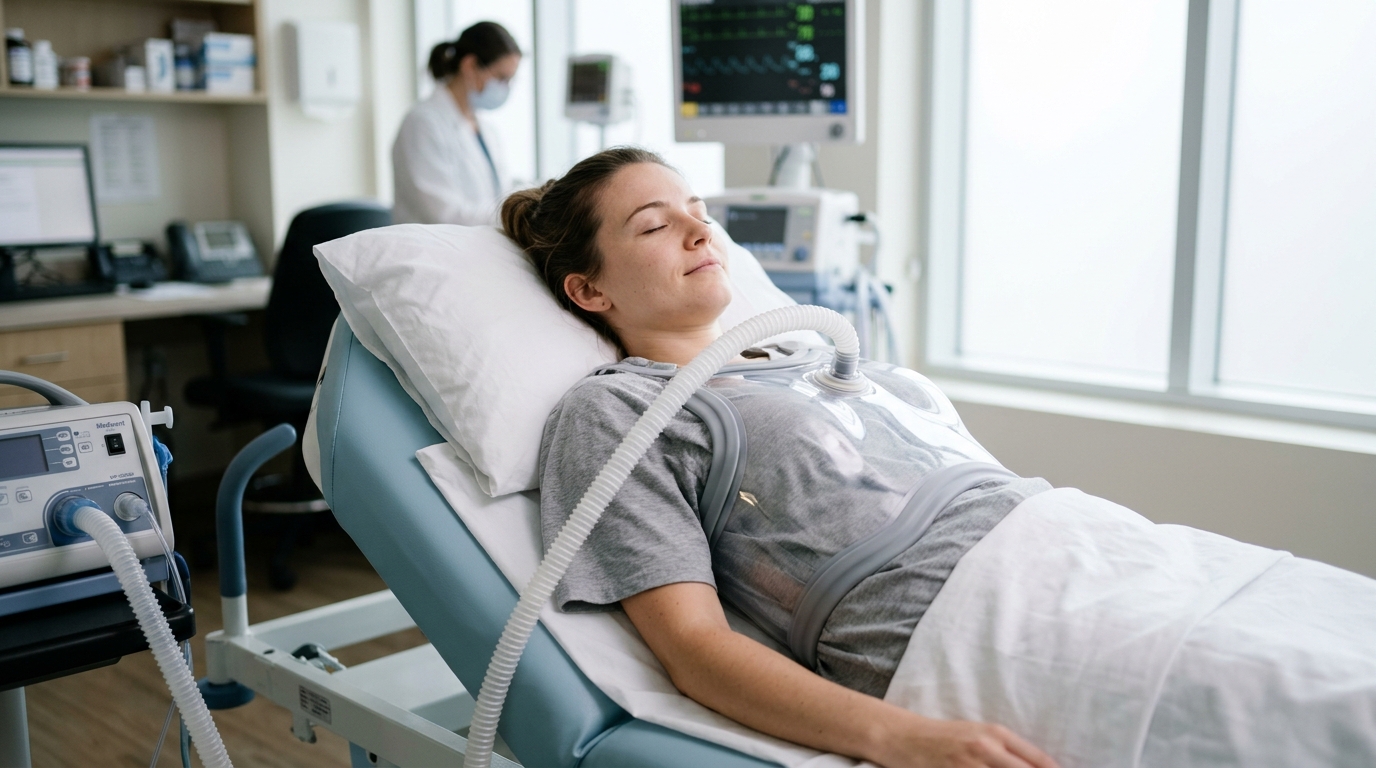
Biphasic cuirass ventilation works by sealing a shell, the cuirass, over the anterior chest and upper abdomen and connecting it to a power unit that actively controls inspiration and expiration by varying the pressure inside the shell. In this study the device ran in control mode with an inspiratory pressure of minus 30 centimeters of water and an expiratory pressure of plus 2 centimeters of water, slightly higher in the first two participants. The inspiration-to-expiration ratio was 1:1 in the first 12 participants and 1:1.5 in the last 8, and the breathing frequency varied between 8 and 14 breaths per minute, adjusted for participant comfort and signs of hyperventilation.
To watch the lymphatics at work, the researchers used near-infrared fluorescence imaging. They injected a small amount of indocyanine green dye intradermally into the first and fourth interdigital spaces of the left foot and behind the medial malleolus, then illuminated the area with a 750-nanometer laser. The dye emits light at 845 nanometers, which a custom camera records, allowing the team to count visible pulsatile movements of lymph packets, defined as contractions, and express them as contractions per minute. On average 3.8 vessels per participant were visible for these measurements.
The results were strikingly flat. Mean contraction frequency was 1.46 per minute at baseline and 1.43 per minute during cuirass ventilation, a difference of just 0.03 contractions per minute with a 95 percent confidence interval spanning minus 0.23 to 0.29 and a p value of 0.81. In other words, the peripheral lymphatic vessels kept pumping at their usual pace while the shell cycled negative and positive pressures around the chest. The researchers had powered the study to detect a 30 percent change in contraction frequency, so this null result carries some statistical weight.
The second part of the experiment added heat as a lymphatic stress test. External heating of the lower limb with a forced-air warming device set at 43 degrees Celsius for 10 minutes was applied first during cuirass ventilation and then again after the shell was removed and a 20-minute acclimatization period had passed. Heating during ventilation slashed contraction frequency to 0.55 per minute, a mean drop of 0.88 contractions per minute compared with ventilation alone, and heating without the shell brought frequency down to 0.33 per minute from a repeated baseline of 1.51. Both comparisons were highly significant, with p values below 0.0001.
That heat result contradicted the team’s own previous work, in which warming had increased lymphatic contraction frequency. The authors point to a key difference in setup: in the earlier studies the leg was placed in heated water in a vertical position, whereas here the leg stayed horizontal while being warmed. Because they have also shown that contraction frequency rises during gravitational stress, most likely due to increased hydrostatic pressure in the veins, the loss of that gravitational component may explain why heat alone suppressed rather than stimulated the vessels this time.
The microvascular side of the story was equally uneventful. Using strain gauge plethysmography, the researchers inflated a cuff on the lower limb in steps from 20 to 80 millimeters of mercury over 20 minutes and tracked the resulting increase in calf volume. The linear rise in volume during steady state reflects continuous extravasation of fluid exceeding lymphatic drainage, and its slope estimates capillary filtration rates. Filtration rates rose physiologically with increasing pressure both at baseline and during ventilation, but did not differ between the two conditions across all seven pressure levels. Isovolumetric pressure, the point at which fluid extravasation and lymphatic drainage are equal, averaged 16.77 millimeters of mercury at baseline and 19.38 during ventilation, a non-significant difference, and the capillary filtration coefficient likewise showed no change.
Why did the negative pressure shell fail to move the lymphatic needle? The authors argue that healthy young adults are already in fluid homeostasis, with no excess interstitial fluid to transport and no elevated afterload for the lymphatic system to drain against, so there was little room for improvement. The technique’s established hemodynamic benefits, primarily an increase in preload that has been demonstrated in both children and adults on the right and left ventricles, may matter most in patients whose central venous pressure is chronically elevated, as suggested by a single case report in which protein-losing enteropathy and plastic bronchitis in a Fontan patient resolved after cuirass ventilation. The study also has limitations: participants were awake and had to synchronize their spontaneous breathing with the ventilator, raising questions about whether negative pressures were fully transmitted to the intrathoracic cavity, although beneficial hemodynamic effects have previously been shown in awake volunteers. Near-infrared imaging sees only superficial lymphatic vessels, leaving deeper vessels undetectable, and a potential change in passive lymph flow driven by cyclical changes in central venous pressure would not have been captured. The authors conclude that future studies of cuirass ventilation during anesthesia are needed to determine whether peripheral lymphatic function can be maintained and post-operative fluid retention and edema avoided in the patients who need it most.
Subject of Research: The effect of biphasic cuirass ventilation on peripheral lymphatic function in healthy young adults
Article Title: The effect of biphasic cuirass ventilation on peripheral lymphatic function in young adults
Article References: Nilsson, C. N., Thorup, L., Kelly, B., Schmidt, J. F., Seltz, M., & Hjortdal, V. (2026). The effect of biphasic cuirass ventilation on peripheral lymphatic function in young adults. Physiological Reports, 14(21), Article e71161. https://doi.org/10.14814/phy2.71161
Image Credits: AI Generated
DOI: 10.14814/phy2.71161
Keywords: biphasic cuirass ventilation, negative pressure ventilation, lymphatic contraction frequency, near-infrared fluorescence imaging, strain gauge plethysmography, capillary filtration rate, central venous pressure, positive pressure ventilation, fluid retention, edema, healthy young adults, Physiological Reports
News Source: Drew Townsend. (November 6, 2026). Chest shell ventilation leaves lymphatic pumping untouched in young adults. Scienmag.