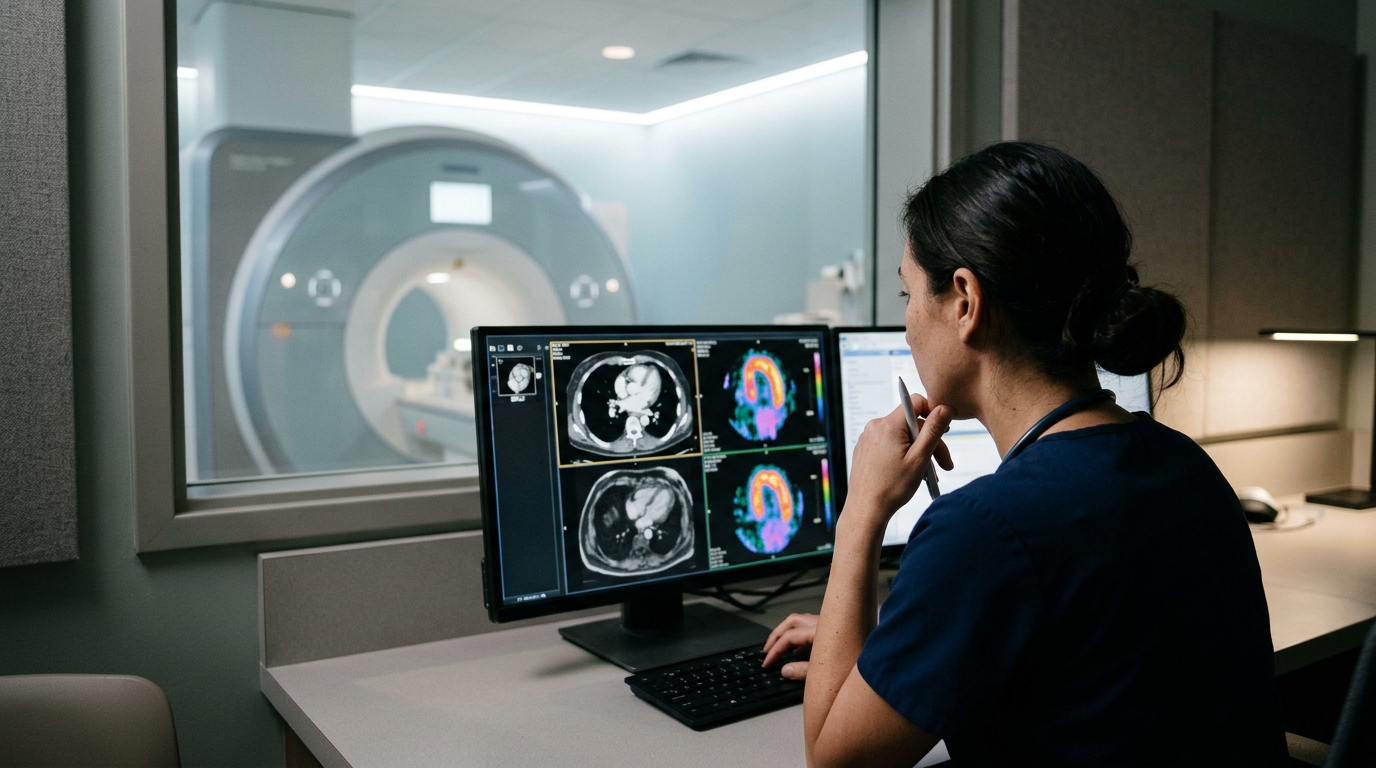
Children with abnormal coronary arteries can look perfectly healthy on a resting electrocardiogram and a standard bedside ultrasound of the heart, yet still carry coronary disease capable of causing myocardial infarction, ventricular dysfunction, or sudden cardiac death. A new narrative review published in the journal Cardiology and Therapy argues that detecting myocardial ischemia in these patients demands a deliberately multimodal imaging strategy, because no single non-invasive test currently offers adequate sensitivity, specificity, and safety across the diverse pediatric conditions that compromise coronary blood flow. The review, led by Justin B. Jin and colleagues including Simon Lee, synthesizes published evidence on stress echocardiography, stress perfusion cardiac magnetic resonance imaging, nuclear perfusion imaging, and coronary computed tomography angiography across four major pediatric populations: Kawasaki disease, anomalous aortic origin of a coronary artery, cardiac allograft vasculopathy after heart transplantation, and children who have undergone coronary reimplantation during congenital heart surgery.
The authors frame the problem around a fundamental mismatch between adult and pediatric coronary disease. In adults, atherosclerotic plaque drives ischemia and symptoms such as chest pain usually prompt evaluation. In children, coronary artery pathology arises from a heterogeneous group of non-atherosclerotic conditions: post-inflammatory vasculopathy following Kawasaki disease, the obliterative arteriopathy of cardiac allograft vasculopathy, congenital anomalies such as anomalous aortic origin of a coronary artery, and complications after coronary reimplantation in operations like the arterial switch procedure. Symptoms in affected children are frequently absent, atypical, or difficult to elicit, and the traditional screening tools of resting electrocardiography and transthoracic echocardiography lack sufficient sensitivity to exclude clinically significant coronary compromise. The review’s methods were qualitative: the authors searched PubMed and Google Scholar, supplemented the search with reference lists and guideline documents, and synthesized original studies, reviews, consensus statements, and society guidelines by disease category and imaging modality, with attention to diagnostic performance, clinical applications, safety, limitations, and evidence gaps.
Stress echocardiography emerges in the review as the most widely available and radiation-free functional option. Exercise stress echocardiography detects inducible regional wall motion abnormalities and provides a more physiologic assessment than pharmacologic stress, but it is generally feasible only in children older than about seven years. A major technical obstacle in pediatric practice is physiological: heart rates in children return to normal rapidly after exercise, which compresses the window for image acquisition and demands short-interval imaging plus specialized expertise that is not a routine part of pediatric cardiology training. For children who cannot exercise, dobutamine stress echocardiography offers an alternative and can even be performed in young children under sedation. In a study of 50 pediatric patients at the convalescent stage of Kawasaki disease, Noto and colleagues reported a strong correlation between stenosis greater than 50 percent in a major coronary branch and corresponding wall motion abnormalities on dobutamine stress echocardiography. Common dobutamine side effects include nausea, headache, anxiety, chest pain, and tachyarrhythmias, though serious complications requiring hospitalization are rare because the drug’s short half-life allows most adverse effects to resolve quickly after test termination.
Stress perfusion cardiac magnetic resonance imaging occupies a growing share of the review’s analysis because it bundles several capabilities into one radiation-free examination. Cardiac magnetic resonance provides comprehensive anatomic, functional, and tissue characterization, and when combined with pharmacologic stress using vasodilators such as adenosine, dipyridamole, or regadenoson, or inotropic agents such as dobutamine, it can detect reversible perfusion defects before wall motion changes develop, consistent with the ischemic cascade. Late gadolinium enhancement identifies fibrosis from prior infarction, adding scar burden to the risk picture. In Kawasaki disease, stress perfusion cardiac magnetic resonance has shown strong concordance with invasive coronary angiography when both are performed, and regadenoson has been demonstrated to be hemodynamically safe and feasible in this population. In anomalous aortic origin of a coronary artery, dobutamine stress cardiac magnetic resonance has gained ground over the past several years: in a study by Doan and colleagues covering 224 examinations in 182 patients with a median age of 14 years, protocols were completed in 98.9 percent of cases with no major adverse events and minor events in only 12.5 percent of patients. Notably, inducible perfusion defects appeared in 14 percent of examinations, but only 42 percent of those patients showed concomitant wall motion abnormalities, underscoring the limited sensitivity of wall motion assessment used in isolation.
Nuclear perfusion imaging, by contrast, is portrayed as a well-established but receding technique. Historically, surveillance strategies for Kawasaki disease relied on nuclear perfusion imaging and serial angiography, and the modality remains effective at quantifying myocardial perfusion. However, the review cites long acquisition times, modest specificity in some populations, false positives particularly among female patients, and cumulative radiation exposure as forces shifting practice toward alternatives. The radiation issue is especially pointed for positron emission tomography in heart transplant recipients: although adult studies show PET detecting cardiac allograft vasculopathy with sensitivities of 81 to 93 percent and a meta-analysis of 12 adult studies reporting 84 percent sensitivity and 90 percent specificity, pediatric data are lacking because radiation doses remain suboptimal for routine surveillance in children. In the post-arterial-switch population, exercise-induced perfusion defects on single-photon emission computed tomography have been reported in roughly 5 to 10 percent of patients, but inconsistent sensitivity and radiation concerns mean nuclear techniques are no longer first-line in many centers.
Coronary computed tomography angiography completes the anatomic half of the review’s integrated model. The modality provides high-resolution characterization of coronary origin, course, and luminal patency, and is described as particularly valuable in congenital coronary anomalies and postsurgical coronary assessment, where knowing whether a coronary artery takes an interarterial or intramural course, has a slit-like ostium, or arises at an acute angle directly informs risk stratification. For anomalous aortic origin of a coronary artery, high-risk anatomic features include an interarterial and intramural course, an acute angle of coronary takeoff, a slit-like ostium, and a high ostial location. The review notes that recognition of congenital coronary anomalies has risen with increased use and improvement of non-invasive cardiac imaging, and that the prevalence of anomalous aortic origin typically ranges from 0.2 to 2 percent in angiographic and computed tomography series.
The disease-specific findings carry their own clinical weight. Kawasaki disease remains the leading cause of acquired heart disease in children in developed countries, present in approximately 0.03 percent of children in the United States, and the coronary artery Z-score during acute illness is the strongest predictor of outcome. Myocardial infarction in Kawasaki disease occurs almost exclusively in patients with large or giant aneurysms, defined as an absolute coronary diameter of at least 8 millimeters or a Z-score of at least 10, and the risk of infarction follows a bimodal distribution with an early peak within months to two years after onset and a second rise in young adulthood. For the highest-risk patients, inducible ischemia testing is recommended every 6 to 12 months. In cardiac allograft vasculopathy, nearly 50 percent of transplant recipients develop the disease by 15 years post-transplant, and it is the most common cause of death beyond 3 years after transplantation; the denervated transplanted heart lacks typical ischemic symptoms, making surveillance especially difficult. Exercise stress echocardiography in 95 pediatric transplant recipients showed that a positive study was associated with significantly increased risk of cardiovascular events and mortality, while a negative study predicted excellent event-free survival at 3 years.
The post-surgical chapters add nuance about who actually needs testing. Coronary obstruction after the arterial switch operation occurs in approximately 5 to 7 percent of survivors and remains the leading cause of ASO-related morbidity and mortality, with ischemic events clustering early after repair in childhood, while late coronary events in adults are uncommon. Current evidence, the review states, does not support routine serial coronary-specific imaging in all asymptomatic post-switch patients, though targeted anatomic surveillance may be reasonable when high-risk coronary features are present. A study of 37 asymptomatic patients by Tsuda and colleagues found that neither exercise stress testing nor myocardial perfusion imaging reliably identified moderate or severe angiographically defined coronary abnormalities, including one patient who subsequently experienced exercise-induced cardiac arrest. After the Ross procedure, literature on routine ischemic surveillance is sparse; in the most relevant study, coronary flow reserve was normal in all nine adolescents studied after Ross, whereas approximately 24 percent of arterial switch patients showed impaired flow reserve and stress-induced perfusion abnormalities despite normal angiography. After repair of anomalous left coronary artery from the pulmonary artery, no consensus guidelines define optimal surveillance timing or modality, though prior ACC/AHA guidance recommended surveillance echocardiography with non-invasive provocative testing every 3 to 6 years.
The review’s conclusions are candid about the limits of the evidence base. Despite advances in multimodality imaging, pediatric-specific data remain limited, and many diagnostic thresholds are extrapolated from adult populations. Much current practice rests on single-center experiences, small observational studies, and adult-derived norms; the diagnostic accuracy, prognostic significance, and optimal surveillance intervals of many non-invasive modalities remain incompletely defined in children. Emerging technologies may help close the gap: computational fluid dynamics modeling can characterize flow patterns related to aneurysm morphology, and CT-derived fractional flow reserve has shown feasibility in pediatric heart transplant patients, with all patients having moderate or severe cardiac allograft vasculopathy recording a value of 0.8 or less, though the computational algorithms underlying that technique are built on adult atherosclerosis data and may not be valid for other forms of pediatric coronary insufficiency. The authors call for multicenter longitudinal studies to refine risk stratification and establish evidence-based surveillance strategies, framing the ultimate goal not as detection of advanced disease but as timely identification of hemodynamically significant coronary compromise before irreversible myocardial injury occurs.
Subject of Research: Multimodality non-invasive cardiac imaging for detecting myocardial ischemia in children with acquired and congenital coronary artery disease
Article Title: Advanced Cardiac Imaging Techniques for Detection of Myocardial Ischemia in Children with Coronary Artery Abnormalities
Article References: Jin, J. B., Williams, J. L., Wang, S. M., & Lee, S. (2026). Advanced Cardiac Imaging Techniques for Detection of Myocardial Ischemia in Children with Coronary Artery Abnormalities. Cardiology and Therapy, 15(3), 439-462. https://doi.org/10.1007/s40119-026-00469-1
Image Credits: AI Generated
DOI: 10.1007/s40119-026-00469-1
Keywords: myocardial ischemia, pediatric cardiology, Kawasaki disease, coronary artery anomalies, stress echocardiography, cardiac magnetic resonance, nuclear perfusion imaging, coronary CT angiography, cardiac allograft vasculopathy, arterial switch operation, coronary reimplantation, risk stratification
News Source: Ophelia Keating. (November 6, 2026). Multimodality Cardiac Imaging Maps Hidden Ischemia in Children with Coronary Artery Abnormalities. Scienmag.