Researchers evaluated calbindin protein levels across tissue microarrays from one hundred forty-seven patients alongside parallel transcriptomic, copy-number, and methylomic profiling of an independent cohort of one hundred ten primary meningiomas. Across clinical models adjusting for established patient and tumor characteristics, high calbindin immunoreactivity was significantly associated with shortened progression-free survival, retaining its adverse prognostic association even when analyses were restricted specifically to World Health Organization grade 2 meningiomas. At the genomic and transcriptomic level, elevated CALB1 messenger RNA abundance tracked closely with recurrent deletions of chromosome arm 6q and localized epigenetic hypomethylation at specific intronic and exonic gene loci, uncovering biological mechanisms that distinguish aggressive meningioma subsets.
Meningiomas represent the most prevalent primary neoplasms affecting the central nervous system, originating from arachnoid cap cells situated throughout the leptomeninges. Although the majority of these tumors behave as clinically indolent neoplasms that yield favorable long-term outcomes following surgical resection, a significant fraction displays aggressive local recurrence, brain invasion, or early therapeutic resistance. The World Health Organization central nervous system tumor classification defines three histological grades based on mitotic thresholds, histopathological subtypes, and overt tissue invasion, yet morphological assessment alone frequently leaves clinical behavior unpredictable. Contemporary consensus updates, including cIMPACT-NOW update 8 guidelines, have progressively incorporated molecular criteria, assigning grade 2 status to morphologically low-grade tumors that harbor combined losses of chromosome arms 1p and 22q or neurofibromin 2 alterations. Furthermore, concurrent losses of chromosome arms 6q and 14q, alongside global DNA methylation classifiers, have emerged as strong markers of therapeutic failure, although the downstream transcriptional programs that drive these high-risk alterations have remained poorly characterized.
Calbindin D28K belongs to the EF-hand family of calcium-binding proteins, fulfilling physiological buffering and calcium-sensing roles that are typically restricted in human tissues to cerebellar Purkinje cells, specialized neuronal subpopulations, and distal renal tubular epithelia. Experimental studies across non-meningeal cell models have demonstrated that calbindin exerts notable cytoprotective and anti-apoptotic functions, notably by inhibiting caspase-3 enzymatic activation, facilitating bypass of cellular senescence pathways, and modulating cellular proliferative capacity. Prior unbiased transcriptomic investigations of meningiomas had identified CALB1 upregulation as part of an aggressive, therapy-resistant stemness signature in primary cell cultures that exhibited reduced nuclear caspase-3 immunoreactivity. However, earlier immunohistochemical evaluations in small clinical series failed to detect the protein, creating an unresolved discrepancy regarding whether calbindin is authentically expressed, epigenetically regulated, or clinically informative within human meningiomas.
Histopathological specimens were reviewed by experienced neuropathologists and classified according to 2016 World Health Organization criteria, encompassing one hundred thirty-three primary meningiomas and fourteen non-corresponding recurrent tumors, predominantly weighted toward clinically aggressive and high-grade presentations. For normal baseline anatomical comparisons, thirteen irreversibly anonymized meningeal tissue samples obtained from routine autopsies were included as non-neoplastic controls. Following the exclusion of a single case due to technical constraints and the confirmation of tumor cell purity exceeding ninety percent via routine histology, one hundred thirty-two primary meningioma samples yielded fully evaluable immunohistochemical staining for quantitative evaluation.
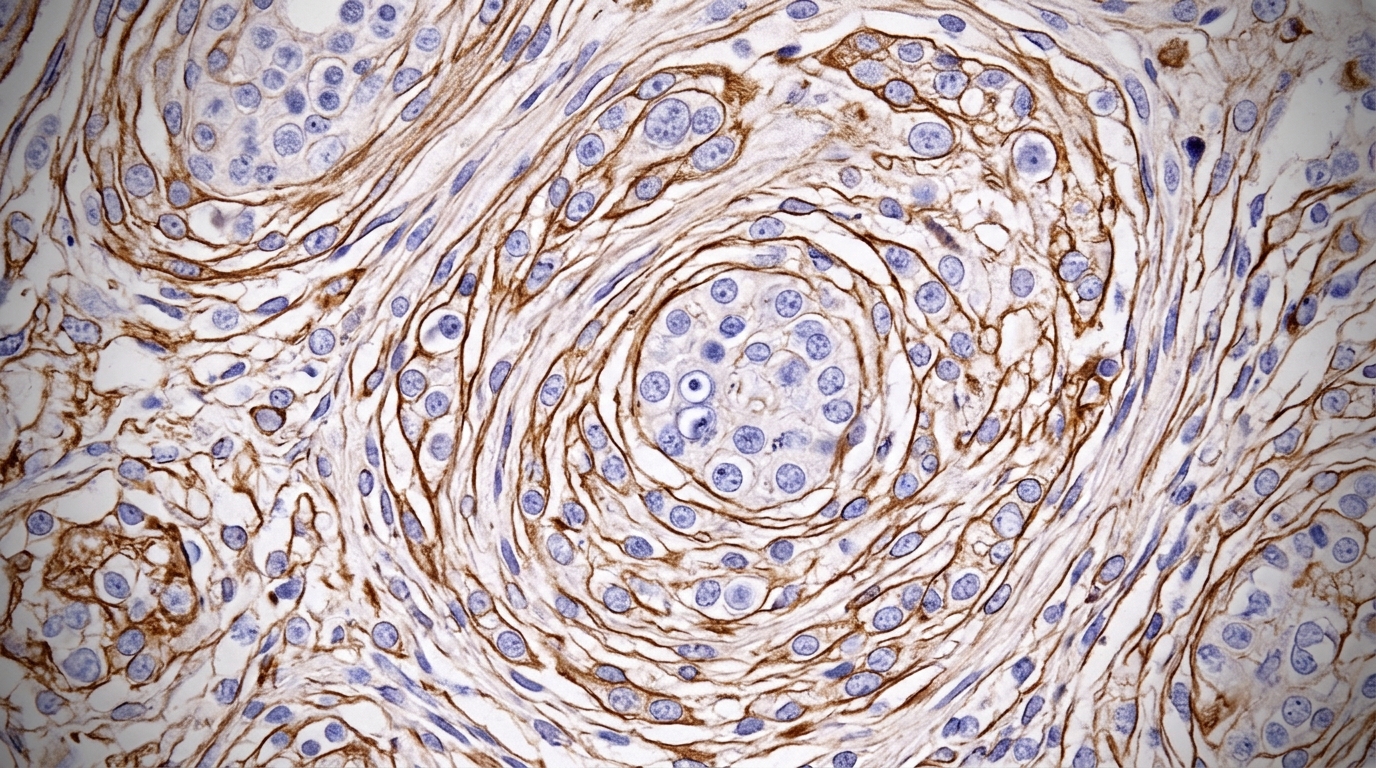
Whole-slide Aperio digital scanning coupled with semi-automated cellular classification within QuPath software established objective, area-adjusted H-scores across cytoplasmic and nuclear cellular compartments. Tumors were systematically categorized as negative, weak, intermediate, or strong, with the latter two groups merged to define a high-expression threshold. Overall, calbindin immunoreactivity was confirmed in 28.8 percent of primary tumors, with 18.2 percent falling into the calbindin-high category. Intratumoral staining presented primarily as a diffuse, continuous pattern across broad sheets of neoplastic cells displaying concurrent nuclear and cytoplasmic signals, whereas low-expression specimens presented only focal cellular clusters or isolated cells. By contrast, normal autopsy-derived meningeal controls demonstrated complete absence of calbindin staining in nine of thirteen specimens, while the remaining four showed only weak staining confined to basal arachnoid cell layers.
To investigate genomic and transcriptomic correlates without confounding clinical variables, the team analyzed an independent molecular cohort comprising one hundred ten publicly available primary meningioma datasets containing matched RNA sequencing, copy-number profiling, and DNA methylation array data. Calbindin transcript abundance was normalized using trimmed mean of M-values algorithms, and secondary cohort specimens were classified into expression categories calibrated against two non-neoplastic arachnoid granulation cell reference samples. Remarkably, the transcriptomic cohort mirrored the protein cohort closely: 7.3 percent of tumors demonstrated weak transcript elevation, while 19.1 percent displayed intermediate or strong expression, producing an aggregate elevated expression frequency of 26.4 percent. Modified integrated molecular grading, synthesizing copy-number profiles with TERT promoter and NF2 mutation status, classified seventy-two secondary tumors as grade 1, twenty-five as grade 2, and three as grade 3, establishing a robust genomic testing ground for subsequent clinical and molecular regression models.
Survival analyses conducted on the primary clinical cohort demonstrated that calbindin protein elevation represents an independent indicator of early tumor relapse. In univariable Cox proportional hazards modeling, high calbindin expression, subtotal surgical resection, and World Health Organization grade 3 histology were significantly associated with shorter progression-free survival, whereas patient age, patient sex, anatomical tumor location, and time-dependent radiotherapy status were not. Upon multivariable adjustment incorporating patient age, sex, primary versus recurrent disease status, surgical resection extent, and tumor grade, high calbindin expression remained an independent predictor of recurrence, yielding an adjusted hazard ratio of 2.62 with a 95 percent confidence interval of 1.21 to 5.69. Crucially, this adverse association remained pronounced in focused survival analyses restricted exclusively to primary, gross-totally resected, non-irradiated histological grade 2 tumors, as well as when restricted to grade 2 tumors defined solely by elevated mitotic counts.
When examining conventional histopathological parameters, the researchers found that calbindin expression operated independently of standard proliferation metrics in both cohorts. Univariable assessments indicated no significant differences in calbindin positivity based on patient sex, with positive staining detected in 30.7 percent of female and 26.4 percent of male patients in the primary cohort, or patient age, which presented median values of 60.5 years in high-expressing versus 57 years in low-expressing cases. Similarly, mitotic counts and Ki-67 proliferation indices failed to segregate according to calbindin status, displaying comparable proportions of positive cases across low, intermediate, and high mitotic categories. Histological subtype comparisons revealed that chordoid meningiomas, an uncommon World Health Organization grade 2 variant, exhibited significantly higher calbindin H-scores than conventional atypical meningiomas in both pairwise and multivariable linear evaluations. However, sensitivity models excluding chordoid and clear cell morphologies confirmed that calbindin’s prognostic detriment was not merely driven by this specialized morphological subtype.
Investigation of DNA methylation profiles across seven shared CpG probes within the CALB1 locus revealed that transcriptional activation is directly coupled with epigenetic remodeling. In comparison to heavily methylated, non-expressing human lung tissue references, meningiomas and normal central nervous system controls demonstrated relative baseline hypomethylation across the gene locus. More specifically, three individual CpG sites located within the first exon and first intron—designated cg26290632, cg12402251, and cg18335796—demonstrated statistically significant relative hypomethylation in calbindin-positive meningiomas compared with negative tumors, with cg18335796 exhibiting the most profound loss of methylation. In multivariable linear models incorporating sequencing batch and clinical covariates, composite hypomethylation across these three specific sites correlated strongly with elevated CALB1 transcript abundance. Furthermore, global methylation subclass profiling linked higher CALB1 expression to the benign 3 subclass, whereas the intermediate B subclass was characterized by significantly suppressed gene expression.
Chromosomal copy-number evaluations revealed an association between CALB1 deregulation and recurrent arm-level losses of chromosome 6q, which were detected in eleven of the one hundred ten molecular cohort tumors. Within the high-risk subgroup defined by concurrent deletions of chromosome arms 1p and 22q, CALB1 emerged as the most strongly upregulated transcript and exhibited the lowest false-discovery-rate adjusted p-value among all upregulated genes when an additional 6q deletion was present. In multivariable chromosome-focused regression models adjusting for copy-number changes across 1p, 1q, chromosome 10, 14q, chromosome 18, and 22q, chromosome arm 6q loss retained an independent positive association with CALB1 transcript levels, which was corroborated in an integrated clinical-molecular model.
To evaluate whether calbindin elevation reflects a broader, non-specific expression of related calcium-buffering proteins or hormonal differentiation markers, the investigators examined calretinin and progesterone receptor levels. Nuclear progesterone receptor expression was detected in 48.1 percent of primary tumors and displayed strong inverse correlations with patient age, mitotic count, and tumor grade, reaching highest levels in chordoid cases. Nevertheless, progesterone receptor status failed to predict progression-free survival in gross-totally resected grade 2 meningiomas. Similarly, transcript analyses of estrogen receptor genes located on chromosome arms 6q (ESR1) and 14q (ESR2) revealed reduced ESR2 in 6q and 14q losses, but neither estrogen receptor transcript correlated significantly with CALB1 expression levels.
The study authors emphasize several methodological limitations that warrant careful consideration prior to translational adoption. The primary and secondary cohorts were strictly complementary rather than identical, meaning that calbindin protein staining and molecular copy-number analyses were conducted on separate clinical patient series, preventing direct, single-sample tripartite concordance verification between 6q deletions and protein abundance. Additionally, tissue microarray evaluation entails intrinsic vulnerability to intratumoral heterogeneity, and the secondary molecular cohort featured only seventeen clinical progression events, which precluded comprehensive multivariable survival modeling and introduced risk of statistical overfitting. Consequently, whether calbindin acts as an active functional driver of therapeutic resistance through apoptotic inhibition or serves merely as a passive downstream biomarker of 6q-associated genomic instability remains unresolved. Nevertheless, the reproducible detection of calbindin immunohistochemistry offers a candidate prognostic adjunct for refining risk stratification in histological grade 2 meningiomas before resorting to comprehensive molecular sequencing.
Subject of Research: Calbindin D28K expression, clinical prognosis, and molecular alterations in meningioma
Article Title: CALB1 expression in meningioma: associations with progression-free survival and chromosome arm 6q loss
Article References: Friedrich, L. S., Liesche-Starnecker, F., Sievers, P., Ertelt-Delbridge, C., Weber, K. J., Schrimpf, D., Pfarr, N., Harter, P. N., Schlegel, J., & Meyer, M. (2026). CALB1 expression in meningioma: associations with progression-free survival and chromosome arm 6q loss. Acta Neuropathologica, 152(1), Article 66. https://doi.org/10.1007/s00401-026-03113-3
Image Credits: AI Generated
DOI: 10.1007/s00401-026-03113-3
Keywords: meningioma, calbindin D28K, CALB1, progression-free survival, chromosome 6q loss, DNA methylation, neuropathology, biomarkers, expression, associations, progression-free, survival
News Source: Ophelia Keating. (November 6, 2026). Calbindin Expression Links to Shorter Meningioma Remission and Chromosome 6q Loss. Scienmag.