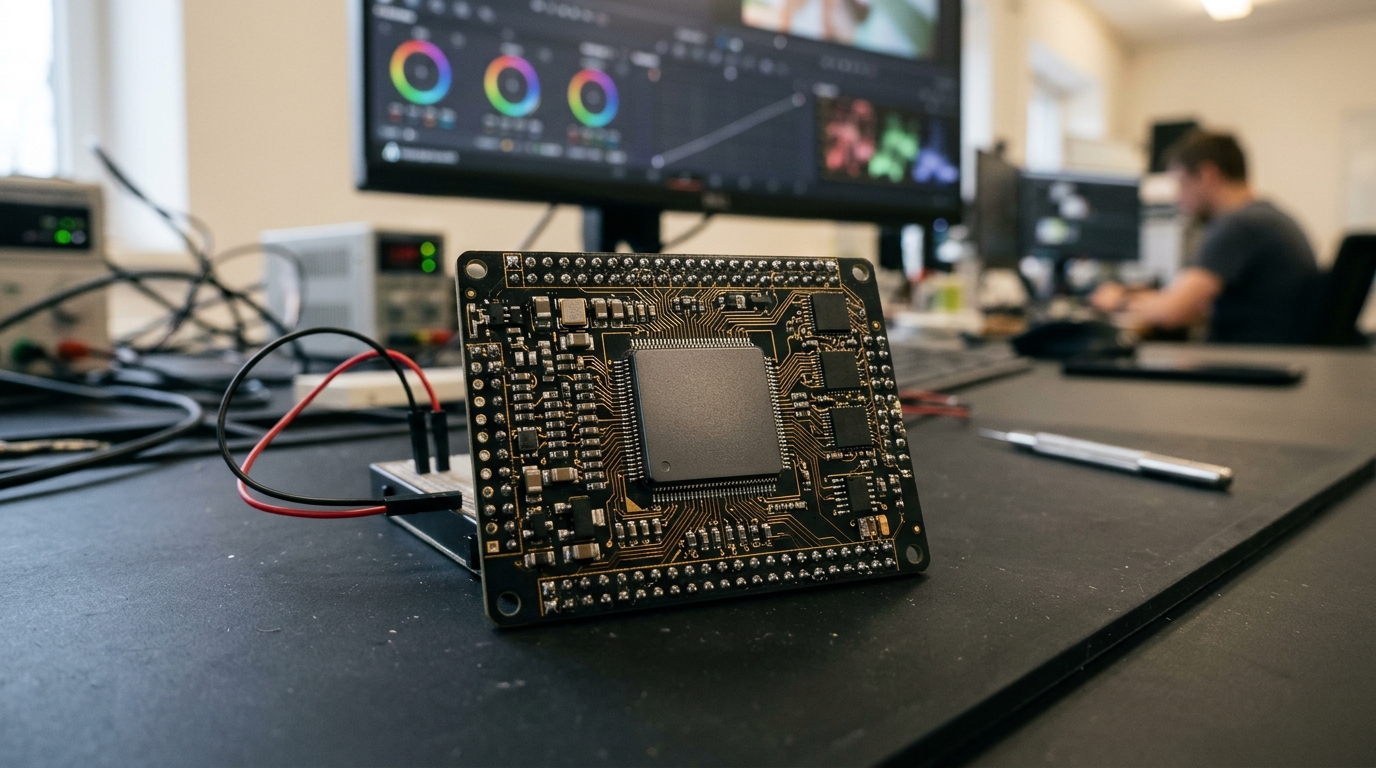
Researchers have developed and evaluated NVCR, an extensible C++20 native runtime engineered to transition learned neural video compression models from isolated experimental frameworks into operational execution pipelines. Reporting in SoftwareX, an engineering team documented the architecture and performance of NVCR version 1.0.8, focusing on its initial production integration with the Deep Contextual Video Compression Real-Time (DCVC-RT) model using TensorRT half-precision arithmetic. Across controlled benchmarks comparing the native runtime directly against an end-to-end Python and PyTorch FP16 reference implementation, the native runtime achieved higher mean process-level throughput for both encoding and decoding across all tested conditions on an NVIDIA GeForce RTX 4070 desktop and a Jetson Orin Nano Super embedded kit. Across six distinct input video resolutions, the software delivered pooled process throughput speedups ranging from 1.96 to 3.05 for encoding on the desktop system and 1.51 to 3.50 on the embedded module, while substantially decreasing peak host memory.
The development of NVCR addresses a persistent systems bottleneck in neural media processing: while deep contextual algorithms achieve competitive rate–distortion performance by modeling learned conditional distributions, temporal context modulation, and reference hierarchies, translating these models into usable software requires extensive infrastructure beyond individual tensor computations. Existing systems highlighted by the authors serve distinct functional domains: research toolkits like CompressAI and OpenDCVCs focus on training and evaluating model variants, general-purpose runtimes like ONNX Runtime, TensorRT, and OpenVINO handle graph optimization and persistent execution states, and established multimedia frameworks including FFmpeg’s libavcodec and GStreamer manage packet lifecycles and buffering. Rather than reinventing low-level inference kernels or codec-specific mathematical transformations, NVCR establishes a unified native bridge between these domains. By placing temporal semantics, state management, and prediction-group decisions behind a modular codec adapter, the runtime isolates model-specific nuances from hardware execution providers, allowing system integrators to manage stateful neural video streaming without exposing underlying framework bindings to external client applications.
At the foundation of NVCR’s software architecture lies an explicit separation between system construction and active media processing operations. Codec initialization begins with a structured RuntimeConfig object that defines the target codec, execution provider, and hardware profile without exposing proprietary initialization routines. Within this design, a static registry supplies factory instances while an artifact resolver verifies target hardware compatibility before passing validated resources to the codec adapter through a shared RuntimeServices interface. Media sessions expose standardized send and receive operations alongside explicit flush and reset methods. In this framework, the encoder accepts planar video frames and emits serialized access-unit packets, returning a try-again status when intermediate neural buffers require additional inputs and signaling end-of-stream only after flushing pipelines. Thread safety is enforced through per-instance mutual exclusion locks covering all session invocations. However, concurrent execution across independent graphics processing unit sessions remains unvalidated, and explicit state resets, while restoring intra-frame baselines, cannot guarantee recovery from underlying physical device faults.
To prevent runtime instability and eliminate heavy development dependencies in production environments, NVCR strictly decouples graph compilation from runtime execution. Offline preparation workflows verify pinned source code and checkpoint cryptographic hashes, export Open Neural Network Exchange graphs and entropy assets, and generate target-specific TensorRT half-precision execution plans. Comprehensive engine records document target operating systems, system architectures, compute capabilities, software toolchain versions, file digests, and provenance metadata. During session startup, the artifact resolver parses these records against detected system capabilities, applying strict ranking rules that prioritize exact target matches before permitting fallback to matching compute capabilities or validated desktop architectures. Jetson embedded targets enforce an exact-match-only policy. The runtime strictly rejects missing targets, altered cryptographic digests, incompatible interface versions, and restricted assets at initialization, preventing implicit engine recompilations or silent fallback to incompatible profiles. Consequently, deployed NVCR instances execute exclusively using validated TensorRT plans, completely eliminating the necessity to load Python interpreters, PyTorch checkpoints, or raw graph descriptions during active video encoding and decoding sessions.
Bitstream encapsulation and memory safety are governed by the native video access unit envelope, designated as NVAU, which establishes clear boundaries between encoded payloads, presentation timestamps, and application metadata. The runtime implements a default version-1 envelope featuring a 32-byte fixed header followed by a public model identifier and a single bounded codec payload, guaranteeing structural stability across evaluated production deployments. An experimental version-2 format introduces a 64-byte header supporting structured profiles, presentation order flags, dependency tracking, pixel format definitions, and typed payload sections. For standalone operational execution and archival verification, the accompanying command-line tool packs these records into length-delimited sequence files using little-endian byte ordering. Before dispatching any serialized buffer to the underlying neural execution backend, the internal parser rigorously verifies declared identifier bounds, spatial dimensions, dependency counters, and total buffer sizes. Any structural defect, including unrecognized flags, truncation, buffer overflow, unknown mandatory sections, or trailing bytes, triggers an immediate structured error, protecting host execution stability against corrupt data.
To rigorously evaluate the system, the researchers conducted extensive controlled experiments evaluating complete NVCR and Python implementations across diverse compute environments. Controlled primary benchmarking compared native NVCR against a Python and PyTorch FP16 baseline across an NVIDIA GeForce RTX 4070 desktop running Ubuntu 24.04 and an NVIDIA Jetson Orin Nano Super developer kit running Ubuntu 22.04 with Linux for Tegra 36.4.7. The experimental matrix spanned 72 distinct operational conditions per platform, incorporating six input configurations derived from standardized Xiph/Derf and High Efficiency Video Coding Class B sequences ranging from 176×144 to 1920×1080. Each resolution condition was evaluated across four quantization parameters (0, 21, 42, and 63) and three group-of-pictures lengths (1, 30, and 100) with a 64-frame reference-reset interval. Every operational condition was measured across ten independent fresh-process executions for encoding and decoding. To reflect real-world pipeline costs, the primary metric was defined as effective process throughput, calculating processed frames divided by total job wall-clock time, including launch, resource initialization, model loading, file input and output, and ten warm-up frames.
Rate–distortion verification confirmed that NVCR’s native runtime infrastructure successfully replicates the compression fidelity of the original framework while maintaining strict bitstream accountability. Using a unified common output evaluator on planar 8-bit YUV 4:2:0 reconstructions, weighted YUV peak signal-to-noise ratio differences between NVCR and Python ranged from −0.119 to +0.084 decibels on the desktop RTX 4070, and between −0.129 to +0.127 decibels on the embedded Jetson Orin. Across all evaluated input sequences, resolutions, and group-of-pictures configurations, calculated Bjøntegaard delta-rate metrics ranged from −0.03% to +3.70% on the desktop system and from +0.22% to +4.06% on the embedded platform, with the FourPeople 720p sequence demonstrating the widest divergence. Detailed accounting revealed that serialized NVCR video outputs introduce an envelope overhead of 9208 bytes across each 100-frame sequence, translating to 92.08 bytes per frame. This structural framing adds approximately 0.0291 bits per pixel at 176×144 resolution and diminishes to 0.000355 bits per pixel at 1920×1080 resolution, demonstrating how fixed sequence framing naturally amortizes over larger frame dimensions.
Execution speed benchmarks highlighted substantial throughput advantages for the native implementation across all evaluated hardware configurations. When pooling 12,000 measured frames across resolutions, quantizers, group-of-pictures settings, and independent repetitions, the desktop platform yielded pooled speedup ratios of 1.96 to 3.05 for encoding and 1.37 to 3.01 for decoding. On the embedded Jetson Orin platform, pooled throughput ratios ranged from 1.51 to 3.50 for encoding and 1.27 to 3.21 for decoding. Repetition statistics demonstrated consistent execution stability, with within-condition coefficients of variation ranging from 0.12% to 4.66% on the desktop system and from 0.18% to 3.07% on the embedded developer board across all tested configurations.
In addition to accelerated process throughput, NVCR demonstrated marked improvements in host system memory efficiency across both operational environments. Memory measurements captured high-water resident set sizes across separate sets of ten fresh process runs per condition using operating system tracking, measuring total host process footprint from launch through completion. On the desktop RTX 4070 platform, NVCR recorded mean peak host resident set sizes between 460.9 and 547.1 megabytes for encoding and 463.0 to 556.4 megabytes for decoding, achieving condition-matched memory reductions of 56.8% to 64.2% for encoding and 55.6% to 63.9% for decoding compared to Python’s gigabyte-scale footprint. On the memory-constrained Jetson Orin developer kit, NVCR’s peak host memory ranged between 1004.3 and 1090.0 megabytes for encoding and 996.9 to 1108.9 megabytes for decoding, delivering reductions of 24.2% to 41.2% and 22.5% to 36.9% respectively. The authors caution that these host-level metrics reflect operating system resident memory rather than dedicated graphics memory allocations, but they clearly demonstrate the elimination of bulky runtime frameworks from the host memory space.
To verify broader portability across diverse computing hardware, the researchers conducted additional validation campaigns on NVIDIA GeForce RTX 3050 and RTX 5060 laptop systems operating via containerized Linux environments under Docker Desktop and Windows Subsystem for Linux. Both laptop configurations successfully executed the unified command-line workflow across resolutions from 144p to 1080p without altering public runtime contracts or engine resolution mechanisms. Despite these validated capabilities, the authors documented clear architectural boundaries and areas for ongoing development. Present verification remains restricted to DCVC-RT running under TensorRT half-precision acceleration on NVIDIA architectures, while central processing unit neural inference, non-NVIDIA accelerators, and native Windows or macOS environments remain unsupported. Furthermore, standard container formats such as MP4 and Matroska, multimedia framework integration with FFmpeg or GStreamer, audio and subtitle multiplexing, and long-running streaming stability require future implementation. The complete software release, accompanying validation test suites, and reproducible measurement records have been archived publicly under open-source terms to support ongoing research into standardized neural video codec deployment.
Subject of Research: Native runtime architecture and deployment benchmarking for neural video codecs
Article Title: NVCR: An extensible native runtime for deploying neural video codecs
Article References: El Ghati, O., Alaoui-Fdili, O., Elghati, H., Alioua, N., & Bouarifi, W. (2026). NVCR: An extensible native runtime for deploying neural video codecs. SoftwareX, 36, Article 103174. https://doi.org/10.1016/j.softx.2026.103174
Image Credits: AI Generated
DOI: 10.1016/j.softx.2026.103174
Keywords: Neural Video Compression, NVCR, DCVC-RT, TensorRT, Video Coding, Embedded Systems, Process Throughput, Memory Optimization, extensible, native, runtime, deploying
News Source: Cassandra Pierce. (November 6, 2026). Native Runtime Accelerates Neural Video Codec Deployment Across Desktop and Embedded Platforms. Scienmag.