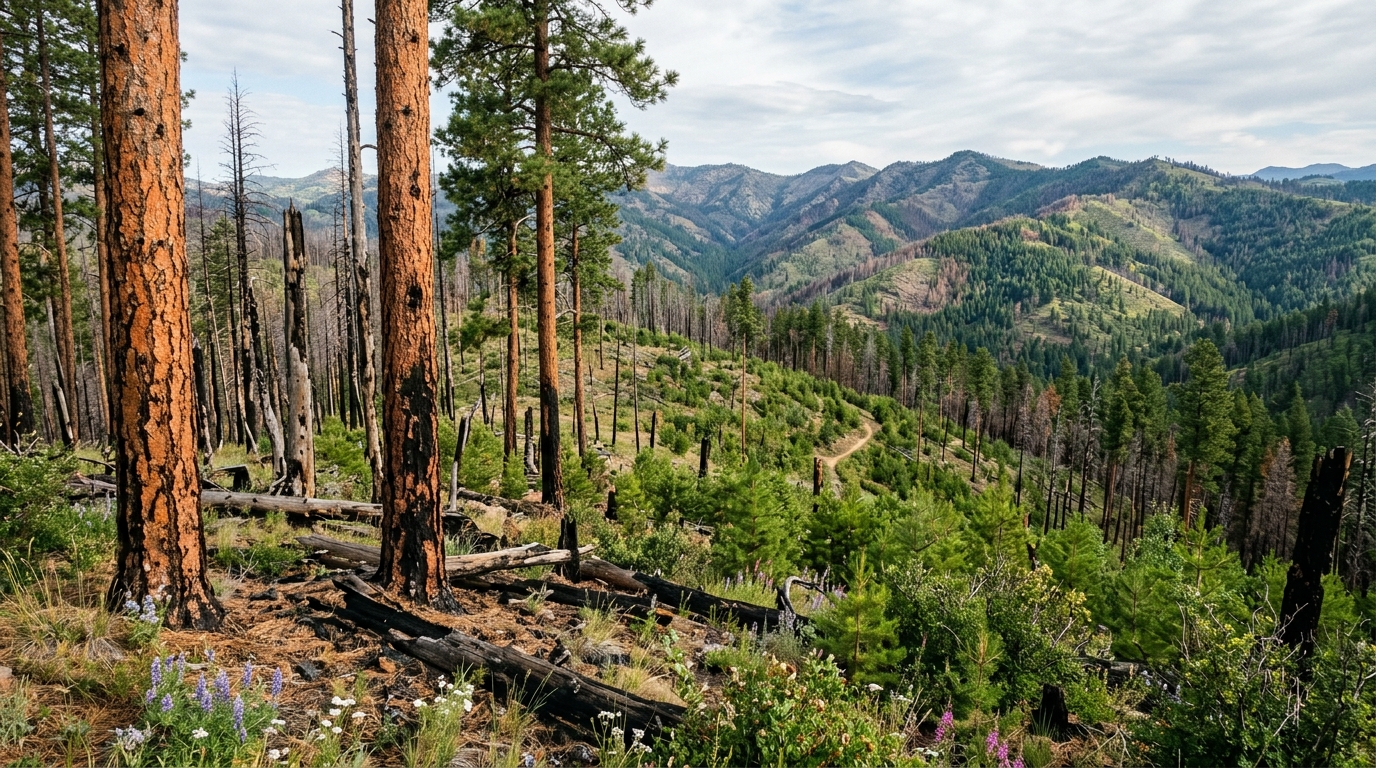
In temperate dry forests of southeastern Australia, recurrent fires occurring at shortened intervals can alter vegetation assemblages beyond their ecological tolerance, driving transitions from tall eucalypt forest to dense alternative states characterized by low, closed canopies. A study led by Aaron E. Heap and colleagues examined how these disturbance-driven structural transformations reshape forest fuel profiles, surface fuel flammability, and modelled fire behavior. Published in the journal Fire Ecology, the investigation focused on dry fire-tolerant native forests within Wilsons Promontory National Park in Victoria, where overlapping fires in the mid-twentieth century eliminated the mature tree overstorey across hundreds of hectares. By integrating standardized field fuel measurements, laboratory flammability testing, and computational fire behavior simulations across multiple weather scenarios, the researchers evaluated whether the physical reorganization of plant communities modifies subsequent fire dynamics in ways that could create long-term vegetation-fire feedbacks.
Forest ecosystems dominated by resprouting eucalypts typically rely on disturbance to stimulate seed release, germination, and vegetative recovery, traits that historically allowed communities to re-establish pre-fire compositions following burning. At Wilsons Promontory National Park, patches of fire-tolerant Shrubby Foothill Forest that were subjected to short-interval wildfires and escaped burns between 1939 and 1951 transitioned into an alternative state dominated by small trees and shrubs, including Kunzea ambigua and Acacia verticillata subsp. verticillata. Because eucalypt species exhibit limited seed dispersal capacity across broad areas, these converted patches have persisted for decades alongside intact reference forests that retained their Eucalyptus obliqua, Eucalyptus muelleriana, and Eucalyptus baxteri canopies under typical five- to twenty-year fire regimes.
To assess how structural shifts alter fuel properties under identical biophysical conditions, the research team established twenty field sites across the national park, pairing ten plots in reference forests with ten plots in adjacent alternative states. All selected sites occurred at low elevations on drier northerly or westerly slopes, remained at least fifty meters away from roads, walking tracks, and ecotones, and were situated within the footprint of a severe 2005 wildfire that burned at high or extreme canopy severity. Field assessments conducted between February 2023 and March 2024 quantified fine fuels under six millimeters in diameter across four vertical strata: surface litter, near-surface vegetation, elevated shrubs, and tree bark. Fine fuel metrics were recorded along intersecting thirty-three-meter transects at twenty-four quadrats per plot, recording cover, depth, height, and dead fuel proportions, while coarse woody fuels greater than seventy-five millimeters in diameter were surveyed along separate fifty-meter transects using line-intercept sampling.
The field assessments revealed pronounced structural differences between forest states, particularly in the vertical arrangement and hazard of fine fuels. In alternative states, elevated shrub fuels extended over a vertical profile of 2.8 meters, with a mean base height of 1.9 meters and a top height of 4.7 meters, compared with a narrower 1.9-meter vertical span in reference forests, where base and top heights averaged 1.1 meters and 3.0 meters respectively. Elevated fuel cover was significantly greater in alternative states at 31.3 percent compared to 14.5 percent in reference plots, leading to significantly higher elevated fuel hazard scores of 3.0 versus 1.4. Conversely, bark fuel hazard scores were significantly lower in alternative states, averaging 0.5 compared to 2.9 in reference forests, reflecting the near-total absence of mature, fibrous-barked eucalypt trunks. Near-surface hazard scores were also lower in alternative stands at 2.5 compared to 3.0 in reference stands, whereas surface fuel hazard scores were higher in alternative stands at 3.9 compared to 3.3, even though surface fuel depth, cover, total load, and bulk density showed no significant differences between the two states.
Complementary laboratory experiments demonstrated that the structural transformation of plant species significantly influenced surface fuel flammability, producing unexpected contrasts with field visual ratings. Destructive surface litter samples collected from each plot were dried to constant mass at 105 degrees Celsius and burned in a flame propagation apparatus using ignited cotton cylinders that simulated falling stringybark firebrands. Despite lower fuel moisture content in alternative-state samples at 1.36 percent compared to 1.87 percent in reference samples, alternative surface fuels exhibited substantially reduced flammability across several key metrics. The probability of sustained ignition was only 0.57 in alternative-state litter compared to 0.95 in reference litter, and alternative fuels required 68 percent longer to achieve ignition, averaging 37.7 seconds compared with 22.5 seconds. Mean maximum flame height in the apparatus was also markedly lower for alternative-state fuels at 5.9 centimeters compared to 24.7 centimeters for reference fuels.
Combustibility and overall fuel consumption were also severely restricted in surface fuels gathered from alternative-state vegetation. Litter combustibility, measured as the lateral rate of flame spread across the containment ring, averaged 1.00 millimeter per second for alternative fuels compared to 1.84 millimeters per second for reference samples, and only 69 percent of successful ignitions in alternative fuels reached the edge of the containment ring versus 95 percent in reference fuels. Furthermore, total mass consumed during combustion was drastically lower in alternative-state samples at 280.9 grams per square meter compared with 987.3 grams per square meter in reference collections. Sustainability of flaming combustion, evaluated via flame duration, remained comparable between states at 281 seconds in alternative samples and 285 seconds in reference samples. The authors attributed this overall reduction in surface flammability to the small leaves of Kunzea and Acacia forming tightly packed, poorly aerated litter beds that restrict oxygen availability and heat transfer, in contrast to the larger, curled eucalypt leaves that promote ventilated fuel beds.
To evaluate how these divergent fuel characteristics manifest during landscape fire events, the authors modelled point-based fire behavior across five weather scenarios using the Vesta Mk2 dry forest model implemented in the Amicus application. The scenarios ranged from low- and high-drought prescribed burning conditions to typical summer conditions and severe wildfire weather based on observed meteorological records from historical 2005 and 2009 fires. Across all five fire-weather scenarios, modelled flame heights were consistently and significantly greater in alternative states, spanning from 6.6 meters under mild burning conditions to 32.8 meters under extreme conditions, whereas reference forest flame heights ranged between 2.2 meters and 25.5 meters. This outcome reflects the prominent influence of understorey vegetation height within the Vesta Mk2 framework, where the taller, denser elevated fuel stratum characteristic of alternative shrub stands drives higher flame dimensions regardless of the weather scenario evaluated.
Simulated forward rates of spread also differed between forest states, though the magnitude and statistical significance of the divergence depended heavily on prevailing fire weather. Under moderate to high fire-weather scenarios, including high-drought planned burning, typical summer conditions, and the 2005 wildfire scenario, alternative states exhibited significantly faster spread rates, with median values outpacing reference forests by 228 to 429 meters per hour. Under the mildest prescribed burning scenario, spread rates showed no significant difference, likely because low fuel availability restricted fire progression to surface and near-surface layers that possessed comparable fuel loads. Under the catastrophic 2009 wildfire scenario, modelled spread rates converged to a minor median difference of 53 meters per hour, representing an approximately two percent variation, as extreme winds and low fuel moisture became the primary determinants of fire spread, overriding localized variations in fine fuel architecture.
In marked contrast to forward spread and flame height, simulated spotting distances were consistently greater in reference forests across every weather scenario tested. Spotting distances in reference stands ranged from an average of 1,246 meters under mild prescribed conditions to 5,253 meters under extreme 2009 wildfire weather, driven by higher convective plumes lofting fibrous stringybark fragments into the wind stream. In alternative states, simulated spotting distances remained uniformly low, ranging from 383 to 1,078 meters across all scenarios without statistically significant variation between weather conditions, directly reflecting the scarcity of eucalypt bark fuels capable of generating airborne embers. Coarse woody debris loads were 52 percent lower in alternative stands at 4.1 tonnes per hectare compared to 8.6 tonnes per hectare in reference stands, yielding estimated burnout times of 0.16 hours versus 0.33 hours and heat release values of 6,180 kilojoules per square meter versus 12,876 kilojoules per square meter, although these coarse fuel differences were not statistically significant due to high spatial variability.
Taken together, the findings demonstrate that alternative-state eucalypt forests generate a distinct fire behavior signature that cannot be captured by any single assessment method alone. While alternative stands display lower surface fuel ignitability and minimal spotting potential, their dense vertical structure generates substantially taller flames and faster rates of spread once flaming combustion takes hold. The authors noted several study limitations, including the standardized capping of understorey height inputs at 2.5 meters in Vesta Mk2, which was exceeded at four alternative sites, potentially underestimating flame heights, and the exclusion of coarse fuels from active rate-of-spread calculations. Nevertheless, the results indicate that taller flames in alternative stands could reach roughly nineteen meters into adjoining intact canopies, potentially increasing crown fire risk in neighboring forests and facilitating further state conversions, while reduced surface flammability within patches may offer practical windows for targeted management and fire exclusion.
Subject of Research: Fire behavior and fuel structure shifts in southeastern Australian temperate eucalypt forests following shortened fire-return intervals
Article Title: Short fire-return intervals modify fuel structure, changing flammability and fire behavior in dry forests of southeastern Australia
Article References: Heap, A. E., Bennett, L. T., Penman, T. D., & Fairman, T. A. (2026). Short fire-return intervals modify fuel structure, changing flammability and fire behavior in dry forests of southeastern Australia. Fire Ecology, 22(1), Article 172. https://doi.org/10.1186/s42408-026-00608-y
Image Credits: AI Generated
DOI: 10.1186/s42408-026-00608-y
Keywords: Fire Ecology, Forest Structure, Flammability, Wildfire Behavior, Eucalyptus Forests, Fuel Hazard, Fire Management, Wilsons Promontory, Short, fire-return, intervals, modify
News Source: Drew Townsend. (November 6, 2026). Frequent Wildfires Alter Forest Structure and Create Distinct Fire Behavior Patterns. Scienmag.