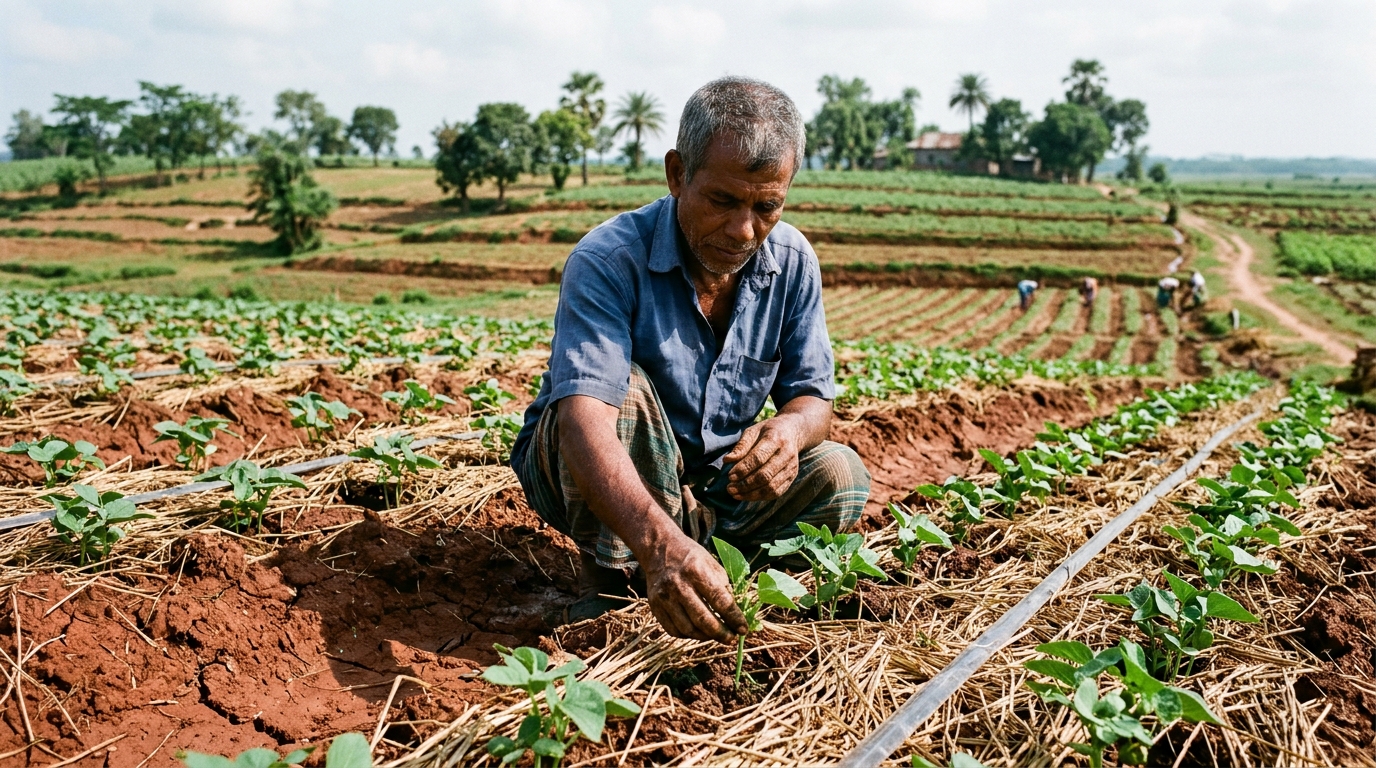
A comprehensive survey of 273 smallholder farmers in the drought-prone Barind Tract of northwestern Bangladesh has identified a persistent structural divide between agricultural awareness and practical implementation: while local cultivators demonstrate moderate to high levels of knowledge and largely positive attitudes toward sustainable farming, their actual adoption remains moderate and is overwhelmingly gated by annual farm income. Published in Discover Agriculture by researchers including A K M Kanak Pervez, Md Mahedi, Ashfaq Ahmad Shah, Shabrin Jahan Shaili, and Md Nurnobi, the investigation utilized the Knowledge, Attitude, and Practice (KAP) framework to evaluate how socio-demographic, economic, and institutional characteristics influence farming households in Rajshahi district. The empirical findings reveal a notable developmental paradox in which environmental awareness alone fails to trigger technological transformation. Household economic capacity serves as the primary enabler of sustainable agriculture, challenging widespread development assumptions that informational deficits or cognitive limitations represent the primary obstacles facing vulnerable smallholders.
The investigation focuses on the high Barind Tract, a vulnerable and resource-scarce agro-ecological zone in Bangladesh characterized by slightly elevated, old alluvial terraces with red-yellow, clayey soils that are inherently low in organic matter and natural fertility. The regional climate is subtropical, exhibiting an average annual rainfall between 1200 and 1600 millimeters that is concentrated heavily during the monsoon months from June to September, leaving the rest of the year subject to acute water scarcity. Because the regional soils possess a coarse texture and low water-holding capacity, farmers depend intensely on artificial irrigation drawn predominantly from shallow tubewells. Heavy groundwater extraction has outpaced recharge, depressing the water table and escalating irrigation expenses. Cropping patterns in Rajshahi district are dominated by an intensive rice-wheat-maize rotation for subsistence and commercial sale, wherein monsoon Aus and Aman rice are followed by winter cereals, heightening environmental degradation amid rising temperatures and droughts.
To analyze how smallholders respond to these severe ecological strains, the authors formulated four explicit research questions exploring the extent of farmers’ knowledge, attitudes, and practices, as well as the socio-economic and institutional factors associated with each domain. The conceptual framework organized potential determinants into two distinct clusters: socio-demographic factors including age, formal education, family size, and farming experience, and economic and institutional variables comprising farm size, annual farm income, training received, agricultural extension contact frequency, innovativeness, cosmopoliteness, sustainable agricultural land proportion, and sustainable agricultural training scores. The authors emphasized that while theoretical models describe sequential linkages moving from knowledge to attitudes and ultimately to practices, these pathways were included solely as conceptual connections rather than empirically tested mediation equations. Instead, the empirical design evaluated the hypothesized socio-demographic and institutional explanatory variables directly across three separate multiple linear regression models, each corresponding to one specific KAP domain.
To select a representative sample of cultivators, the researchers implemented a four-stage random sampling design across the high Barind Tract in Rajshahi district. In the first stage, Rajshahi district was selected purposively. In the second stage, five upazilas out of nine were randomly selected, followed by the random selection of four unions from each chosen upazila. The third stage involved randomly picking two villages from each selected union, after which individual farm households were drawn from complete village registries using random number generation. The primary household decision-maker was interviewed in numbers proportional to each village’s farming population. Sample size was determined using the Daniel and Cross finite-population correction formula, parameterized with a total farmer population of 2,915,009, a proportion of 0.50, a 0.05 margin of error, and a critical z-value of 1.645 at a 90 percent confidence level. This yielded a target sample of 271 farmers, rounded to 273 respondents.
Data collection was carried out through face-to-face interviews using a structured schedule across three seasons in 2025: pre-monsoon (March to June), monsoon (July to September), and post-monsoon (October to December). The survey instrument was pre-tested with 20 farmers outside the sampled areas to refine item clarity, with random spot checks ensuring data quality. Dependent variables were quantified through composite indices: knowledge was measured across 10 items covering sustainability definitions, environmental suitability, and input use, each rated on a four-point scale from none (0) to high (3), yielding a potential composite range from 0 to 30. Attitudes were evaluated through 14 statements on a five-point Likert scale from strongly disagree (1) to strongly agree (5), creating a range of 14 to 70. Practices were measured across eight sustainable techniques: seven were scored on a five-point frequency scale from not at all (1) to always (5), while soil health management utilized a four-point scale from not at all (0) to frequently (3), yielding a composite practice range of 7 to 38.
Scale reliability evaluations produced internal consistency coefficients of alpha equals 0.59 for the attitude scale, alpha equals 0.26 for the knowledge index, and alpha equals 0.03 for the practice index. The authors explained that knowledge and practice instruments represent formative indices sampling disparate dimensions of sustainable farming rather than reflective psychometric scales; consequently, high internal consistency is not expected, and quality was established through content coverage and expert review. In contrast, the attitude scale was treated as a reflective construct, with its modest alpha of 0.59 recognized as a limitation requiring future confirmatory factor analysis. Respondents were classified into low, medium, and high categories using predetermined substantive score cut-offs, though continuous composite scores served as dependent outcomes in multiple linear regression models. Multicollinearity diagnostics confirmed acceptable tolerance and variance inflation factors between 1.06 and 5.59, with models computed in IBM SPSS Statistics 27 and rechecked in Python statsmodels 0.14.
The socio-demographic profile summarized in Table 1 outlined an aging, resource-constrained smallholder population with minimal institutional support. Nearly half of the respondents (45.05 percent) were older than 50 years, 39.20 percent were middle-aged between 36 and 50 years, and only 15.75 percent were aged 17 to 35. Educational attainment was modest, with 64.10 percent having completed only primary education and 35.89 percent having attained secondary schooling. Farm finances were notably strained, as 62.64 percent earned low annual family incomes up to 3 lakh Bangladeshi Taka, while only 4.40 percent earned high incomes above 4.5 lakh BDT. Landholdings were predominantly medium-sized between 1.01 and 3.00 acres for 90.11 percent of farmers, with 9.89 percent managing small farms between 0.21 and 1.00 acre. Family sizes were mostly medium with five to eight members (56.04 percent). While farming experience was extensive—39.90 percent reported 17 to 30 years and 34.80 percent reported 31 or more years—only 19.05 percent had received formal agricultural training, 52.01 percent exhibited low cosmopoliteness, and 87.91 percent reported moderate or low agricultural extension contact.
Evaluation of the knowledge and attitude domains revealed predominantly favorable cognitive dispositions. Composite knowledge scores averaged 19.27 out of 30, with 49.82 percent falling in the medium band and 39.56 percent in the high band. Item analysis showed farmers possessed strongest knowledge regarding the social acceptance of sustainable farming (score 557), environmental suitability (score 556), and health hazards of chemical fertilizers (score 551), while understanding was weakest concerning product quality (score 466), organic fertilizer application (score 484), and required materials (score 508). Composite attitudes averaged 56.34 out of 70, with 52.01 percent classified as moderately favorable and 30.40 percent as highly favorable. Farmers most strongly endorsed statements regarding efficient resource use (score 1119), stable yields (score 1118), and lower input costs (score 1116), but showed relative hesitation regarding market risk reductions (score 1070) and alignment with traditional practices (score 1071).
In sharp contrast to knowledge and attitude levels, the composite practice score averaged only 18.42 out of 38, falling below the scale midpoint of 22.5. Over half of farmers (56.78 percent) occupied the medium-practice category, 17.94 percent were in the low band, and 25.28 percent reached the high tier. Intercropping proved most common (score 691), followed by agroforestry (score 677) and crop rotation (score 662), while integrated livestock-crop systems were least common (score 632). Multiple regression models were statistically significant across all domains: knowledge (F = 73.55, p < 0.001, R² = 0.772), attitude (F = 49.83, p < 0.001, R² = 0.697), and practice (F = 29.40, p < 0.001, R² = 0.576). Annual farm income emerged as the strongest predictor across all domains and the sole statistically significant correlate of practice (B = 2.064, p < 0.001), while education, extension, and training exhibited no significant associations.
The authors concluded that economic capacity functions as the fundamental enabler of sustainable agriculture in the Barind Tract, where higher farm incomes provide the financial slack required to absorb transition risks and input expenses. Unexplained variance—reaching 42.4 percent for practice—suggests unmeasured structural conditions such as land tenure security, credit availability, and output price premiums heavily influence adoption. To bridge the knowledge-practice gap, the study recommended establishing financial de-risking mechanisms, including input subsidies and adapted micro-credit, reforming agricultural extension toward participatory, farmer-led demonstration networks, and developing secure supply chains for biological inputs. Future research must deploy longitudinal designs, structural equation modeling, and expanded sampling to confirm these causal dynamics across broader agro-ecological regions.
Subject of Research: Farmers' knowledge, attitudes, and practices regarding sustainable agriculture in the Barind Tract of Bangladesh
Article Title: Knowledge, attitudes, and practices of farmers towards sustainable agriculture in the Barind Tract of Bangladesh
Article References: Pervez, A. K. M. K., Mahedi, M., Shah, A. A., Shaili, S. J., & Nurnobi, M. (2026). Knowledge, attitudes, and practices of farmers towards sustainable agriculture in the Barind Tract of Bangladesh. Discover Agriculture, 4(1), Article 332. https://doi.org/10.1007/s44279-026-00770-6
Image Credits: AI Generated
DOI: 10.1007/s44279-026-00770-6
Keywords: sustainable agriculture, Barind Tract, smallholder farmers, knowledge attitude practice, agricultural extension, farm income, agroforestry, Bangladesh agriculture, Knowledge, attitudes, practices, farmers
News Source: Alan Morgan. (November 6, 2026). Research report: Knowledge, attitudes, and practices of farmers towards sustainable agriculture in the Barind Tract of Bangladesh. Scienmag.