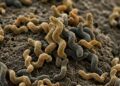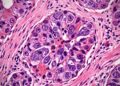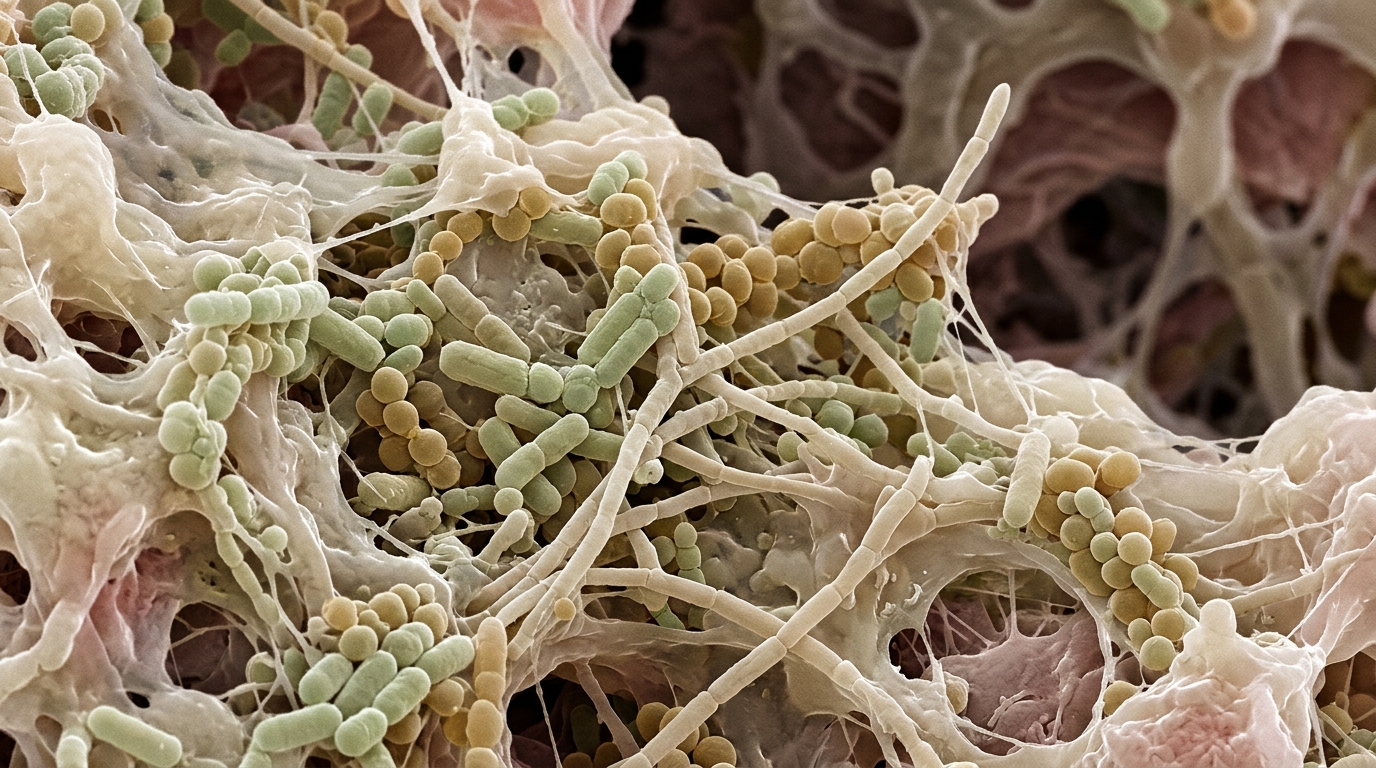
A rare abdominal cancer once thought of as a sterile mass of jelly has turned out to carry its own living microbial world. In a study published in Microbial Biotechnology, researchers analysed mucin from patients with pseudomyxoma peritonei, a disease in which gel-forming mucus accumulates throughout the peritoneal cavity, most often after an appendiceal mucinous tumour ruptures. Using bacterial and fungal gene sequencing, laboratory culture, histochemical staining and spatial RNA imaging, the team detected bacterial and fungal communities embedded in the tumour-associated mucin, and showed that the bacterial composition differs between low-grade and high-grade disease.
Pseudomyxoma peritonei is uncommon, with an estimated incidence of two to four cases per million people per year and a prevalence of roughly 25.1 cases per million. It is classified as low-grade or high-grade according to Peritoneal Surface Oncology Group International criteria, categories that correlate with prognosis and clinical behaviour. Standard treatment combines cytoreductive surgery with hyperthermic intraperitoneal chemotherapy, an approach that is effective but demanding, and recurrence remains common. The biological drivers of persistence and progression are still poorly understood, which is one reason the researchers set out to map the microbial ecology of the mucin itself.
The study analysed 15 samples collected at Reina Sofía University Hospital in Cordoba, Spain: five from patients with low-grade disease, five from patients with high-grade disease and five non-tumoral appendiceal controls from PMP patients or people who had prophylactic appendectomy for unrelated conditions. All patients gave informed consent and the local ethics committee approved the work. The researchers also examined tumours from patient-derived xenograft models, in which PMP tissue was transplanted into immunodeficient mice, to see whether the microbial association survived xenotransplantation.
Because mucin traps microorganisms, the team first used a mucin-degrading pre-treatment with dithiothreitol to release encapsulated microbial cells before extracting DNA. They then sequenced 16S rRNA gene amplicons for bacteria and 18S rRNA gene amplicons for fungi. Bacterial DNA was detected in every group, including the normal appendiceal controls. Although the average number of bacterial identifications tended to fall from controls to high-grade tumours, that trend was not statistically significant. At the phylum level, Firmicutes, Bacteroidetes and Proteobacteria predominated in all groups, while Actinobacteria differed significantly between low-grade and high-grade samples, with an adjusted p-value of 0.017.
The compositional shifts extended to bacterial families. Control tissues were enriched in dominant commensal families such as Lachnospiraceae, Ruminococcaceae and Bacteroidaceae, whereas PMP samples, particularly high-grade tumours, showed a relative reduction in these families alongside increased representation of Enterobacteriaceae and Streptococcaceae. Alpha diversity, measured with Shannon diversity and Pielou’s evenness, did not differ significantly among groups, but high-grade samples displayed greater inter-individual variability, indicating increased community heterogeneity. Multidimensional scaling based on Aitchison distances showed partial overlap between controls and low-grade samples, while high-grade samples tended to segregate from the others, although PERMANOVA did not reach statistical significance (F = 1.47, R2 = 0.20, p = 0.09).
Sequencing alone cannot distinguish living microbes from residual DNA, a particular concern in low-biomass samples. To address this, the researchers cultured fresh mucin on a range of media, including anaerobic blood agars designed to mimic the low-oxygen tumour environment, and identified colonies by MALDI-TOF mass spectrometry, with Sanger sequencing as a fallback. Viable bacteria were recovered from the majority of human PMP samples and from all analysed PDX tumours. The isolates included members of the genera Staphylococcus, Enterococcus, Bacillus, Escherichia, Parabacteroides, Phocaeicola and Sphingomonas, among others, and their identities were consistent with the sequencing results. In one case, culture resolved Sphingomonas paucimobilis at the species level, where sequencing had only reached the genus.
The fungal component had never previously been investigated in this disease. Fungal DNA was detected in all experimental groups, which the authors describe as the first evidence of a fungal microbiome associated with PMP. The mean number of fungal identifications tended to rise in PMP samples, especially high-grade tumours, but the difference was not statistically significant. Fungal communities were dominated by Ascomycota across all groups, followed by Basidiomycota, with Chytridiomycota and Cryptomycota at much lower abundances. Cladosporiaceae was the predominant family, with Aspergillaceae among the lower-abundance taxa, and the overall community structure remained broadly comparable across disease stages.
Two independent visual methods then confirmed that the fungal DNA corresponded to actual fungal structures. Periodic acid–Schiff staining revealed fungal elements embedded within the extracellular mucin of both low-grade and high-grade samples, and because PAS also stains host polysaccharides, the team used Calcofluor White, a fluorescent dye that binds chitin in fungal cell walls, to verify discrete fungal structures within the tumour-associated mucin. Chromogenic RNAscope in situ hybridisation added spatial confirmation: punctate signals for bacterial 16S rRNA appeared within epithelial and mucin-rich tumour regions in all analysed PMP samples, and fungal 18S rRNA signals were found within tumour-associated mucin. Comparable signals were also detected in the PDX tumours, showing that the spatial association of microbes with mucin persisted after xenotransplantation. Positive and negative control probes behaved as expected, supporting assay specificity.
The researchers also asked whether bacterial communities from different tumour grades differed in predicted function. Using Tax4Fun pathway prediction based on the 16S data, they found no significant differences between control tissues and PMP samples after correction for multiple comparisons, but clear differences between low-grade and high-grade disease. High-grade-associated communities showed predicted enrichment of pathways related to carbohydrate and energy metabolism, lipid metabolism, host–microbe interactions and genetic information processing, including glycolysis, fructose and mannose metabolism, glycerolipid metabolism, NOD-like receptor signalling, bacterial invasion of epithelial cells, extracellular matrix–receptor interaction, ribosome and RNA polymerase. Low-grade-associated communities were enriched in pathways involving energy, lipid and amino acid metabolism, such as pyruvate, propanoate and butanoate metabolism, steroid biosynthesis, and arginine, proline and phenylalanine metabolism. Because these profiles are inferred from taxonomic data rather than measured gene expression, the authors caution that they represent hypotheses requiring confirmation by shotgun metagenomics, metatranscriptomics or metabolomics.
The study has limitations the authors acknowledge. The cohort is small, a consequence of the disease’s rarity, although comparable in size to previous PMP microbiome studies, and all patients were recruited from a single centre, which may limit generalisability. The xenograft models rely on immunodeficient hosts, restricting the study of tumour–microbe–immune interactions, and the functional analyses are predictions rather than direct measurements. How microorganisms reach the mucin and persist there remains unknown, though the appendiceal origin of most cases suggests local translocation from intestinal or appendiceal microbiota as one plausible route, with the abundant extracellular mucin and hypoxic environment potentially providing a permissive niche. What the study establishes is convergent, multi-method evidence that PMP mucin harbours viable bacteria and, for the first time, fungi, redefining this gel-filled tumour environment as a polymicrobial niche and opening a new line of investigation into how bacteria, fungi and host cells interact within it.
Subject of Research: Multi-kingdom microbial communities associated with pseudomyxoma peritonei mucin
Article Title: Integrated Microbial Profiling Identifies Bacterial and Fungal Communities in Pseudomyxoma Peritonei Mucin
Article References: Pezzopane, R., Barbudo‐Lunar, M., Bura, F. I., Granados‐Rodríguez, M., Martínez‐López, A., Rodríguez‐Ortiz, L., Rufián‐Andújar, B., López‐Jiménez, J., Luna‐Guerrero, V., Alhama, J., Michán, C., Vázquez‐Borrego, M. C., Arjona‐Sánchez, Á., & Romero‐Ruiz, A. (2026). Integrated Microbial Profiling Identifies Bacterial and Fungal Communities in Pseudomyxoma Peritonei Mucin. Microbial Biotechnology, 19(11), Article e70457. https://doi.org/10.1111/1751-7915.70457
Image Credits: AI Generated
Keywords: pseudomyxoma peritonei, tumour microbiome, mycobiome, 16S rRNA sequencing, 18S rRNA sequencing, MALDI-TOF, RNAscope, mucin, appendiceal cancer, CRS-HIPEC, Tax4Fun, patient-derived xenograft
News Source: Nathaniel Bowman. (November 6, 2026). Bacteria and Fungi Found Living Inside Rare Abdominal Cancer Mucin. Scienmag.