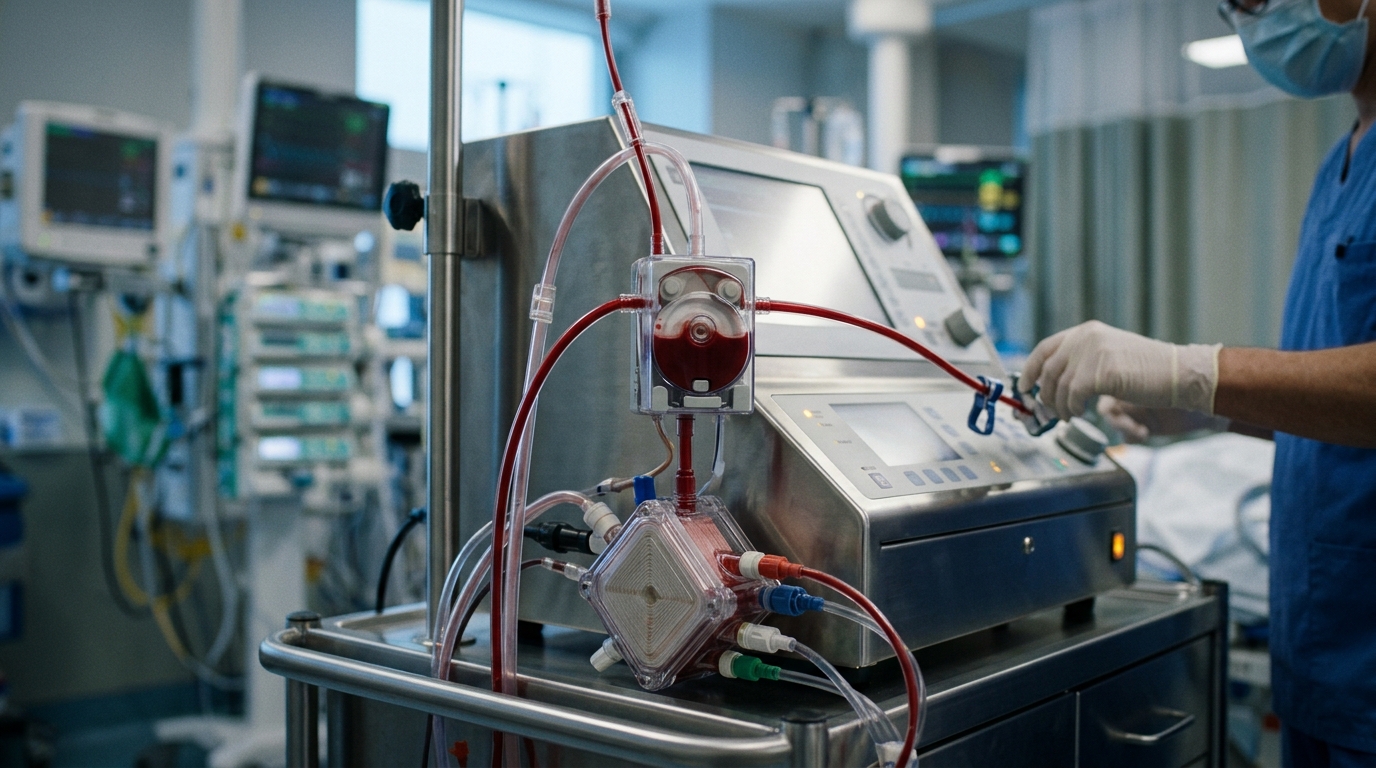
Extracorporeal membrane oxygenation, the machine that oxygenates blood outside the body when the heart or lungs fail, is quietly transforming a second field: organ donation and transplantation. A new perspective article published in Frontiers in Anesthesiology argues that ECMO has evolved from a last-resort rescue therapy into an integral component of the entire transplantation pathway, supporting critically ill patients before death and preserving organs afterward. The authors, clinicians from Royal Papworth Hospital in Cambridge and Southmead Hospital in Bristol, describe how a technology once reserved for desperate cases now touches nearly every stage of the journey from intensive care bed to transplant operating room.
The scale of modern ECMO practice explains why the stakes are so high. Data from the United States show a 23-fold increase in the use of veno-arterial ECMO for cardiogenic shock between 2002 and 2018, and indications continue to expand. Increasingly, the technique serves as a bridge-to-decision, bridge-to-device or bridge-to-transplantation, and it is now deployed proactively before profound shock or cardiac arrest develops, rather than only as a rescue measure. The patient population is changing too. German registry data show that the proportion of veno-arterial ECMO patients aged over 75 more than doubled, from 6.8 percent to 14.6 percent, between 2007 and 2018.
Yet mortality remains stubbornly high, and this is where the donation opportunity emerges. Approximately one-third of patients receiving veno-venous ECMO and half of those on veno-arterial ECMO do not survive. Many of these deaths follow either a diagnosis of brain death or a decision to withdraw life-sustaining treatment, which places a substantial number of ECMO patients on the path toward organ donation. The authors argue that these patients remain an under-recognized and under-utilized source of donor organs. A recent single-center UK study found that only 7.7 percent of ECMO patients referred for organ donation ultimately became donors, a figure the authors attribute to limited outcome data, unfamiliarity with donation from ECMO-supported patients, and historical uncertainty about how to determine death neurologically in this setting.
That uncertainty is now being addressed. National guidance in the United Kingdom supports brainstem death testing in patients receiving ECMO, removing one of the principal barriers to donation after brain death in this population. The greatest technical challenge is the apnea test, a cornerstone of neurological determination of death that requires carbon dioxide to accumulate in the blood after ventilation stops. The ECMO oxygenator, however, continuously removes carbon dioxide, preventing the expected rise in arterial carbon dioxide tension. Well-described protocols now minimize sweep gas flow while maintaining oxygenation through both the ventilator and the oxygenator, allowing safe and reliable testing. Drug pharmacokinetics add a second layer of complexity: hemodilution, altered protein binding, variable hepatic and renal perfusion, and sequestration of sedatives within the circuit can all prolong drug clearance, so careful washout periods and, where appropriate, ancillary investigations remain essential before brain death testing.
Once death is confirmed, ECMO offers tangible advantages for donor optimization. By maintaining stable hemodynamics, oxygen delivery and end-organ perfusion, extracorporeal support may reduce the secondary organ injury that often follows brain death while the retrieval team waits. The benefits must be weighed against potential harms, however. ECMO itself can trigger systemic inflammation, hemolysis and coagulopathy, and together with volume overload these effects can damage end organs. Configuration matters as well: retrograde flow in veno-arterial ECMO increases the afterload experienced by the left ventricle, which can reduce ejection, raise left ventricular end-diastolic pressure and cause pulmonary edema, sometimes requiring unloading strategies. Lung assessment is complicated because the oxygenator masks the true oxygenating capacity of the lungs, and liver assessment can be confounded by elevated bilirubin from hemolysis, a common finding in ECMO patients that is associated with poorer outcomes and decreased liver graft survival.
The observational evidence on graft outcomes, while limited to retrospective studies, is encouraging. Bronchard and colleagues, examining French registry data, found no difference in graft outcomes for kidney and liver transplants when ECMO donation-after-brain-death donors were compared with non-ECMO donors. A systematic review by Rajsic and colleagues, incorporating heterogeneous studies from eight countries, demonstrated an overall graft survival rate of 91 percent across study-specific follow-up periods extending to three years, with 95 percent and 89 percent graft survival for kidneys and liver respectively. Lungs fared worst, at 70 percent, in keeping with Japanese findings showing poorer graft survival of lungs from ECPR donors compared with non-ECPR donors. There are hints that transplant teams still treat these organs cautiously: Altshuler and colleagues observed that kidneys from ECMO donors in the United States were more likely to be shared with regional and national centers, with longer cold ischemic times, and that veno-venous ECMO was associated with a higher incidence of delayed graft function and lower one-year kidney graft survival than veno-arterial support, at 77 percent versus 94 percent.
The most striking opportunity lies in controlled donation after circulatory death, where pre-existing ECMO cannulation offers a distinct advantage. Existing cannulae can be flushed and clamped after withdrawal of extracorporeal support, allowing rapid connection to a normothermic regional perfusion circuit once the cerebral circulation has been excluded. The original circuit is not reused because of the risk of thrombosis. Published experience remains limited, but reported times from the start of the retrieval procedure to NRP initiation range from just 3 to 6 minutes. This dramatic reduction in functional warm ischemia is particularly relevant in liver transplantation, where NRP has consistently been associated with lower rates of ischemic cholangiopathy and early allograft dysfunction. In DCD liver transplantation specifically, NRP has shown an eight-fold reduced incidence of ischemic cholangiopathy at six months, and a 2023 meta-analysis found that delayed graft function was reduced in kidney transplants following NRP compared with in-situ cold perfusion.
Beyond the controlled pathway, extracorporeal cardiopulmonary resuscitation and uncontrolled donation after cardiac death programs introduce both opportunities and ethical complexities. Across Europe, roughly 55 patients per 100,000 population suffer an out-of-hospital cardiac arrest each year; only about one-third achieve return of spontaneous circulation and overall survival remains below 10 percent. Uncontrolled DCD is practiced in only a handful of countries, including Spain, France, the Russian Federation, the Netherlands and selected centers in the United States, reflecting the heavy financial and manpower investment required and the legal and ethical difficulties involved. The incidence of brain death among patients receiving ECPR is 22 to 28 percent, considerably higher than the roughly 2 percent among veno-venous ECMO patients and 8 percent among veno-arterial patients, suggesting that ECPR may expand the pool of brain-death donors among those who do not survive. The authors stress that the primary objective of ECPR is always patient survival, and decisions to initiate or discontinue resuscitation must remain entirely independent of donation considerations, a distinction they describe as fundamental to maintaining public confidence.
From a service perspective, ECPR and uncontrolled DCD programs share much of the same infrastructure: rapid cannulation capability, dedicated retrieval pathways, trained multidisciplinary teams and immediate access to extracorporeal support. Integrating the two pathways could offer practical and economic advantages, but the authors caution that such programs are resource-intensive and require careful governance to ensure that resources intended for therapeutic ECMO are not diverted in ways that compromise access for patients with a realistic chance of survival. The context makes the need acute. In the United Kingdom, the annual number of deceased donor transplants remained relatively stable between 2015 and 2025, at 3,528 and 3,592 respectively, while the transplant waiting list grew by approximately 25 percent over the same period.
The authors conclude that wider implementation will require coordinated multidisciplinary teams, standardized protocols, appropriate resource allocation and robust clinical and ethical governance. Because ECMO patients who become donors represent a small cohort, the evidence base remains retrospective and must be interpreted with caution; prospective multicenter research is needed to clarify donor selection, organ utilization, long-term graft outcomes and cost-effectiveness. Still, the direction of travel is clear. ECMO, once viewed solely as a means of supporting potential transplant recipients, is increasingly an integral component of the entire transplantation pathway, extending from the treatment of critically ill patients to donor optimization, organ preservation and expansion of the donor pool, and it is likely to play a growing role in addressing the persistent shortage of transplantable organs.
Subject of Research: The expanding role of extracorporeal membrane oxygenation in organ donation, donor optimization and organ preservation
Article Title: Extracorporeal membrane oxygenation in organ donation and organ preservation
Article References: Young, E., Rubino, A., & Manara, A. (2026). Extracorporeal membrane oxygenation in organ donation and organ preservation. Frontiers in Anesthesiology, 5, Article 2000511. https://doi.org/10.3389/fanes.2026.2000511
Image Credits: AI Generated
DOI: 10.3389/fanes.2026.2000511
Keywords: ECMO, organ donation, transplantation, normothermic regional perfusion, DCD, DBD, ECPR, donor optimization, organ preservation, graft outcomes, critical care, Extracorporeal
News Source: Ophelia Keating. (November 6, 2026). ECMO’s Second Life: From Rescue Machine to Organ Donation Powerhouse. Scienmag.