Extracorporeal membrane oxygenation, or ECMO, has traditionally been used cautiously in trauma because of bleeding, coagulopathy, traumatic brain injury and the need for repeated surgery. A review published in Critical Care argues that this caution should now be weighed against a changed technical landscape. Advances in venovenous ECMO, anticoagulation strategies, trauma critical care and ECMO transport have broadened the therapy’s potential role in selected trauma patients, the authors write, although combat-specific data remain limited.
The review, led by Elchanan Parnasa and colleagues, treats combat casualties as a distinct subgroup. These patients are often young and previously healthy, with preserved cardiopulmonary reserve, yet they may develop severe but potentially reversible respiratory or circulatory failure after penetrating, blast, thoracic or polytraumatic injury. That combination, the authors suggest, makes some of them plausible candidates for a therapy that substitutes for lung or heart function while the underlying injuries are treated.
The evidence base is framed as feasibility rather than proof of benefit. Current evidence supports ECMO as a feasible rescue strategy in selected trauma patients, particularly for refractory trauma-induced respiratory failure, the review states. The authors examine trauma-ECMO evidence and representative cases, patient selection, ECMO configuration, trauma-specific complications, care across military roles, contested evacuation and resource allocation. No claim is made that ECMO improves survival in combat casualties; the argument is that it can be delivered, in selected patients, as a rescue option when conventional support fails.
The review is explicit about the limits of its own conclusions. Given the scarcity of combat-specific data, the clinical and operational frameworks it proposes should be viewed as conceptual models rather than validated algorithms or consensus recommendations, the authors write. ECMO, they conclude, should remain a highly selective, system-dependent rescue strategy rather than a routine battlefield therapy. That distinction matters for readers hoping for a battlefield breakthrough: the paper offers a structured way to think about when ECMO might help, not a validated protocol for when it does.
The technical core concerns configuration and anticoagulation. Venovenous ECMO, which supports the lungs, is the configuration most relevant to refractory respiratory failure, and advances in this mode have expanded its applicability in trauma. Anticoagulation strategies, the traditional sticking point for bleeding patients, are described as an area of active evolution, alongside progress in trauma critical care and in transporting patients already on an ECMO circuit. The review also addresses trauma-specific complications that arise when an extracorporeal circuit is added to a multiply injured patient.
The operational chapters are where the review is most distinctive. Care across military roles, contested evacuation and resource allocation are treated as integral to any realistic ECMO programme for combat casualties, because the therapy demands equipment, trained staff and a stable environment for cannulation and circuit management. The authors frame these as system-dependent prerequisites: without a chain of care that can sustain the circuit, the therapy cannot function as a rescue option at all.
For the general reader, the significance lies in the framing rather than any single result. The paper consolidates what is known about ECMO in trauma, organises the special considerations combat casualties raise, and sets out future directions. It is published as open access, and the version shared ahead of the final Version of Record is citable and carries a permanent DOI.
Subject of Research: The current evidence, special considerations and future directions for using ECMO in combat casualties
Article Title: ECMO for combat casualties: current evidence, special considerations, and future directions
Article References: Parnasa, E., Rokach, Y., Golomb, M., Eisenkraft, A., Gelman, R., Nissan, B.-E., Sarkar, I., Asleh, R., Amir, O., & Nachman, D. (2026). ECMO for combat casualties: current evidence, special considerations, and future directions. Critical Care. https://doi.org/10.1186/s13054-026-06350-w
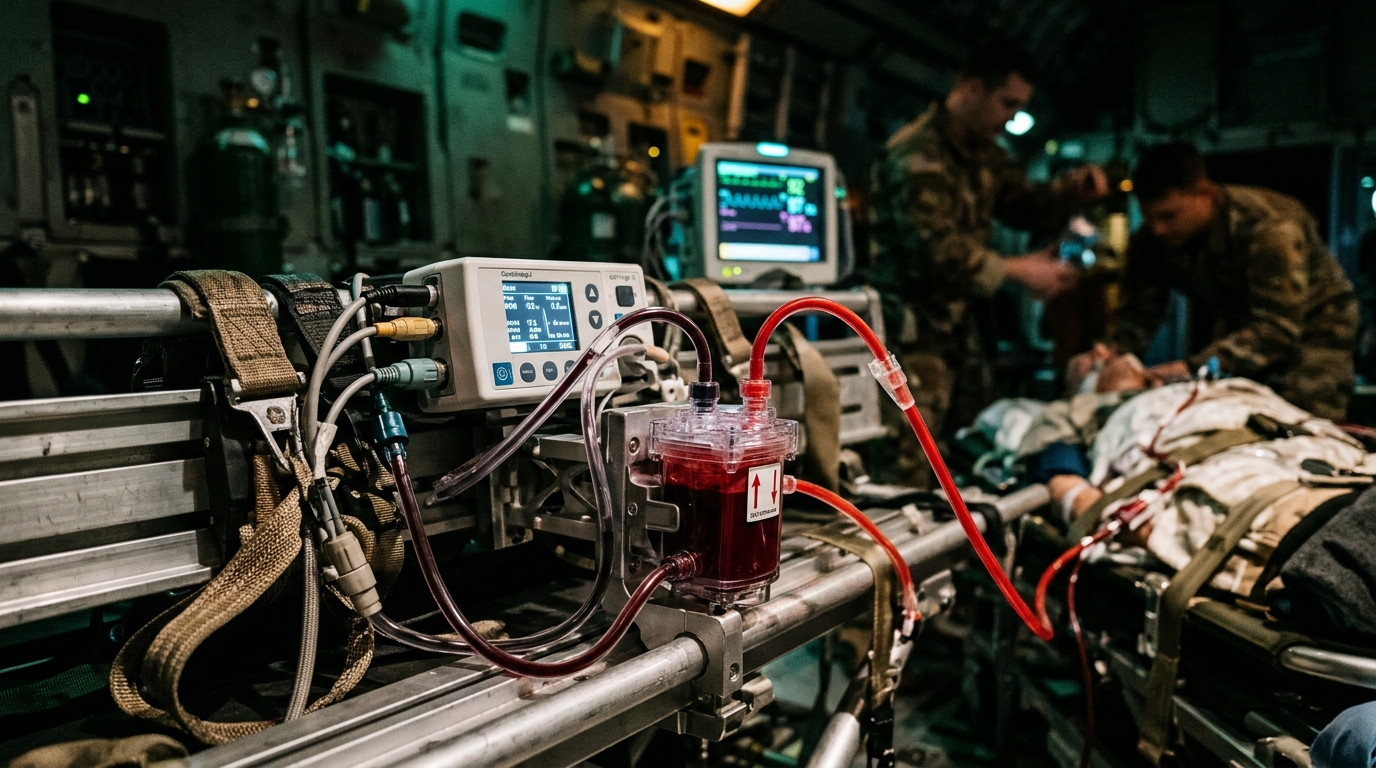
Image Credits: AI Generated
DOI: 10.1186/s13054-026-06350-w
Keywords: ECMO, combat casualties, trauma, respiratory failure, anticoagulation, echelon care, contested evacuation, military medicine, critical care, patient selection, combat, casualties
News Source: Ophelia Keating. (November 5, 2026). ECMO shows promise as rescue therapy for combat casualties, but evidence remains thin. Scienmag.