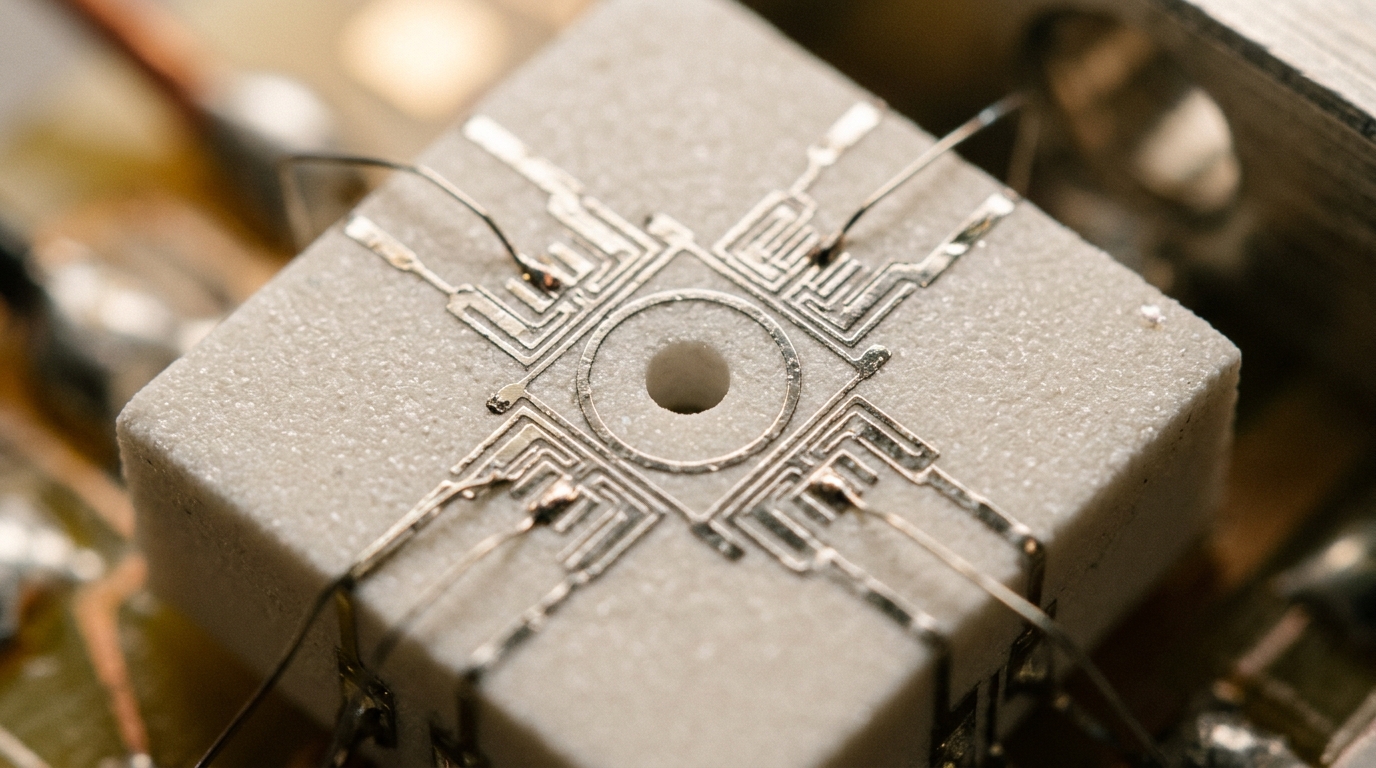
A miniature zirconia amperometric oxygen sensor built around an alumina disc pierced by a microneedle-made micro-hole has been fabricated and characterized, with its diffusion-limited current behavior mapped across oxygen concentrations, temperatures, response times, warm-up and altitudes up to 65,000 feet. The work, published in Discover Sensors, describes how the geometry of the diffusion barrier defines the characteristics of a diffusion-limited zirconia amperometric oxygen sensor, and reports fabrication details and characteristics of a miniature sensor in which the diffusion barrier is an alumina disc with a micro-hole in its middle created using a microneedle during its green stage, and a glass ring ensures a predetermined separation between the diffusion barrier and the oxygen pump. The microneedle-based micro-hole creation provides a low-cost sensor fabrication process, while the glass-ring separator provides consistent sensor geometry and sensor characteristics.
Zirconia-based oxygen sensors are widely used for controlling air-fuel ratio in combustion processes in automobiles, control of chemical reactions and flue gas analysis, control in industrial combustion and boilers, and measurement of oxygen activity in molten metals. Beyond these applications, there are niche uses where they must perform in the harsh aircraft environment: measurement of oxygen concentration in the breathing gas supplied to the pilot of fighter aircraft, and measurement of oxygen concentration in the output of onboard inert gas generation units. The new sensor targets precisely this demanding niche, where size, power draw and predictable behavior under falling pressure all matter.
Zirconia oxygen sensors are fabricated and operated in three basic configurations: the potentiometric configuration or Nernst cell, the amperometric configuration or oxygen pump, and the dual cell-pump configuration. The practical implementation of an amperometric zirconia oxygen sensor is in the form of a limiting current type sensor, which is essentially an oxygen pump covered with a diffusion barrier that limits the oxygen transfer rate from ambient gas to the pump’s cathode. The diffusion barrier is often a cover with a small diffusion hole, and less frequently a porous layer on the cathode surface. The oxygen pump and the diffusion barrier are sealed well together to ensure that gas molecules reach the cathode only through the diffusion hole, and a screen-printed platinum heater provides the operating temperature necessary for the oxygen pump to work.
In a current-limiting zirconia amperometric oxygen sensor with a diffusion hole barrier and an entrapped cavity, when a voltage is applied across the zirconia membrane with negative polarity on the cathode, oxygen molecules from the cavity are pumped across the electrolyte in the form of O2− ions. When the cavity is nearly depleted of oxygen, the ionic current is limited by oxygen diffusion into the cavity through the diffusion hole and is proportional to the ambient partial pressure of oxygen. Tape-casting and screen-printing technologies have made these sensors compact and low in power consumption, but fabrication can be cumbersome, often using discrete components joined together. Among these components, the diffusion barrier and micro-hole geometry and its hermetic sealing with the oxygen pump are very critical, and dictate the diffusion-limiting current characteristics of the sensor.
The diffusion barrier geometry determines the mechanism of gas diffusion in the sensor. When the diffusion barrier diameter is greater than the mean free path of the oxygen molecules, intermolecular collisions dominate and collisions with the pore wall become negligible; this is called normal bulk diffusion. When the diffusion barrier diameter is smaller than the mean free path, gas-wall collisions dominate, and the transport is called Knudsen diffusion. These two mechanisms show different dependencies on oxygen concentration, pressure and temperature. In the normal bulk diffusion region, the limiting current depends logarithmically on the oxygen molar fraction, and because the oxygen diffusion coefficient in this region depends on both total pressure and absolute temperature, the limiting current is independent of total pressure. In the Knudsen region, the limiting current is proportional to the oxygen molar fraction and, because the Knudsen diffusion coefficient depends only on temperature, the limiting current is proportional to total pressure.
The sensor assembly consists of a pump, a yttria-stabilized zirconia disc screen-printed with porous platinum electrodes on both sides; a diffusion barrier, a zirconia or alumina disc with a micro-hole in its middle that also supports a screen-printed thick-film platinum heater; glass sealing of the sensor disc and diffusion barrier disc around their rim; and a Chromel-Alumel thermocouple junction bonded to the base of the sensor. The final assembly with six electrical leads is packaged inside a six-pin TO header whose cup has a nozzle for sample gas inlet and a 1-millimeter opening for release of excess pressure, with loose quartz wool above and below the assembly to reduce the effects of shock and heavy air-gush. Partially stabilized zirconia with 5 mol percent yttria was chosen for its better mechanical properties and thermal shock resistance, despite lower oxygen ion conductivity than fully stabilized zirconia. Green-stage 5YSZ tapes 125 micrometers thick were punched into 8-millimeter discs and sintered, and fritless conducting platinum paste was screen-printed to an approximate thickness of 10 micrometers, with platinum-rhodium wires laid over them.
Green-stage alumina tapes of 99.99 percent purity, 200 micrometers thick, were laminated into 400-micrometer tape, and 8-millimeter discs were punched out. Micro-holes of diameter in the range 15 to 20 micrometers were created at or near the centre of these green-stage alumina discs using a microneedle and then sintered, with an annular resistive platinum heater screen-printed over the disc using fritted platinum conductive ink. The pump and diffusion barrier were joined around their rim by glass sealing in two steps: first placing a green-stage glass ring and curing it to form a cavity with predetermined separation, then applying glass paste around the periphery between the two discs and curing to ensure hermetic sealing with a leak rate less than 10−9 cubic centimeters per second, so that gas diffusion to the sensor cell occurs only through the micro-hole. The cavity volume is approximately 9.8 × 10⁻³ cubic centimeters.
The I-V characteristics were measured for calibrated gas mixtures with oxygen concentrations of 21, 40, 60, 80 and 95 percent, supplied at a flow rate of 200 cubic centimeters per minute, with the sensor maintained at operating temperatures between 500 and 600 °C and the current measured for excitation voltages from 0.1 to 2 V in steps of 0.1 V. The characteristics reveal a linear increase in sensor current at low applied voltages, followed by the characteristic plateau region with almost constant current before a breakdown region at high voltages. At low voltages the rate-determining step is the pumping of O2− ions across the zirconia electrolyte; at intermediate voltages it is the diffusion of gaseous O2 molecules through the diffusion hole; and above roughly 2 V the current rises rapidly because of electronic conduction at such higher polarizations. As expected in the bulk diffusion regime, the dependence of limiting current on oxygen concentration is logarithmic, and the limiting current increases as the micro-hole diameter grows from 15 to 20 micrometers.
During development, anomalous behaviors appeared in the I-V characteristics depending on the sealing materials. Sensors built with green-stage glass rings made from glass tapes using methyl ethyl ketone and toluene as solvents and oleic acid as dispersant showed a broad dip in the current plateau, more prominent at higher oxygen concentrations, which flattened over multiple heating runs before stable diffusion-limited characteristics emerged, probably due to deposition of MEK onto the platinum electrodes during curing and its burnout over repeated heating; the anomaly disappeared after MEK was discarded from the glass-tape fabrication. A thin layer of sinterable gold paste, applied early on to improve adhesion of the glass ring to the alumina barrier, produced a small peak on the plateau whose position shifted to higher voltages with increasing oxygen concentration and to lower voltages with increasing operating temperature. The authors suggest this peak may be related to gold atoms that diffused into the YSZ electrolyte, leading to localized electronic currents, though its exact origin is beyond the scope of the paper.
Response time measurements, made by switching the input gas between 21 and 95 percent oxygen, gave a rise time of approximately 16 seconds and a fall time of approximately 6 seconds, longer than potentiometric zirconia sensors because the sample gas must travel through a micro-hole smaller than 20 micrometers before reaching the sensing surface and then be pumped across the electrolyte. Warm-up to the stable operating temperature of 600 °C from a 25 °C ambient took less than 150 seconds, with a maximum electrical power of 7 W during heat-up and a steady-state requirement of 4 W, and warm-up from −40 °C was nearly the same because the lower ambient temperature lowers the heater resistance and draws a higher initial current. The pressure and altitude dependence, measured up to 65,000 feet, showed a limiting current that is pressure-independent at higher pressures but pressure-dependent at lower pressures, indicating mixed diffusion behavior with bulk diffusion transitioning into Knudsen diffusion. The authors ascribe this to possible narrow leakage paths in the glass sealing around the sensor cavity, supported by leak-rate measurements in which individual discs show leak rates of order 10−11 cubic centimeters per second while fabricated sensors show about 10−9. Fitting the entire altitude range with an effective diffusion coefficient combining normal and Knudsen components yielded best-fit constants of 0.165 and 2.7, and applying this correction produced an oxygen concentration versus altitude plot that is flat except for minor deviations above 100 mbar, near 60,000 feet, possibly due to larger pressure-sensor measurement error in the high-altitude chamber. Testing against qualification criteria for long-term stability and environmental effects remains a prolonged study to be published in future.
Subject of Research: Fabrication and diffusion-limited current characteristics of a miniature zirconia amperometric oxygen sensor with a microneedle-created micro-hole diffusion barrier
Article Title: Diffusion limited current characteristics of Zirconia amperometric Oxygen sensor
Article References: Radhakrishnan, J. K., Kamble, S. S., Geetika, Nithila, & Kumara, M. (2026). Diffusion limited current characteristics of Zirconia amperometric Oxygen sensor. Discover Sensors, 2(1), Article 62. https://doi.org/10.1007/s44397-026-00096-4
Image Credits: AI Generated
DOI: 10.1007/s44397-026-00096-4
Keywords: zirconia oxygen sensor, amperometric sensor, diffusion-limited current, bulk diffusion, Knudsen diffusion, yttria-stabilized zirconia, micro-hole diffusion barrier, glass ring sealing, oxygen pump, limiting current, altitude dependence, platinum heater
News Source: Denise Maddox. (November 5, 2026). Miniature Zirconia Oxygen Sensor Tames Diffusion With a 20-Micrometer Hole. Scienmag.