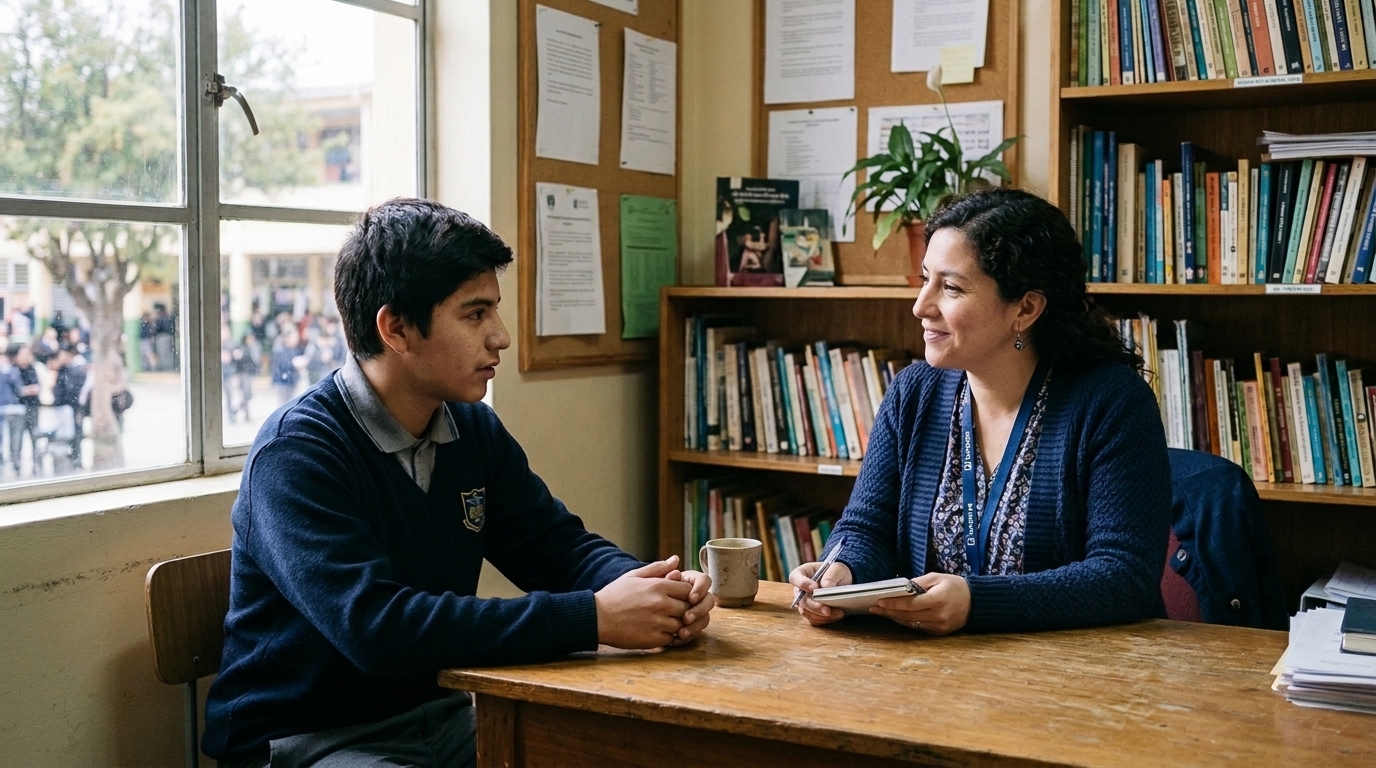
Chilean secondary school communities describe adolescent mental health in two very different registers at once: as emotional well-being to be nurtured, and as a landscape of problems, diagnoses, treatments and specialized care. That dual picture comes from an interpretive qualitative study that analyzed social representations of adolescent mental health among 118 participants drawn from secondary schools across diverse locations in Chile, including 48 students, 41 teachers and 29 parents or caregivers. The researchers conducted individual interviews and focus groups, then examined the material through reflexive thematic analysis to identify patterns of meaning, nuances and tensions across the participant groups.
The study set out to map how school communities make sense of adolescent distress, emotional crises and requests for support, and how they decide what to do when a student is struggling.
One of the clearest findings concerns openness. Contemporary adolescents were described by participants as more willing to recognize and express distress than previous generations. Teachers and parents, however, did not uniformly celebrate that shift. Adult participants also interpreted the greater openness as potentially associated with greater vulnerability or with a reduced tolerance of frustration, reading the same behavior either as healthy emotional literacy or as a sign that today’s teenagers cope less well with adversity.
Participants broadly agreed that adolescent mental health has become a widespread contemporary problem. Where they disagreed was on how to interpret that apparent novelty. Some treated the surge in visibility as evidence that distress itself had grown, while others linked the increased visibility to greater recognition and openness toward forms of distress that had previously been overlooked.
When participants reached for explanations of why adolescents struggle, two contextual frameworks stood out with particular salience: family relationships and social media. Both were repeatedly invoked as settings that shape adolescent emotional life, placing the origins of distress in relational dynamics and in the digital environments young people inhabit.
Yet the responses participants could articulate did not match that relational framing. Individualized and professionally mediated responses, such as referral toward diagnosis, treatment and specialized care, were more clearly articulated than relational, pedagogical or broader institutional alternatives. The authors characterize this as a tension within the representational field between predominantly relational and social explanations of adolescent distress and a comparatively individualized set of responses.
The methodological design shapes what these findings can and cannot show.
The practical implication the study surfaces is a mismatch worth attending to.
The article was published open access in Discover Mental Health on 3 November 2026 and is being shared early as peer-reviewed, accepted research carrying a permanent DOI, with a final version of record to follow. The research team included Gabriela Nazar, Leonor Benítez, Pamela Grandón, Germán Lagos, Caterin Romero and Félix Cova.
Subject of Research: Social representations of adolescent mental health among students, teachers and caregivers in Chilean secondary school communities
Article Title: A qualitative study of how chilean school communities understand and respond to adolescent mental health challenges
Article References: Nazar, G., Benítez, L., Grandón, P., Lagos, G., Romero, C., & Cova, F. (2026). A qualitative study of how chilean school communities understand and respond to adolescent mental health challenges. Discover Mental Health. https://doi.org/10.1007/s44192-026-00650-x
Image Credits: AI Generated
DOI: 10.1007/s44192-026-00650-x
Keywords: adolescent mental health, Chile, school communities, qualitative research, social representations, thematic analysis, teachers, parents and caregivers, students, family relationships, social media, mental health stigma
News Source: Glenn Wilkins. (November 5, 2026). Chilean school communities see teen mental health as widespread but respond one student at a time. Scienmag.