Reaching carbon neutrality by 2050 would cost Cyprus around 81 billion euros in energy-related investments between 2031 and 2050, according to a model-based study published in the journal Carbon Neutral Systems. The analysis, carried out by Theodoros Zachariadis and Constantinos Taliotis, finds that public investment would need to absorb close to 1 percent of gross domestic product each year until mid-century, roughly twice what public funds currently provide for climate action. Yet the same calculations suggest the transition could pay off: implementing the net-zero scenario requires about 508 million euros in additional investments but yields around 4 billion euros in lower fuel costs by 2050, largely by cutting imports of oil and gas.
The study addresses a gap that European policy bodies have repeatedly flagged. The European Scientific Advisory Board on Climate Change noted in 2023 that estimates of climate investment needs rest on a variety of sources with different scopes, and that there is insufficient information on the investments required to fund the transition to climate neutrality, along with a lack of indicators to track progress at the sectoral level. The authors of the new paper argue that their transparent, sector-by-sector method of identifying public and private funding requirements helps close that gap, and they position it against earlier work such as that of the Institute for Climate Economics, which excludes sectors like urban public transport and solar thermal equipment.
Cyprus is an instructive case. As an island European Union member state, it carries comparatively high greenhouse gas emissions per unit of economic output and remains heavily dependent on imported fossil fuels, while sitting in one of the world’s most vulnerable regions to climate change. Under the European Climate Law, it must contribute to the EU-wide targets of a 55 percent emissions reduction by 2030 compared with 1990 and net zero emissions by 2050. The revised National Energy and Climate Plan of December 2024, consistent with European Environment Agency analysis, concludes that meeting the legally binding 2030 targets is unlikely because there is not enough time for all green energy investments to be implemented, even though the country has secured more than 2 billion euros in EU funds for its green transition since 2021.
The modelling framework behind the projections is itself a first. Cyprus has become the first country in the EU to adopt a fully open-source energy modelling framework, using OSeMOSYS as the core energy system model, for its official energy projections. The toolkit combines an energy demand forecast model, a cost-optimization model that determines the least-cost mix of technologies to satisfy projected demand, a macroeconomic input-output model and a consumer demand model, together yielding long-term projections of energy demand and supply, greenhouse gas emissions, economic activity, employment and cost-of-living impacts. The models are updated at least annually and run across numerous scenarios aligned with policy questions, with assumptions on macroeconomic developments, technology costs, energy prices and carbon prices documented in the national climate plan.
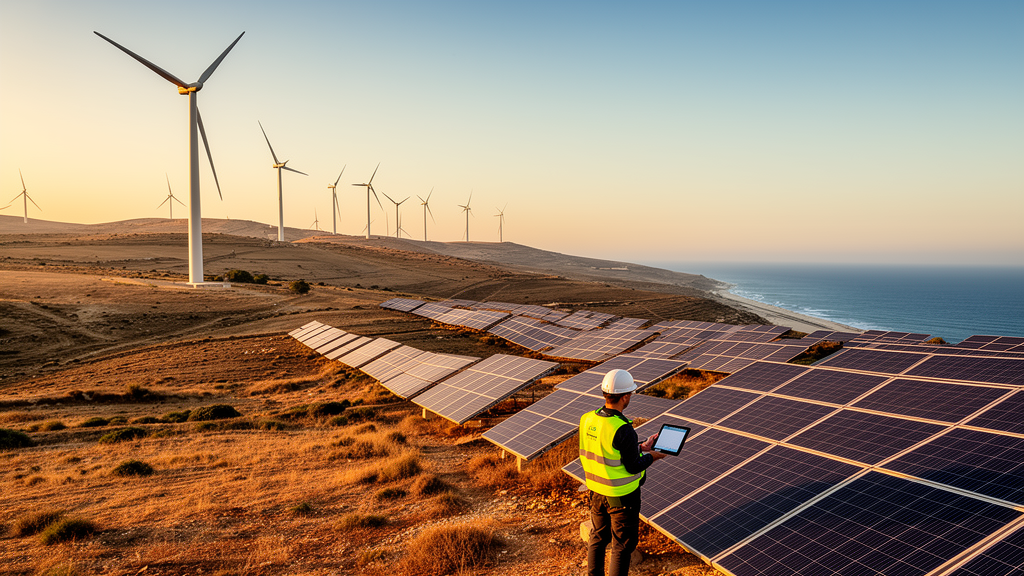
In the central net-zero scenario, renewables supply about two thirds of primary energy by 2050, while solid and liquid fuels virtually disappear. Natural gas remains in power generation but is paired with carbon capture and storage so that net emissions reach zero. Liquid fuels, which currently make up more than half of final energy demand, are largely replaced by 2040 and almost fully by 2050 through electricity, renewable sources and biomass. Electricity demand by 2050 more than doubles the amount the country consumed in 2021, driven by intense electrification across transport, buildings and industry. Photovoltaic capacity climbs steeply to 3,200 megawatts, joined by 500 megawatts of concentrated solar thermal, 450 megawatts of onshore wind, 350 megawatts of offshore or floating wind and 126 megawatts of new biogas and biomass plants, bringing renewable capacity above 4.5 gigawatts. Battery storage reaches 188 megawatts, or 752 megawatt-hours, by 2050, needed because variable renewables exceed 4,000 megawatts while the planned electricity interconnector capacity stays at 1,000 megawatts.
The power system does not become entirely renewable even in 2050: 76 percent of generation comes from renewables, with the remainder supplied by combined cycle gas plants fitted with carbon capture. The authors caution that this hinges on an assumption about storage costs proposed by the European Commission, since it is unknown whether Cyprus has suitable geological sites for storing carbon dioxide. If captured carbon had to be shipped abroad, for example to old oil and gas fields in Egypt roughly 500 kilometres away, costs would rise. A sensitivity case assuming an extra 20 euros per tonne of carbon dioxide for liquefaction, shipping and offloading, plus 25 percent higher investment costs for capture units, changed the outlook only slightly: gas-fired capacity with capture fell from 649 to 615 megawatts, offset by more renewables, and average electricity system costs from 2031 to 2050 rose negligibly from 121 to 124 euros per megawatt-hour. The result underscores a hard technical reality: without non-fossil baseload plants, gas capacity is still needed to provide grid inertia and ancillary services that solar panels with conventional batteries cannot deliver.
Electricity interconnection with Greece emerges as another pivotal variable. The foreseen link spans more than 900 kilometres through deep sea, making it costly and politically uncertain. In a scenario with no interconnection at all through 2050, renewable investment drops by 1,000 megawatts because export opportunities vanish, but securing supply requires 1.1 gigawatts of additional storage, adding 1.5 billion euros in 2022 prices. Between 2035 and 2050, electricity system costs run 20 to 33 percent higher than in the central scenario, reaching 186 euros per megawatt-hour in 2050 versus 154 euros with interconnection. A third sensitivity analysis examined energy efficiency: if improvements stagnate at 2030 levels, electricity demand in 2050 runs 20 to 100 percent higher, driving investments in generation, storage and grids up by 2 to 7 billion euros, or 15 to 50 percent above the central scenario. The authors highlight this as evidence that continuous investment in energy conservation in residential, commercial and industrial sectors remains essential even as solar and battery costs fall.
On the investment accounting itself, the study distinguishes total spending from the amounts relevant to policymakers. Total investments of 81 billion euros for 2031 to 2050 correspond to 8.8 percent of the GDP of that twenty-year period; including aviation and shipping fuels could raise the figure to 83 billion euros, or 9 percent of period GDP. Because household spending on private cars and appliances counts as consumption rather than gross fixed capital formation in the national accounts, excluding private vehicles brings the figure to 41 billion euros, about 2 billion euros per year. For comparison, Cyprus’s gross fixed capital formation has run at roughly 4 to 5 billion euros annually over the past five years, suggesting the required investments are within the economy’s capacity but would need to be a priority. Achieving climate neutrality requires roughly 6 billion euros more than a reference scenario in electricity generation, building and industrial energy upgrades, and sustainable mobility, offset by about 5.5 billion euros less spending on motor vehicles, mainly because a smaller private car stock means fewer new car purchases.
Public investment for the energy system alone is estimated at close to 6 billion euros in 2022 prices, or 0.64 percent of period GDP. Adding non-energy investments in the agri-food sector and waste management, plus infrastructure for clean aviation and shipping fuels, brings the requirement to nearly 1 percent of GDP per year, equivalent to 4 to 4.5 billion euros per decade, about double the public funds allocated to climate action in the current decade. These figures assume major natural gas infrastructure and the Greek interconnection are completed by 2030; any post-2030 expansion would add to the bill. The comparison of investment and fuel costs shows the net-zero scenario requiring more than 1 billion euros of extra investment in electricity generation with negligible fuel savings, about 4 billion euros more in buildings and industry yielding 2 billion euros in fuel savings, and roughly 6 billion euros less in both investments and fuel costs in road transport. The authors note their undiscounted presentation may overstate benefits since savings accrue far in the future, but also understate them because some investments generate fuel savings well beyond 2050.
The policy implications are stark. The transition means shifting from an economy with high operating costs to one with high upfront capital costs and lower running costs, which poses challenges for inflation, the trade balance and potentially growth, requiring timely tax reform, stronger domestic value creation from green investments and sufficient labour. Reduced exposure to volatile international oil and gas prices would ease inflationary pressure, and lower operating costs could free resources for reinvestment. The authors warn that delays will be more costly to Cypriot society, that policies now seeming cost-effective could lock the economy into a high-emissions path with stranded assets, and that the cost of the transition is far lower than the cost of uncontrolled climate change in a region already identified as highly vulnerable.
Subject of Research: Model-based assessment of investment needs for Cyprus's transition to a net-zero economy by 2050
Article Title: The transition of the Republic of Cyprus to carbon neutrality: an in-depth assessment of investment needs
Article References: Zachariadis, T., & Taliotis, C. (2026). The transition of the Republic of Cyprus to carbon neutrality: an in-depth assessment of investment needs. Carbon Neutral Systems, 2(1), Article 12. https://doi.org/10.1007/s44438-026-00033-3
Image Credits: AI Generated
DOI: 10.1007/s44438-026-00033-3
Keywords: Cyprus, carbon neutrality, net zero 2050, investment needs, energy system modelling, OSeMOSYS, renewable energy, carbon capture and storage, electricity interconnection, energy efficiency, public investment, fuel imports
News Source: Sloane Callahan. (October 29, 2026). Cyprus needs 81 billion euros and double public spending to reach net zero by 2050. Scienmag.