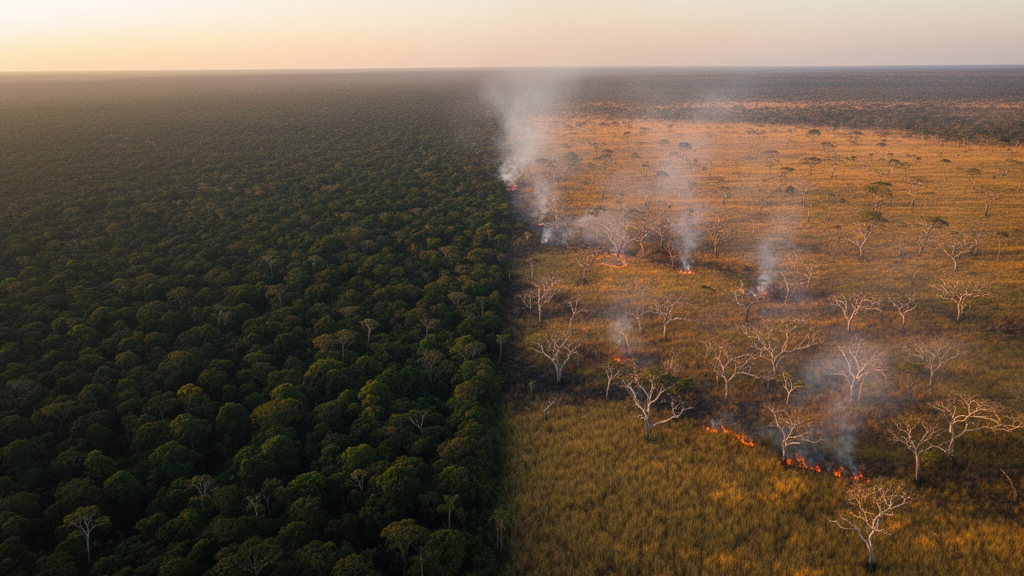
Brazil burns across two fundamentally different worlds: fire-adapted savannas that have burned for millennia, and fire-sensitive rainforests where flames arrive almost exclusively on the heels of deforestation. A new analysis of forty years of satellite burned-area data shows that these two fire worlds remain persistently, measurably separated in geographic space — and that the separation follows a single dominant gradient running from the Cerrado to the Amazon.
The study, published in the journal Fire Ecology, analyzed annual burned-area maps from MapBiomas Fire Collection 4 covering the entire Brazilian territory from 1985 to 2024. Rather than tracking total burned area, which the authors argue can mask critical geographic shifts, the researchers computed an annual burned-area centroid for the whole country — essentially a center of mass for every burned pixel in a given year — separately for two land-cover contexts: fire occurring in Natural Vegetation and fire occurring in Anthropogenic Land Use, as classified within the MapBiomas system.
The headline result is a persistent spatial gap. Across the four decades, the mean distance between the Natural Vegetation centroid and the Anthropogenic Land Use centroid was 308.2 kilometers, with a 95% bootstrap confidence interval of 304.6 to 312.9 kilometers and an observed range of 73 to 499 kilometers. Even in the year of closest convergence, 2011, the two centers of gravity remained 73 kilometers apart. A within-year permutation test, which randomly reassigned the context labels among burned patches 9,999 times, rejected the possibility that this separation arose by chance.
The separation is not just a matter of distance but of direction. When each annual centroid was projected onto a fixed axis defined by the geographic centers of the Cerrado and Amazon biome polygons — an axis established independently of the fire data to avoid circularity — a rank-based measure of separability yielded an area under the curve of 0.904, with a 95% confidence interval of 0.845 to 0.958. In practical terms, roughly 90% of possible pairs of annual centroids are correctly ordered along the Cerrado–Amazon gradient: natural-vegetation burning sits toward the savanna end, anthropogenic burning toward the rainforest end. Along a data-driven axis of maximal separation, that figure rises to 98%.
To understand what pulls the national centroid around from year to year, the authors treated Brazil-level centroids as biome-weighted centers of mass and applied two complementary diagnostics. Leave-one-out anchoring measured how far the national centroid would shift if a single biome were removed from the calculation, while geometric leverage captured the product of a biome’s burned-area share and its distance from the national centroid. The two contexts produced sharply different structures. Under Natural Vegetation, the Cerrado exerted the strongest anchoring effect, consistent with its status as Brazil’s fire-adapted savanna mosaic, where recurrent burning occurs under both natural and human ignition. The Amazon, by contrast, achieved the greatest geometric leverage in that context because its centroid often lies far from the national one. Under Anthropogenic Land Use, the Amazon dominated both anchoring and leverage, with the Cerrado and Atlantic Forest contributing secondarily.
The decomposition also separated two mechanisms behind year-to-year centroid movement: biome reweighting, meaning changes in each biome’s share of total burned area, and within-biome migration, meaning shifts in where burning occurs inside a biome even when its share stays stable. The study found that both mechanisms contribute, and that they frequently partially cancel each other out — component magnitudes can exceed the observed displacement when their vectors oppose one another, a relationship captured by a cancellation ratio. Some years were dominated by reweighting; the large displacements of 1992 and 1993 were driven mainly by within-biome movement despite comparatively stable biome shares.
The 2020 Pantanal fire season illustrates how a single extreme event can temporarily reorganize the national picture. That year, exceptional drought combined with human activity produced an unprecedented burning episode affecting nearly 30% of the biome. In the Natural Vegetation context, the Pantanal accounted for 27.98% of burned area in 2020 — a technical tie with the Cerrado at 27.86%, both behind the Amazon at 35.40%. This surge coincided with an elevated weight-driven component and a southward displacement of the national Natural Vegetation centroid, with near-complete alignment along the Cerrado–Amazon axis. The authors emphasize that this represents a short-lived reweighting rather than a persistent directional shift.
Overall, the along-axis analysis showed that a median of roughly 73% of the annual inter-context separation falls along the Cerrado–Amazon gradient, and that this alignment has strengthened over time, from a median of 0.56 in 1985–1994 to 0.81 in 2015–2024. The magnitude of along-axis separation correlated strongly with total inter-centroid distance, with a Spearman rank correlation of 0.70, though the authors note this association should be read descriptively because it was not adjusted for possible year-to-year autocorrelation.
The framework comes with clearly stated limitations. A centroid collapses an entire year’s burning into a single point, making it insensitive to multimodality — two distinct fire clusters can yield the same centroid as one concentrated cluster. Biome-level aggregation averages away within-biome heterogeneity, and the bootstrap confidence intervals treat burned patches as spatially independent, which likely understates positional uncertainty given that adjacent scars often belong to the same fire event. The authors also stress that the Natural Vegetation versus Anthropogenic Land Use split reflects land-cover context, not ignition source: human-set fires can occur in natural vegetation, and ecological fire can spread into farmland.
Despite these caveats, the study argues that centroid trajectories offer something aggregate burned-area totals cannot: a compact, reproducible indicator of macro-scale spatial reorganization. Because relatively modest changes in Amazonian burning can exert disproportionate leverage on the national signal, the framework provides a quantitative way to detect when fire activity in a fire-sensitive biome becomes consequential at the national scale. The authors suggest the approach could support Brazil’s National Policy for Integrated Fire Management by distinguishing years dominated by the expansion of burning into fire-sensitive landscapes from years dominated by reorganization within fire-prone regions, and by being nested within governance-relevant partitions such as tenure classes and deforestation frontiers. They also raise, explicitly as an untested research question, whether monthly burned-area centroids from the operational MapBiomas Fire Monitor could flag incipient spatial shifts within a fire season before they appear in annual totals.
Subject of Research: Spatial reorganization of burned area in Brazil from 1985 to 2024, analyzed through annual burned-area centroids separated by land-cover context
Article Title: Directional centroid trajectories reveal shifting fire activity across Brazilian biomes
Article References: Neto, M. B. R., & Hofmann, G. S. (2026). Directional centroid trajectories reveal shifting fire activity across Brazilian biomes. Fire Ecology, 22(1), Article 155. https://doi.org/10.1186/s42408-026-00588-z
Image Credits: AI Generated
DOI: 10.1186/s42408-026-00588-z
Keywords: Brazil, fire ecology, Cerrado, Amazon, MapBiomas, burned area, centroid analysis, remote sensing, land use, biome decomposition, integrated fire management, Pantanal
News Source: Drew Townsend. (October 29, 2026). Brazil’s Fires Split Along Cerrado–Amazon Divide, Four Decades of Data Show. Scienmag.