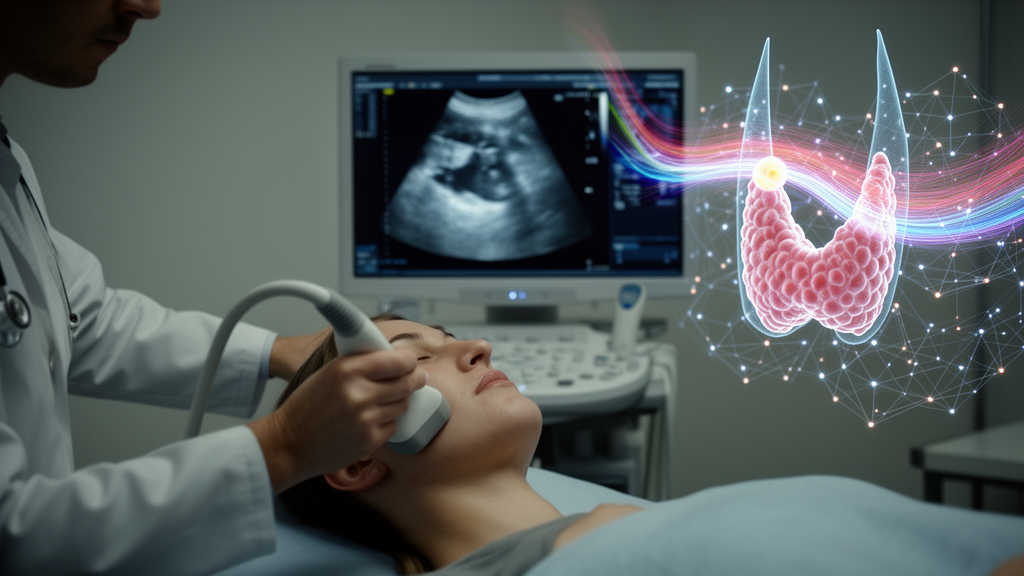
A new study in BMC Medical Informatics and Decision Making reports an explainable multimodal machine learning framework that combines ultrasound-derived clinical features with Raman spectra acquired from fine-needle aspiration samples, aiming to sharpen that decision.
The analytical cohort included 203 patients from a single center who underwent thyroid surgery. Postoperative histology classified 64 lesions as follicular adenomas and 139 as malignant, the latter comprising 117 papillary thyroid carcinomas, 21 follicular-variant papillary thyroid carcinomas, and one mixed lesion containing both follicular adenoma and papillary carcinoma tissue.
Architecturally, the model is a fixed stacking ensemble. A clinical Logistic Regression classifier processes the ultrasound-derived features, while a raw-Raman Extra Trees classifier handles the spectral data from the aspiration samples. A Logistic Regression meta-learner then fuses the outputs of the two base classifiers into a single prediction. This design lets each modality contribute independently before the meta-learner weighs their combined evidence.
Validation was deliberately conservative. The team used stratified fivefold cross-validation repeated 20 times, and critically, all data-dependent preprocessing, stacking, and operating-threshold selection were restricted to the training data within each fold.
The stacked model achieved a mean repeated out-of-fold AUC of 0.856, with a 95 percent case-level bootstrap confidence interval of 0.796 to 0.909 and a resampling standard deviation of 0.011. In an exploratory held-out analysis restricted to 93 TIR3A and TIR3B cytology cases, the diagnostic gray zone where clinical uncertainty is greatest, the AUC was 0.859, with a 95 percent confidence interval of 0.783 to 0.922 and a resampling standard deviation of 0.019.
These analyses identified model-dependent clinical and Raman associations that remained stable at the level of clinical features and Raman spectral regions across resampled outer folds, suggesting the model’s behavior was not driven by fold-specific artifacts.
The authors are explicit about the limits of these results. The cohort comes from a single center and consists entirely of patients who underwent surgery, a selection that does not reflect the full spectrum of thyroid nodules encountered in clinic. The held-out TIR3 analysis is described as exploratory rather than a definitive performance estimate.
Accordingly, the study concludes that the multimodal model showed promising internal discrimination, but that prospective multicenter validation of a locked model, together with a prespecified clinical decision strategy, is required before any claims about clinical utility or effects on surgical management can be made. Raman spectroscopy of fine-needle aspirates combined with explainable machine learning remains a research direction with encouraging early numbers rather than a deployed diagnostic tool.
Subject of Research: Explainable multimodal machine learning integrating ultrasound and Raman cytological features for thyroid cancer diagnosis
Article Title: Improving thyroid cancer diagnosis through stacked explainable machine learning integrating ultrasound and Raman cytological features
Article References: Di Gioacchino, M., Palermo, A., Diacono, D., Tommasi, R., Amoroso, N., Bellantuono, L., Crucitti, P., La Rocca, M., Longo, F., Marrocco, N., Monaco, A., Naciu, A. M., Pantaleo, E., Bellotti, R., Crescenzi, A., & Sodo, A. (2026). Improving thyroid cancer diagnosis through stacked explainable machine learning integrating ultrasound and Raman cytological features. BMC Medical Informatics and Decision Making. https://doi.org/10.1186/s12911-026-03922-2
Image Credits: AI Generated
DOI: 10.1186/s12911-026-03922-2
Keywords: thyroid cancer, machine learning, Raman spectroscopy, ultrasound, fine-needle aspiration, stacked ensemble, SHAP, cross-validation, papillary thyroid carcinoma, follicular adenoma, diagnostic AUC, single-center study
News Source: Ophelia Keating. (October 29, 2026). Stacked machine learning pairs ultrasound and Raman spectra to flag thyroid cancer. Scienmag.