Rising from the floor after a fall is something most people do without a second thought, but for individuals who have lost a leg above the knee, the movement is far from simple. A new study from Japanese researchers has now documented, in detail, the distinct strategies that people with unilateral transfemoral amputation use to get back on their feet, offering a rare window into the compensatory biomechanics of post-fall recovery.
The research, conducted by Yukihiko Mizuno, Ryota Morishima, Shio Katoh, Genki Hisano and Hiroaki Hobara, and published in Frontiers in Rehabilitation Sciences, focused on the floor-to-stand transition, abbreviated FTST. Lower-limb amputation is frequently associated with impaired mobility and an elevated risk of falls, making the restoration of functional independence a primary objective in rehabilitation.
Despite that clinical importance, the movement strategies employed by individuals with unilateral transfemoral amputation had remained poorly characterized. The absence of active knee control on the amputated side fundamentally alters the mechanics of standing up, since the intact limb and the upper body must compensate for the missing muscular control at the knee joint. Understanding exactly how people adapt could help clinicians design better training programs.
To fill this gap, the team recruited sixteen individuals with unilateral transfemoral amputation. Each participant performed a single floor-to-stand trial from a long-sitting position. The movements were video-recorded and then evaluated by independent reviewers, who classified the strategy each participant used to reach standing.
Two distinct strategies emerged from the analysis. In the first, observed in eleven of the sixteen participants, the rise was primarily supported by the intact limb, with assistance from one or both upper limbs.
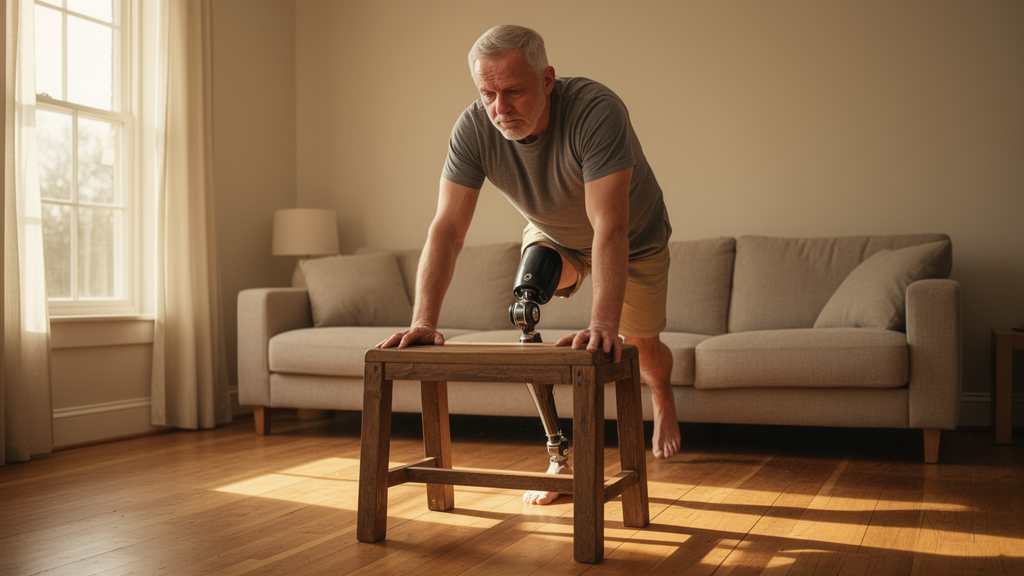
The second strategy, adopted by five participants, involved a trunk rotation into a quadruped-like posture followed by bilateral hand support to achieve standing. Rather than rising directly from long sitting, these individuals first rotated their trunk and repositioned themselves onto hands and knees, then used both hands to push up to standing.
When the researchers compared the demographic and clinical characteristics of the two groups, they found no statistically significant differences between them. However, the data pointed to suggestive patterns that did not reach statistical significance. Participants who adopted the trunk-rotation strategy tended to be older than those who used the intact-limb strategy, and they also required more time to complete the floor-to-stand transition. The authors are careful to frame these observations as tendencies rather than established differences, given the small sample size and the lack of statistical significance.
The study’s authors interpret these findings as highlighting the compensatory biomechanical adaptations that individuals with transfemoral amputation employ in the absence of active knee control. Because the prosthesis cannot actively flex and extend the knee the way biological muscle does, every rise from the floor must be engineered around that limitation, whether by loading the intact limb heavily or by reorganizing the movement into a hands-and-knees intermediate step.
Based on their observations, the researchers suggest that rehabilitation should emphasize movement-specific training that accounts for biomechanical demands and age-related differences, with the goal of enhancing safety and efficiency during post-fall recovery.
As the authors note, the study is a brief research report based on a single trial per participant in a small sample of sixteen individuals, so the findings should be read as an initial characterization rather than a definitive classification. Nevertheless, by systematically documenting how people with above-knee amputation actually rise from the floor, the work provides a concrete foundation for future studies and for rehabilitation approaches aimed at safer, more independent post-fall recovery.
Subject of Research: Floor-to-stand transition strategies used by individuals with unilateral transfemoral amputation
Article Title: Floor-to-stand transition strategies observed in individuals with unilateral transfemoral amputation
Article References: Mizuno, Y., Morishima, R., Katoh, S., Hisano, G., & Hobara, H. (2026). Floor-to-stand transition strategies observed in individuals with unilateral transfemoral amputation. Frontiers in Rehabilitation Sciences, 7, Article 1959397. https://doi.org/10.3389/fresc.2026.1959397
Image Credits: AI Generated
DOI: 10.3389/fresc.2026.1959397
Keywords: transfemoral amputation, floor-to-stand transition, prosthesis, fall recovery, rehabilitation, biomechanics, mobility, amputee, knee control, physical therapy, Floor-to-stand, transition
News Source: Ophelia Keating. (October 29, 2026). How People with Above-Knee Amputations Rise from the Floor After a Fall. Scienmag.