Yet the freeze-thaw process itself is punishing to sperm cells. Ice crystals form, osmotic balance is disrupted, and reactive oxygen species accumulate, damaging the delicate plasma membrane and the acrosome, the enzyme-filled cap the sperm needs to fertilize an egg. Researchers have long searched for additives that can be mixed into freezing extenders to blunt this damage, and a new preliminary study now offers a careful, quantified comparison of three candidate compounds under identical laboratory conditions.
The study, published in Acta Veterinaria Scandinavica, tested trehalose, low-dose pentoxifylline, and the mitochondria-targeted antioxidant MitoTEMPO, both individually and in combination, as supplements for ram semen cryopreservation. Semen was collected from six clinically healthy adult Merino rams aged two to three years, maintained at a university research farm during the breeding season. Collections took place twice weekly over four weeks using a sterilized artificial vagina pre-warmed to 44 to 45 degrees Celsius. Only ejaculates meeting strict quality thresholds were accepted: mass motility of at least 3 on a 0-to-5 scale, sperm concentration of at least 2.5 billion per millilitre, motility of at least 70 percent, and abnormal morphology of no more than 15 percent.
Eligible ejaculates were pooled on each collection day to minimize individual variation and to provide enough volume for simultaneous allocation to all treatment groups. The pooled semen was divided into eight groups: an untreated control, trehalose at 50 millimolar, pentoxifylline at 0.25 or 0.5 micromolar, MitoTEMPO at 0.025 or 0.05 millimolar, and two combinations of MitoTEMPO with pentoxifylline at 0.5 micromolar. All additives were incorporated into a Tris-based extender containing egg yolk and 6 percent glycerol before freezing. The procedure was repeated on eight separate occasions, producing eight independent pooled ejaculates per treatment group, with each pooled ejaculate treated as one biological replicate.
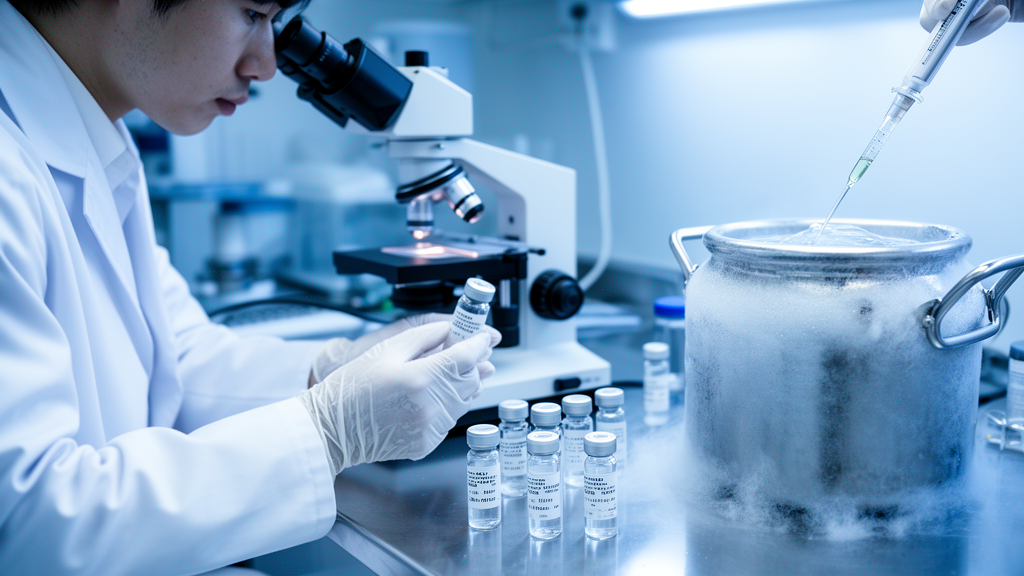
Diluted semen was loaded into 0.25 millilitre French straws, sealed with polyvinyl alcohol powder, and equilibrated at 5 degrees Celsius for two hours. The straws were then held in liquid nitrogen vapour at roughly minus 110 to minus 120 degrees Celsius, about four centimetres above the nitrogen surface, for fifteen minutes before being plunged into liquid nitrogen for long-term storage. Thawing took place in a 37 degree water bath for thirty seconds, and for each replicate three straws per group were thawed and averaged to generate a single replicate-level value for statistical analysis.
Evaluation covered six endpoints. Post-thaw motility was assessed by phase-contrast microscopy at 400 times magnification by a single experienced operator blinded to treatment groups, with at least five randomly selected fields and at least 200 spermatozoa counted per evaluation. Plasma membrane integrity was measured with SYBR 14 and propidium iodide fluorescent staining, acrosome integrity with fluorescein isothiocyanate-conjugated peanut agglutinin and propidium iodide, and capacitation status with the chlortetracycline fluorescence assay. Total antioxidant capacity and total oxidant status were determined with commercial colorimetric assays based on Erel’s spectrophotometric methods, expressed as Trolox and hydrogen peroxide equivalents respectively. Because each pooled ejaculate was divided among all treatment groups, the data were analysed with a linear mixed-effects model, with treatment as a fixed effect and pooled ejaculate as a random effect, followed by Sidak-adjusted pairwise comparisons where the overall effect was significant.
The results were clear for two of the three additives. Trehalose at 50 millimolar significantly raised post-thaw motility from 31.25 plus or minus 4.43 percent in the control group to 42.50 plus or minus 5.35 percent, plasma membrane integrity from 53.78 plus or minus 2.47 percent to 65.29 plus or minus 4.14 percent, and acrosome integrity from 54.66 plus or minus 4.41 percent to 69.69 plus or minus 1.48 percent, all at P less than 0.05. Pentoxifylline at 0.5 micromolar also outperformed the control, delivering motility of 40.63 plus or minus 4.96 percent, plasma membrane integrity of 64.24 plus or minus 2.09 percent, and acrosome integrity of 64.56 plus or minus 2.69 percent. Notably, pentoxifylline at 0.25 micromolar also showed significantly higher plasma membrane and acrosome integrity than the control, although the abstract highlights the 0.5 micromolar dose as the effective level for the broader trait set.
The oxidative balance measurements added further nuance. The overall treatment effect was significant for total antioxidant capacity, with P less than 0.001, and Sidak-adjusted pairwise comparisons confirmed that trehalose and pentoxifylline at 0.5 micromolar achieved significantly higher antioxidant capacity values than the control group. Total oxidant status showed a significant overall treatment effect at P equal to 0.037, but the pairwise comparisons did not identify significant differences between individual treatment groups, so the authors interpreted no group-specific differences in oxidant levels. Capacitation status, assessed by the chlortetracycline index, did not differ significantly among groups at P equal to 0.178, which the researchers read as evidence that the effective additives preserved sperm structure without triggering premature capacitation-like changes after thawing.
MitoTEMPO told a different story. Despite its rationale as a mitochondria-targeted superoxide scavenger, and despite prior reports of benefits in chilled ram semen and cryopreserved sperm from other species, MitoTEMPO alone at either tested dose did not significantly improve the main post-thaw quality traits compared with the control group. The two MitoTEMPO plus pentoxifylline combinations likewise failed to provide a significant additional benefit over trehalose or pentoxifylline at 0.5 micromolar alone. The authors caution against overinterpreting these negative findings, noting that the effect of MitoTEMPO on sperm cryopreservation may vary according to species, extender composition, glycerol concentration, dose, and post-thaw evaluation time, and that reducing mitochondrial ROS alone may have been insufficient to counteract the combined osmotic, membrane, acrosomal, and structural injuries inflicted by freezing and thawing.
The study carries several important limitations that the authors themselves flag. Sperm motility was evaluated by subjective microscopic assessment rather than a computer-assisted sperm analysis system, which would have provided more objective kinematic data. Semen samples were pooled before treatment allocation, which prevented evaluation of individual ram responses and inter-animal variability, and detailed breeding histories and fertility records for the rams were not available. Most importantly, no fertility trials were performed, so improvements in laboratory sperm quality parameters cannot be assumed to translate directly into improved reproductive performance. The findings should therefore be interpreted at the pooled-ejaculate level and as strictly preliminary.
Even with those caveats, the study offers a useful head-to-head benchmark for extender supplementation in ram semen cryopreservation. Under these specific experimental conditions, trehalose and pentoxifylline at 0.5 micromolar improved motility, membrane integrity, acrosome integrity, and total antioxidant capacity, while MitoTEMPO alone and the combination treatments did not deliver statistically supported additional benefits. The authors call for future work using individual ejaculates, dose-response designs, optimized additive concentrations, computer-assisted sperm motion analysis, and in vivo fertility outcomes before any practical recommendations can be made.
Subject of Research: Cryoprotective additives for improving post-thaw quality of frozen ram semen
Article Title: Preliminary in vitro effects of trehalose, pentoxifylline and MitoTEMPO on post-thaw quality of ram semen
Article References: Öztürk, C., Bodu, M., Öztürk, A. E., Bucak, M. N., Aksoy, N. H., Arslan, R., & Ataman, M. B. (2026). Preliminary in vitro effects of trehalose, pentoxifylline and MitoTEMPO on post-thaw quality of ram semen. Acta Veterinaria Scandinavica, 68(1), Article 37. https://doi.org/10.1186/s13028-026-00882-5
Image Credits: AI Generated
DOI: 10.1186/s13028-026-00882-5
Keywords: ram semen, cryopreservation, trehalose, pentoxifylline, MitoTEMPO, sperm motility, oxidative stress, antioxidants, sperm membrane integrity, acrosome integrity, artificial insemination, reproductive biotechnology
News Source: Drew Townsend. (October 29, 2026). Trehalose and Pentoxifylline Boost Frozen Ram Sperm Quality in Preliminary Lab Study. Scienmag.