A machine-learning study of breast cancer patients has found that MRI-based radiomics can help predict which patients will achieve a pathological complete response to neoadjuvant chemotherapy, but that the most complex combined model may have been overfitted to its training data.
The retrospective single-center study, published in BMC Medical Imaging, included 272 patients treated between May 2020 and May 2025. Pathological complete response, meaning no residual tumor in the breast and no residual tumor in sampled axillary nodes, was determined using the Miller-Payne grading system. In total, 98 patients, or 36.03 percent, achieved pCR.
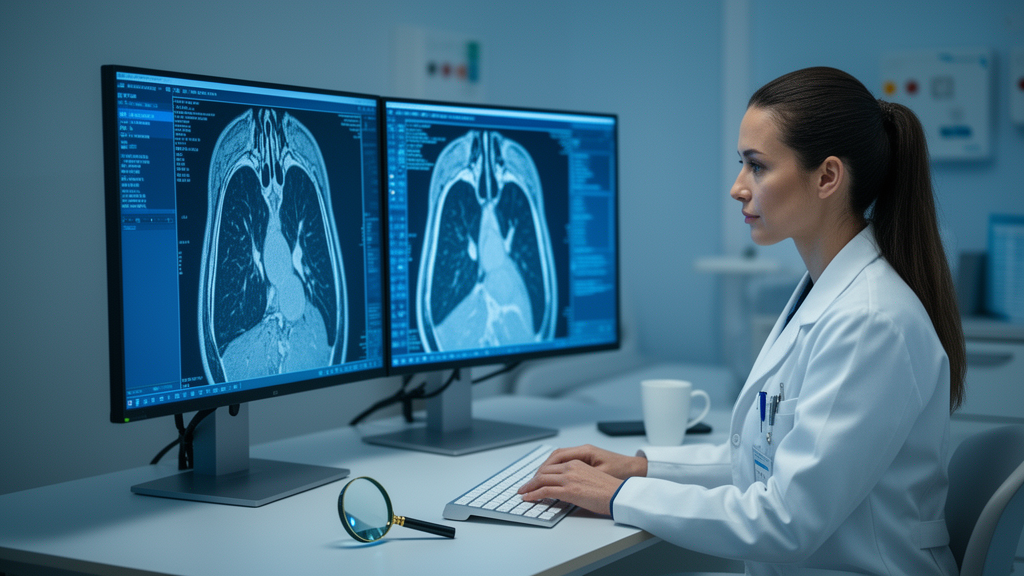
The researchers extracted 1,834 features from pretreatment phase-3 dynamic contrast-enhanced MRI scans using the PyRadiomics software. Feature selection proceeded in stages: Mann-Whitney U testing and Spearman redundancy pruning retained 34 features, from which LASSO regression selected 17 with non-zero coefficients.
A key methodological feature of the study was the strict separation of data. All feature selection and hyperparameter tuning were performed exclusively in a training cohort of 217 patients, while a held-out test cohort of 55 patients was used only once for final evaluation. This design allows an honest assessment of how well each model generalizes to unseen data.
Three machine-learning approaches were compared: logistic regression, a radial-basis-function support vector machine, and a multilayer perceptron. The SVM-based radiomics model performed best among the radiomics models, achieving a training AUC of 0.873 and a test AUC of 0.782, indicating moderate discrimination that held up reasonably well in the independent cohort.
Perhaps surprisingly, a simple clinical signature based on only two variables, HER2 status and axillary nodal status, proved to be the most stable model. It achieved a training AUC of 0.885 and a test AUC of 0.806, meaning that HER2-positive and node-negative patients were robustly identified as those most likely to achieve a complete response.
The combined radiomics-clinical nomogram told a different story. Although it recorded the highest training AUC at 0.901, its performance dropped markedly in the test cohort, where the AUC fell to 0.686 with a wide 95 percent confidence interval of 0.350 to 1.000. The decision curve analysis advantage seen in training was also not reproduced in the small test cohort, and the authors attribute this to possible overfitting.
The study’s conclusions are cautious. The authors state that MRI radiomics provided moderate complementary discrimination, but that the incremental benefit of the combined nomogram was not confirmed in the independent test cohort. They emphasize that radiomics-based models require stratified or external validation before any clinical deployment.
For patients and clinicians, the findings underscore that established clinical markers such as HER2 status and nodal status remain the most reliable predictors of response in this dataset, while advanced imaging-based models still need validation in larger, external cohorts before they can inform treatment decisions.
Subject of Research: Machine learning models based on DCE-MRI radiomics for predicting pathological complete response after neoadjuvant chemotherapy in breast cancer
Article Title: MRI-based radiomics analysis: comparative application of different machine learning models in predicting pathological complete response after neoadjuvant chemotherapy for breast cancer
Article References: Li, H., Zhang, L., Zeng, Y., Ye, Z., & Zhang, Y. (2026). MRI-based radiomics analysis: comparative application of different machine learning models in predicting pathological complete response after neoadjuvant chemotherapy for breast cancer. BMC Medical Imaging. https://doi.org/10.1186/s12880-026-02917-9
Image Credits: AI Generated
DOI: 10.1186/s12880-026-02917-9
Keywords: breast cancer, MRI radiomics, machine learning, neoadjuvant chemotherapy, pathological complete response, DCE-MRI, support vector machine, nomogram, HER2, overfitting, BMC Medical Imaging, MRI-based
News Source: Nathaniel Bowman. (October 28, 2026). MRI radiomics models show promise but limited stability in predicting breast cancer response to chemotherapy. Scienmag.