Where should an autonomous vehicle put its outward-facing displays so that pedestrians actually see them? A new analytical study offers one of the most granular answers yet: the parts of a vehicle most often visible to a pedestrian waiting on the sidewalk are the wheels, the front fenders, and the headlights. Based on those results, the researchers propose that external human-machine interfaces, or eHMIs, be installed on at least two of three regions: the windshield, the front fenders, or the side mirrors. The work, published in the journal Autonomous Intelligent Systems, was carried out by Jose Gonzalez-Belmonte and Jaerock Kwon.
External human-machine interfaces are the screens, lights, and other signaling devices that an autonomous vehicle can use to communicate with people outside the cabin. With conventional cars, drivers rely on body language, eye contact, and other implicit social cues to negotiate ambiguous situations with pedestrians, and the arrival of driverless vehicles removes those cues from the road. eHMIs were introduced as a way to replace them, letting the vehicle explicitly express its intent. Previous studies have tested whether eHMIs work and what symbols they should display, but comparatively few have tackled a more basic question: where on the vehicle should they be placed so they are visible as often as possible?
To answer that question, the team built a simulation in the Unity game engine that measures what they call the exposedness of different points on a vehicle’s exterior, using the Merriam-Webster sense of exposed as open to view and not shielded. The virtual environment is a two-way street with alleyways intersecting it from both sides. The main road is 6.94 meters wide and 57.719 meters long, the sidewalks are 2.216 meters wide and stand 0.102 meters above the road, and the scene is populated with static obstacles including twelve bollards and sixteen lamp posts that can partially block a pedestrian’s view.
The simulation recorded fifteen different vehicle types, from a motorcycle and a smart car to a sedan, an SUV, a panel van, a pickup truck, a moving truck, a motor home, and single- and double-decker buses. The models were selected using vehicle classifications from the Federal Highway Administration as a base, downloaded from Sketchfab under Creative Commons licenses, and resized to match the dimensions of their closest real-life equivalents. The vehicles were grouped into four size categories: small, medium, large, and extra large, based on their length and class.
Each vehicle was tested under fifty-seven different scenarios, a first for this kind of study. In every scenario, one vehicle is designated the Target Vehicle, the only one whose visibility is recorded, while the remaining positions on the road are filled with Blocking Vehicles that use the same model and exist purely to occlude the target from view, replicating conditions such as vehicles queued in a line. The program generates all possible permutations of target and blocking vehicle placements across eight possible vehicle positions, including six spots on the main road and two alleyway positions where a vehicle crosses the sidewalk.
A virtual camera, standing in for a pedestrian on the left sidewalk, cycles through ten camera positions placed 1.2 meters from the street, eight facing directions in 45-degree increments, and five heights: 1.0, 1.2, 1.4, 1.6, and 1.8 meters, chosen to approximate the height of the median American at ages 3, 6, 10, 13, and 20. During each data capture, the camera casts 14,400 rays in a 160 by 90 grid with a 60-degree horizontal field of view. When a ray hits the target vehicle, the point of contact is rounded to the nearest grid point on the vehicle’s mesh, and a counter at that point is incremented. Each grid point can only be counted once per capture, which corrects for a proximity bias that would otherwise inflate counts when the camera is close to the vehicle.
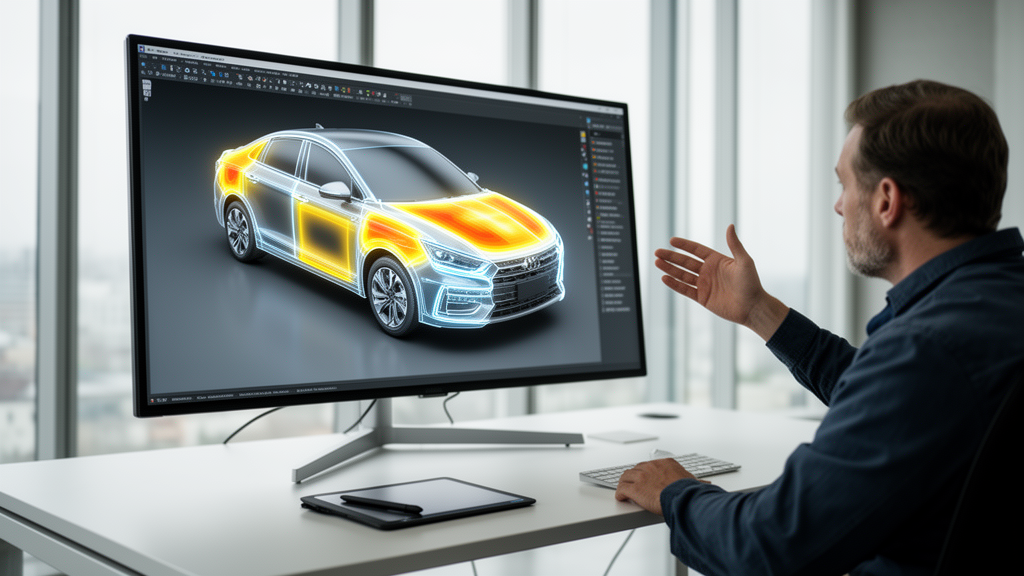
The simulation was run nineteen times per vehicle, producing 860 output files, with runs lasting from one minute to eight hours on two desktop computers. Results were divided by the vehicle’s facing direction and by three distance ranges between the camera and the vehicle: 0 to 5 meters, 5 to 25 meters, and 25 to 75 meters, yielding 180 heatmaps in total. The analysis showed that position on the road matters considerably: vehicle parts were most consistently captured when the vehicle was in the lane adjacent to the pedestrian, where fewer blocking vehicles could occlude it. In the 5 to 25 meter range, the parts with the highest average exposedness scores were the front wheels, front fenders, headlights, side mirrors, and rear wheels. In the 25 to 75 meter range, the rear wheels led, followed by the front wheels, headlights, front bumper, and windshield, and the authors note a drop in resolution at long distances because the spacing between captured points grows with distance from the camera.
The findings connect with earlier eye-tracking research in instructive ways. Previous work found that pedestrians tend to fixate on the windshield and lose their willingness to cross when a vehicle is within about 40 meters, yet the present study reveals that the windshield is also an area easily occluded by other elements on the road, standing out mainly in the 25 to 75 meter range. The conclusion by an earlier 3D simulation study that the sides of vehicles are a good placement for eHMIs is backed by the new data, since wheels and fenders are lateral elements with high exposedness scores. Headlights, which already carry turning lights, also scored highly, consistent with findings that pedestrians focus on the front of the vehicle during crossing events, though the authors raise concerns about visual distinction and overload if signaling is concentrated there.
From these results, the researchers recommend a distributed approach to eHMI placement rather than a single standardized location, offering three recommended pairings of forward-facing surfaces: windshield and front fenders, which provide three large display surfaces; windshield and side mirrors, which provide one large surface and two smaller ones; and front fenders and side mirrors, which provide one large and two secondary surfaces that pedestrians do not usually gaze at. Each pairing suits different vehicle types, and the authors note that wheels, despite their high scores, are impractical because they can be obstructed by high sidewalks and puddles and are difficult and costly to fit with displays. The results also suggest that larger displays are needed, particularly on smaller vehicles, given how exposedness changes with distance.
The authors are careful to spell out the study’s limitations. The ray-casting method captures only the geometry of the vehicle, ignoring reflections, color, and finish, as well as poor weather, low light, and visual impairment. The camera’s specifications, a single point source with a 60-degree field of view and 160 by 90 resolution, resemble a digital camera more than binocular human vision. The environment included no parked vehicles, kiosks, or bikes as obstacles, each road side has a single lane, blocking vehicles always matched the target vehicle’s type, and all vehicles were static, so the subtle perspective changes of moving traffic were not replicated. Model detail also varied across the freely downloaded 3D assets. The team describes the software, whose code and data are publicly available, as a platform for future work on left-hand driving, mixed vehicle types, moving vehicles, and virtual reality tests of the recommended placements.
Subject of Research: Simulation-based analysis of which exterior vehicle surfaces are most visible to pedestrians for external human-machine interface placement on autonomous vehicles
Article Title: Analytical study on the exposedness of potential positions for external human-machine interfaces
Article References: Gonzalez-Belmonte, J., & Kwon, J. (2026). Analytical study on the exposedness of potential positions for external human-machine interfaces. Autonomous Intelligent Systems, 6(1), Article 16. https://doi.org/10.1007/s43684-026-00139-y
Image Credits: AI Generated
DOI: 10.1007/s43684-026-00139-y
Keywords: autonomous vehicles, external human-machine interfaces, eHMI placement, pedestrian safety, vehicle-pedestrian communication, Unity simulation, ray-casting, exposedness analysis, vehicle design, windshield displays, human-machine interaction, traffic simulation
News Source: Denise Maddox. (October 28, 2026). Simulation Reveals Which Parts of a Vehicle Are Best for Pedestrian Displays. Scienmag.