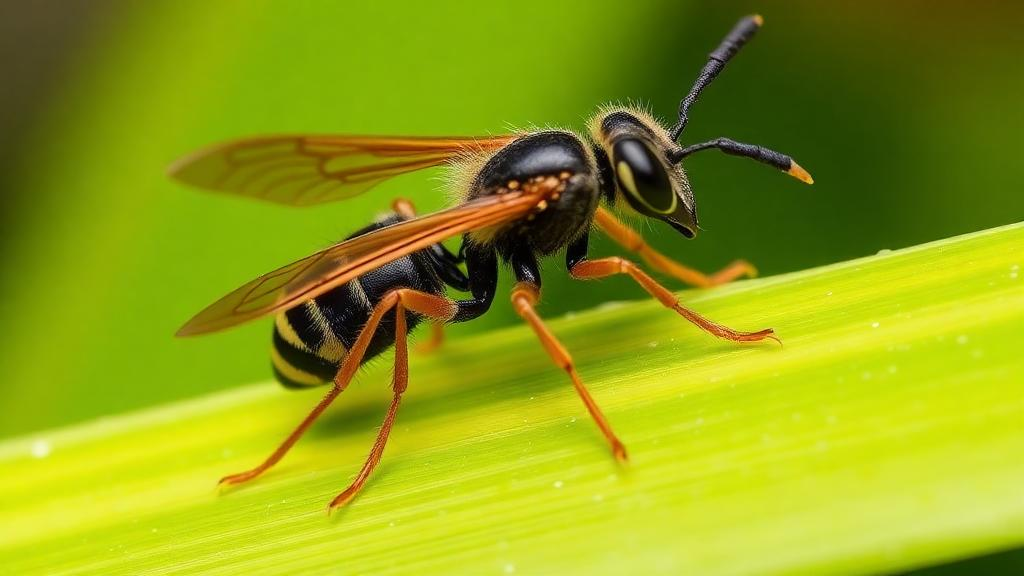
A laboratory study of the egg parasitoid wasp Telenomus busseolae has documented a steady erosion of the traits that make the insect useful in pest control. Over ten successive generations reared on eggs of the sugarcane stem borer Sesamia nonagrioides, the wasp’s parasitism rate fell from 85.2 percent to 61.3 percent, its fertility dropped from 42.1 to 25.7 parasitized eggs per female, its emergence rate declined from 92.3 to 71.8 percent, and female longevity shrank from 9.2 to 5.8 days. The offspring sex ratio, strongly female-biased in the earliest generations, drifted toward an even split by later ones.
After pupation, moths were sexed by genital slit morphology and paired in oviposition cages, and only egg masses laid after confirmed mating entered the experiments.
To measure quality across the rearing timeline, the researchers evaluated seven generations: F0, F1, F3, F5, F7, F8 and F10. For each generation, 30 randomly selected mated females were housed individually in glass tubes and given 30 fresh host eggs, less than 24 hours old, every day until death. Host eggs were glued onto strips of radiographic polyester film with a honey-water solution, and adult wasps received filter paper strips soaked in 20 percent honey-water. Parasitism rate was standardized as the proportion of eggs parasitized during the first 24 hours of exposure, while fertility counted the total number of eggs parasitized over a female’s lifetime. Emergence rate was calculated as the share of parasitized eggs bearing exit holes, and offspring sex ratios were scored for each generation.
Parasitism rates differed significantly among generations, with F0 highest at 85.2 percent and F10 lowest at 61.3 percent, a 28.1 percent relative decline. Fertility also varied significantly, falling from 42.1 parasitized eggs per female in F0 and 39.5 in F1 to 25.7 in F10, a 39.0 percent drop. Female lifespan decreased significantly from 9.2 days to 5.8 days, a 37.0 percent reduction. Emergence rate, arcsine-square-root transformed before analysis, declined significantly by 22.2 percent across the same span. A logistic analysis of variance using a binomial generalized linear model confirmed a significant overall effect of generation on offspring sex ratio, with Wald chi-square of 18.45 on six degrees of freedom and a p-value of 0.005.
In the F0 and F1 generations, offspring sex ratios were significantly female-biased, at roughly 75 percent female in the field-derived generation, deviating significantly from a 1:1 expectation.
Why does laboratory rearing degrade a parasitoid so quickly? The discussion section assembles several interacting explanations. Continuous rearing on a single host species may create nutritional shortfalls. Inbreeding depression, the increased homozygosity that arises when genetically related individuals mate, exposes deleterious recessive alleles; in haploid males these alleles are always expressed, compromising survival and reproduction. Reduced emergence rates may reflect increased embryonic mortality from such deleterious alleles, while shortened longevity points to declining stress tolerance and metabolic efficiency. The authors note that the deterioration they observed within ten generations was disproportionately faster than in related systems, citing work showing that Trichogramma brassicae maintained quality for more than 40 generations under similar rearing conditions.
The comparison with other parasitoid systems sharpens the practical message. Studies on Telenomus remus and various Trichogramma species have repeatedly shown that rearing conditions significantly shape biological quality and that, without rigorous assessment and selection of robust isolines, mass-reared parasitoids frequently exhibit reduced parasitism rates, fertility and suboptimal sex ratios. Laboratory rearing of T. remus has been reported to reduce foraging and flight capacity, undermining field efficacy. The authors caution that direct cross-species comparisons require standardized experimental protocols, so the contrast should be read as suggestive rather than definitive.
The study has acknowledged limitations. The host colony was maintained under strict environmental and dietary controls, but wild-type moths were not periodically introduced into it, meaning any untracked decline in host quality or genetic bottleneck effects from the initial field collection could have compounded the apparent decline in parasitoid parameters. The authors also note that while arcsine-square-root transformation followed by analysis of variance provided robust comparisons, future work on proportional data such as parasitism and emergence rates could employ binomial logistic regression for a more appropriate statistical framework.
For biological control practitioners, the recommendations are concrete. The authors advise periodic introduction of field populations or wild genetic material into laboratory colonies, optimization of rearing diets, and stringent environmental control to sustain the efficacy of T. busseolae in augmentative release programs. They also point to iso-female line selection as a potential tool for preserving robust genetic lines.
Subject of Research: Decline in biological quality of the parasitoid wasp Telenomus busseolae across successive laboratory generations reared on sugarcane stem borer eggs
Article Title: Biological quality assessment of different generations of the parasitoid, telenomus busseolae Gahan (Hymenoptera: Scelionidae) reared on eggs of the sugarcane stem borer sesamia nonagrioides Lefèbvre (Lepidoptera: Noctuidae)
Article References: Safaran, M., Yarahmadi, F., Zandi-Sohani, N., & Rajabpour, A. (2026). Biological quality assessment of different generations of the parasitoid, telenomus busseolae Gahan (Hymenoptera: Scelionidae) reared on eggs of the sugarcane stem borer sesamia nonagrioides Lefèbvre (Lepidoptera: Noctuidae). Egyptian Journal of Biological Pest Control, 36(1), Article 27. https://doi.org/10.1186/s41938-026-00909-z
Image Credits: AI Generated
DOI: 10.1186/s41938-026-00909-z
Keywords: Telenomus busseolae, Sesamia nonagrioides, sugarcane stem borer, biological control, mass rearing, inbreeding depression, parasitism rate, sex ratio, emergence rate, fertility, Khuzestan, egg parasitoid
News Source: Drew Townsend. (October 28, 2026). Laboratory Generations of Sugarcane Parasitoid Wasp Lose Fitness Within Ten Generations. Scienmag.