


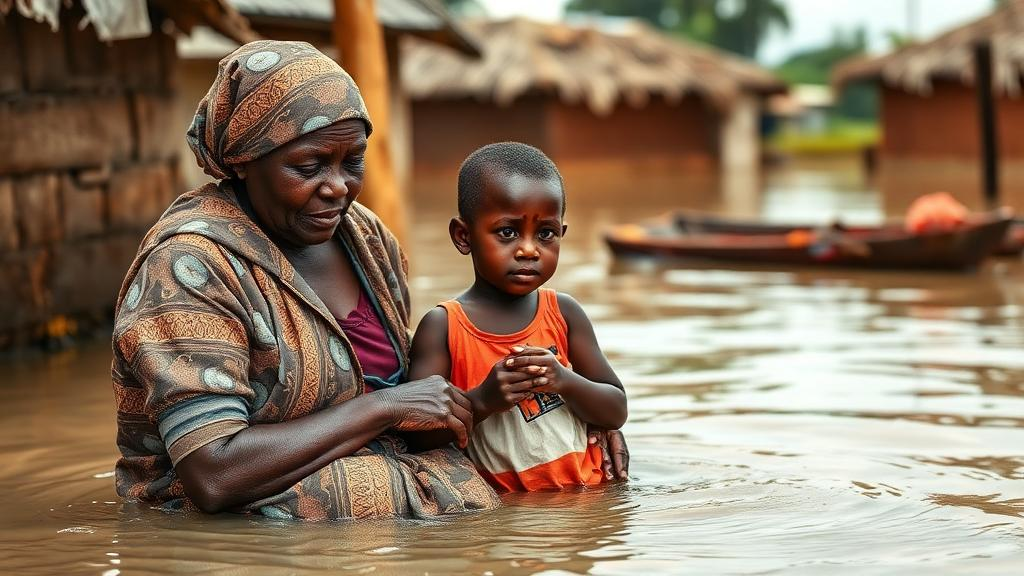
In Benue State, Nigeria, flooding is not an occasional disaster but a recurring feature of daily life, and a new qualitative study documents how mothers, health workers, community leaders, and policymakers describe its toll on maternal mental health and the conditions that shape early childhood development. The research, published in Frontiers in Public Health, drew on six focus group discussions and six individual interviews with 54 participants across three local government areas, Makurdi, Gboko, and Otukpo, and found that climate-related disruption was woven through nearly every aspect of household life, from sleep and food security to schooling, safety, and family relationships.
The study used a qualitative descriptive design, combining focus group discussions with semi-structured interviews and analysing the material through reflexive thematic analysis. Twenty-four mothers of children aged zero to five and twenty-four frontline health workers took part in focus groups, one group for each stakeholder category in each local government area, with eight participants per group. Three policymakers and three community leaders gave individual interviews, one of each per area. Data collection ran from late February to late March 2026 and was conducted in Tiv, Idoma, Nigerian Pidgin, and English, with recordings transcribed verbatim and translated with attention to preserving contextual meaning. Twelve participants later reviewed transcripts and preliminary interpretations, and no substantive disagreements were raised.
The sample was deliberately structured rather than driven by data saturation, which the authors note is inconsistent with reflexive thematic analysis; instead, they judged adequacy through information power given the focused aim and quality of dialogue. Among the mothers, 62.5 percent were aged thirty to thirty-nine, three-quarters had secondary education, and half relied on trading as their main household income source. Nearly all, 95.8 percent, had experienced flooding in the preceding two years, and 70.8 percent reported flood-related displacement. Health workers were predominantly female and mostly community health extension workers employed in primary health centres. All the community leaders and policymakers were male, and half reported direct involvement in flood response and policy activities.
Analysis generated five themes. The first concerned flooding exposure and spatial-infrastructural vulnerability. Participants framed flooding as a regular aspect of life rather than an exceptional event. One community leader in Otukpo said the frequency was high because every year when it rains there is bound to be flood, while a policymaker in Makurdi described a trend in which certain local government areas are usually affected when flooding comes. Flood-prone communities were described as low-lying, river-bound, and typically occupied by low-income families who could not afford land elsewhere. Participants also linked severity to infrastructure: absent street drainage that left water standing, houses built across water channels, poor roads, and obstructed passages. Some of these infrastructure failures extended to healthcare access, with a health worker in Otukpo noting that inaccessible roads meant patients could not reach the hospital.
The second theme, household disruption and caregiving strain, captured flooding as a compound shock. Mothers described losing beds, clothes, and domestic space, while community leaders reported families sleeping outside with mattresses and children. Economic consequences followed: crop loss, disrupted trading, and inability to work during flood periods. One policymaker described putting all income into a farm only to have the flood wipe it away, returning to square one. Food and water insecurity tracked these losses, with participants describing contaminated water sources, destroyed food stocks, and compromised cooking. Caregiving itself became more labour-intensive, with mothers describing the struggle to find food before children could eat and the impossibility of cooking when a home was submerged. Night-time routines broke down during the rainy season, and extreme heat added further strain, particularly for mothers fanning children who could not sleep from night till daybreak.
The third theme addressed maternal psychological distress under climate stress, and the authors are explicit that these accounts represent participants’ descriptions of emotional and psychological strain rather than clinically assessed maternal mental health outcomes. Mothers described anticipatory worry that began when clouds gathered and rain signalled the possibility of renewed flooding. Community leaders associated anxiety and instability among mothers with flooding, saying it instils fear in mothers’ minds. Distress was tied to children’s wellbeing as well as household conditions, with mothers describing children crying for food they had no way to obtain and health workers observing mothers constantly thinking about how to keep children okay. Economic losses added another layer, with damaged household items, washed-away farmlands, and lost market income described as producing repeated setbacks and uncertainty. Participants also reported that these pressures affected family stability, with one community leader attributing marital breakdown to flooding-related hardship. Stigma and cultural beliefs, including attributing distress to traditional belief rather than seeking medical treatment, were described as barriers to formal mental health care.
The fourth theme covered early childhood development implications. Participants described climate-related disruption as affecting not only children’s immediate health but the broader conditions necessary for development across nutrition, illness exposure, healthcare and immunisation access, learning continuity, safety, caregiving, and social interaction. Nutrition was prominent: mothers reported difficulty feeding children after flooding damaged food supplies or limited safe water, and health workers and community leaders associated these conditions with child malnutrition, with one community leader noting inadequate food and unsafe water contributing to conditions such as kwashiorkor, a severe form of protein-energy malnutrition characterised by oedema and impaired growth. Access to healthcare was disrupted by bad roads, and participants linked flooding to interruption of routine immunisation services. Schooling was also affected, with one community leader noting that from August onward children could not be seen going to school. Displacement disrupted familiar routines, caregiving arrangements, and social support networks. Safety concerns were acute, with community leaders describing floodwaters as capable of carrying away small children and highlighting insecurity around displacement and temporary shelter.
The fifth theme documented coping, protection, and response gaps. Communities mobilised collectively, with leaders describing efforts to clear blocked drainage channels and create pathways for floodwater drainage, though participants acknowledged the limits of such action without broader infrastructure support. Neighbours, family members, and religious networks provided temporary shelter, food, and assistance. Policymakers described formal mechanisms including a WASH Emergency Technical Working Group that responded with awareness campaigns, movement of people to safe places, and preparedness, plus relief supplies of food and clothing to impacted households. Yet operational challenges persisted: health personnel were described as insufficient during floods, logistics posed difficulties, and lack of collaboration left the Ministry of Health inadequately carried along in some activities. Community leaders emphasised the absence of medium-term and long-term support for resettlement and recovery, describing recurring flooding as requiring repeated short-term coping in the absence of sustained structural support.
The authors situate these findings within a broader evidence landscape. They note that perinatal mental health problems are estimated to be more prevalent in low- and middle-income countries, citing a pooled prevalence of perinatal depression of 24.7 percent from a systematic review and meta-analysis of 589 studies across 51 countries, and that emerging evidence suggests climate-related events including floods and storms can exacerbate these vulnerabilities. They also point to Nigerian flood exposure figures, noting that around 24.7 million people, about 8.3 percent of the population, were exposed to flooding in 2015 with exposure increasing over time. The study’s limitations are clearly stated: it was conducted in a single state, all community leaders and policymakers were male so fathers’ perspectives were not captured, findings rely on self-reported accounts subject to recall and social desirability bias, translation across four languages may have lost some nuance, and extreme heat was explored only with mothers and health workers, not with policymakers or community leaders. Maternal mental health was explored through participants’ own descriptions rather than validated measures, child developmental outcomes were not directly assessed with validated instruments, and no objective flood or heat exposure measurements or formal climate-attribution analysis were undertaken, meaning the study cannot establish whether the events described were directly attributable to climate change. What it documents instead is how people living with recurrent flooding and heat describe their consequences, and the authors argue that responses could usefully extend beyond emergency relief to support continuity of health services, nutrition, early learning, safe environments, psychosocial support integrated into routine antenatal, postnatal, and child health services, and community participation in designing interventions grounded in climate-resilient health-system planning.
Subject of Research: Qualitative accounts of how recurrent flooding and extreme heat affect maternal psychological distress and early childhood development conditions in flood-prone Benue State, Nigeria.
Article Title: Experiences of maternal distress and early childhood development amid climate-related stress in Benue state, Nigeria: a qualitative study
Article References: Idemili-Aronu, N., Jemisenia, J., Aluh, D., Ezeanolue, E. E., Ravindrarajah, R., Blakemore, A., Mulla, Z., Le, T., Maharani, A., & Miah, J. (2026). Experiences of maternal distress and early childhood development amid climate-related stress in Benue state, Nigeria: a qualitative study. Frontiers in Public Health, 14, Article 1940042. https://doi.org/10.3389/fpubh.2026.1940042
Image Credits: AI Generated
DOI: 10.3389/fpubh.2026.1940042
Keywords: flooding, extreme heat, maternal mental health, early childhood development, Nigeria, Benue State, qualitative research, psychological distress, food insecurity, caregiving, climate stressors, health services
News Source: Ophelia Keating. (October 28, 2026). Flooding and Heat Leave Mothers in Nigeria Distressed, Children Vulnerable. Scienmag.



