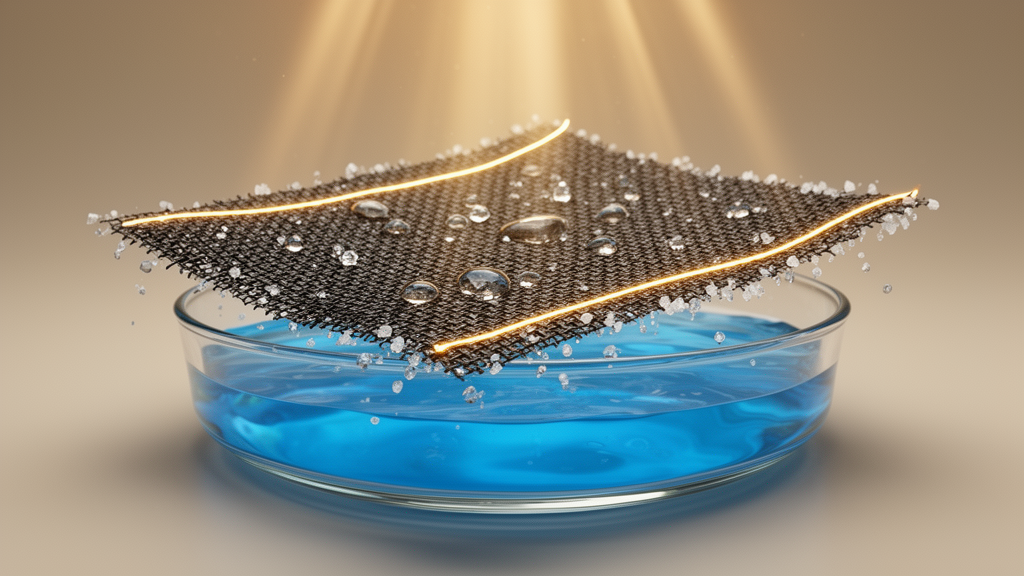
A new desalination evaporator made from graphene nanoplatelets and silicone-coated carbon cloth can produce freshwater using sunlight alone, electricity alone, or both together, and it does so without salt crystals building up on its light-absorbing surface. In laboratory tests reported in the journal Discover Surfaces, the device achieved an evaporation rate of 1.96 ± 0.04037 kilograms per square meter per hour at 64.8 percent efficiency under illumination of one sun, the intensity of full midday sunlight. When a modest 4-volt electrical input was applied alongside the same solar input, the evaporation rate jumped to 9.46 ± 0.39537 kilograms per square meter per hour at 82 percent efficiency.
The work was carried out by Anindya Sundar Patra, Hyeong Woo Lim and Sang Joon Lee, who set out to address two well-known weaknesses of interfacial solar steam generation, a technique in which a floating photothermal material concentrates heat at the water-air interface to drive evaporation. The approach is attractive because it converts solar energy locally, produces no carbon emissions during operation and has low running costs. Yet two problems have slowed its practical deployment. Salt deposited on the evaporator surface over long operation reduces sunlight absorption and slows vapor generation, and the intrinsic intermittency of solar irradiance, driven by weather and the day-night cycle, means a purely solar device cannot run around the clock.
The team’s answer is a composite they call PGCC: a commercially available carbon cloth first coated with graphene nanoplatelets through a repeated dip-coating process, then covered with polydimethylsiloxane, or PDMS, the silicone elastomer familiar from household sealants. Graphene nanoplatelets were chosen for their broadband solar absorption, high thermal and electrical conductivity, large surface area and chemical stability, which allow the same material to serve both as a solar absorber and as a resistive Joule heater. PDMS brings low thermal conductivity, chemical inertness, ultraviolet resistance and biocompatibility, and it converts the fabric from hydrophilic to superhydrophobic.
That superhydrophobicity is central to the anti-fouling design. Water contact angle measurements showed the PDMS-modified cloth repelling water at 148 degrees, compared with 140 degrees for the untreated carbon cloth, which is already somewhat hydrophobic. Because the photoabsorber does not absorb liquid water, salt cannot nucleate and crystallize on its surface. Instead, water is drawn up through a thin polyvinyl alcohol foam wick, 2 millimeters thick, threaded through a polystyrene foam block in an inverted U shape with both ends submerged in the saline reservoir. The hydrophilic foam transports water rapidly through its interconnected pores, and the researchers report that its porous network back-diffuses ions and prevents ion supersaturation in the evaporation layer, while the short diffusion path helps reject salt.
Getting the PDMS coating thickness right proved decisive. The team tested three PDMS-to-toluene dilution ratios. At a ratio of 1:2, the coating was too thin to seal all the pores of the carbon cloth, so water permeated through and salt fouled the surface during desalination tests. At 1:0.5, the coating was so thick that it diminished the benefits of both photothermal and electrothermal heating. The intermediate 1:1 formulation was selected as the optimal photoabsorber. Scanning electron microscopy confirmed that graphene nanoplatelets were uniformly deposited without blocking the cloth’s internal porosity, and that PDMS formed a thin polymeric layer over the fibers. Energy-dispersive X-ray mapping showed uniform distributions of carbon, oxygen and silicon, and Raman spectroscopy revealed characteristic silicone bands alongside the graphitic D and G bands, with an increasing defect ratio across the modified samples.
Optical measurements supported the design rationale. Diffuse reflectance spectra recorded from 250 to 2500 nanometers showed that the bare carbon cloth absorbed roughly 91 percent of visible light but only weakly absorbed in the near-infrared, where more than half of the solar energy reaching Earth resides. Adding graphene nanoplatelets turned the fabric deep black, enhanced absorption, and reduced both reflectance and transmittance. X-ray diffraction confirmed the graphitic phases of the cloth and nanoplatelets, plus a broad polymer peak in the final composite, while Raman analysis confirmed the presence of both GnP and PDMS in the finished material.
Temperature measurements showed how strongly the electrical input changes the operating conditions. After ten minutes, the evaporator surface reached 41.7 degrees Celsius under one sun alone, but 74.3 degrees Celsius at 4 volts without illumination, and 81.5 degrees Celsius when 4 volts and one sun were applied together. Intermediate voltages produced intermediate temperatures, with combined-mode readings of 56 degrees at 2 volts plus sunlight and 67.1 degrees at 3 volts plus sunlight. All evaporation trials used 3.5 weight percent artificial seawater in a chamber held near 25 degrees Celsius and 48 percent relative humidity, with water mass tracked on a precision microbalance after steady state was reached.
The performance numbers trace a clear pattern. Under photothermal operation alone, the PGCC evaporator reached 1.96 kilograms per square meter per hour, compared with 1.6 kilograms per square meter per hour at 40 percent efficiency for bare carbon cloth under the same conditions, an improvement the authors attribute to enhanced light absorption from the GnP and PDMS treatments. Electrothermal operation alone yielded 2.48 ± 0.05148, 4.61 ± 0.13519 and 5.77 ± 0.11546 kilograms per square meter per hour at 2, 3 and 4 volts, with efficiencies of 41.5, 57 and 48 percent. In combined mode, the rates were 4.15 ± 0.1121, 5.59 ± 0.25281 and 9.46 ± 0.39537 kilograms per square meter per hour at 2 volts plus one sun, 3 volts plus one sun and 4 volts plus one sun, with efficiencies of 79, 68 and 82 percent.
To test all-weather feasibility, the team ran a 24-hour desalination experiment with 3.5 weight percent seawater: twelve hours at 4 volts alone to simulate nighttime, followed by twelve hours at 4 volts plus one sun to simulate daytime. Evaporation remained consistent throughout, and the evaporator surface stayed free of salt fouling. The authors note limits, however. When operation exceeded four hours or feed salinity rose to 10 weight percent or higher, salt accumulated at the bottom and edges of the PVA wicking layer, where evaporation-induced accumulation overpowered diffusion back into the feed; the accumulated salt redissolved within a few hours in the dark, and no fouling appeared on the PGCC surface itself. Durability was further assessed through repeated desalination cycles under both photothermal and combined modes.
Water quality was checked by measuring four major ions in the condensate with inductively coupled plasma optical emission spectrometry. The simulated seawater contained 1630 milligrams per liter of sodium, 61 milligrams per liter of potassium, 43.6 milligrams per liter of calcium and 317 milligrams per liter of magnesium; after evaporation, the collected condensate showed much lower ion levels, which the authors say validates the system’s ability to yield water meeting potable standards. The device was assembled from inexpensive, commercially available components using simple dip-coating steps, and the authors position it as a step toward standalone, off-grid desalination and ultimately zero liquid discharge. As with all laboratory demonstrations, the results come from controlled benchtop conditions with artificial seawater rather than field trials, so real-world performance under variable weather, wave motion and natural seawater chemistry remains to be demonstrated.
Subject of Research: A superhydrophobic graphene nanoplatelet and PDMS-coated carbon cloth evaporator for combined photothermal and electrothermal seawater desalination with salt-fouling resistance
Article Title: Synergistic photo-electrothermal evaporation on superhydrophobic carbon cloth for high-efficiency freshwater production and excellent anti-salt fouling
Article References: Patra, A. S., Lim, H. W., & Lee, S. J. (2026). Synergistic photo-electrothermal evaporation on superhydrophobic carbon cloth for high-efficiency freshwater production and excellent anti-salt fouling. Discover Surfaces, 1(1), Article 3. https://doi.org/10.1007/s44507-026-00004-8
Image Credits: AI Generated
DOI: 10.1007/s44507-026-00004-8
Keywords: solar steam generation, desalination, graphene nanoplatelets, PDMS, carbon cloth, electrothermal evaporation, Joule heating, salt fouling, superhydrophobic, freshwater, interfacial evaporation, seawater
News Source: Bethany Barker. (October 28, 2026). Superhydrophobic carbon cloth evaporator pairs sunlight and electricity to keep salt away. Scienmag.