


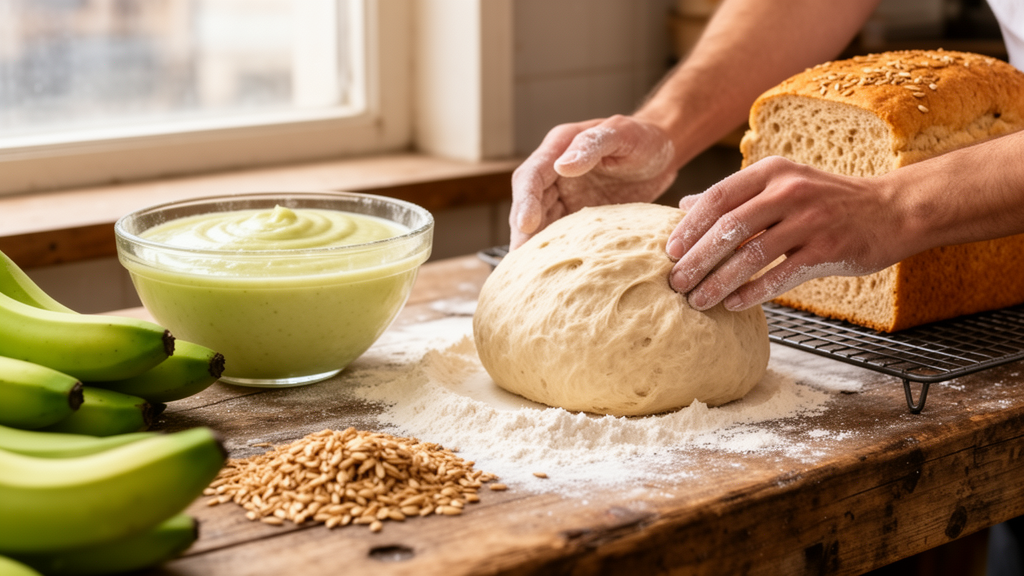
Bakers in Uganda have shown that wheat dough can take on raw, undried green mature cooking banana puree and still produce an appealing loaf, but the trade-off is a weaker dough, a smaller loaf, and noticeably lower scores from a trained sensory panel. The new study, published in Food Science & Nutrition, tested four different forms of the N23 hybrid cooking banana — fresh whole fingers, fresh pulp, whole finger flour, and pulp flour — each substituted for 30% of the wheat flour in composite bread dough, against a 100% wheat control and a 50:50 banana flour–wheat flour control.
The motivation is rooted in Uganda’s bread economics. Bread is consumed as a breakfast snack by roughly 65% of the urban population and 31% of people in rural areas of the country, yet its high cost stems largely from imported wheat sourced from major European producers. At the same time, Uganda is Africa’s largest producer of cooking bananas and ranks second in the world after India, producing approximately 10.5 million metric tons of plantains, 0.5 million metric tons of dessert bananas, and 4.34 million metric tons of cooking bananas. Much of this harvest is marketed raw with no processing or value addition, and banana postharvest losses stand at about 40%. Finding bakery uses for locally grown bananas could, in principle, reduce import dependence and cut waste simultaneously.
The research team, working at Kyambogo University’s Food Science Laboratory with samples obtained from the National Agricultural Research Organization at Kawanda, chose the N23 hybrid deliberately. N23 was developed by the National Banana Research Programme after the East African Highland cooking bananas known locally as Matooke became susceptible to pests and diseases, but most developed hybrids faced rejection by local consumers because they lacked the sensory attributes valued in Matooke. Redirecting such hybrids toward industrial baking offers a route to use them without depending on Matooke-style consumer acceptance. The bananas were harvested at green maturity, 14 months after planting, and processed into the four treatment forms, with flour samples dried in a conventional air oven at 60°C for 24 hours and ground before use.
Green mature bananas bring a distinctive nutritional profile to the dough. They contain high levels of starch — about 22% — and low levels of natural sugars at 1%, protein below 1%, and lipids between 0.15% and 0.58%. Fresh green mature cooking bananas in Uganda have been reported to contain 4% to 15.2% starch, of which 38% to 68% is resistant starch, a carbohydrate fraction that resists digestion in the small intestine and is instead fermented by bacteria in the colon. Dietary fiber behaves similarly, resisting digestion and absorption while providing substrate for bacterial fermentation that helps maintain the structure and proper function of the gut. The banana peel, which remains in the whole-finger formulations, is largely fiber, a point that turned out to matter greatly in the final bread chemistry.
Rheological testing revealed the central technical challenge. Using a consistograph and an alveograph, the researchers found that adding bananas in any form significantly increased the time required for the dough to reach maximum consistency, although the water absorption needed for optimum dough production did not differ significantly among treatments, hovering around 53.3% to 53.6%. More consequentially, resistance to deformation — the PrMax value — fell from 2328 millibars in the 100% wheat control to between 2107 and 2179 millibars in the banana composites, a pattern the authors interpret as poor dough handling behavior and low tolerance during fermentation. The alveograph told the same story: the elasticity index of banana composite samples ranged from 10.2 to 15.9, far below the 54.1 recorded for the wheat control, and baking strength dropped from 262 × 10⁻⁴ joules for wheat alone to between 98 and 229 for the composites. Notably, the fresh whole finger and fresh pulp samples produced alveograph profiles relatively similar to the wheat control, while the dried flours showed much higher configuration ratios and weaker baking strength.
The authors attribute these weakened doughs to gluten dilution. When non-gluten banana particles enter the mix, they become entrapped in the gluten network and disrupt it, and the non-gluten chemical constituents of bananas do not readily bind with gluten proteins to enhance elasticity. Because gluten proteins form the cohesive viscoelastic network that retains fermentation gas and produces a leavened, fluffy crumb, diluting them inevitably compromises dough structure. This mechanical disruption of the gluten network, together with reduced dough elasticity, explains the low bread volume observed in samples formulated from whole fresh fingers.
Despite the weaker doughs, the baked loaves looked surprisingly good. The general appearance of bread from the banana-wheat composite doughs was appealing and comparable to the wheat-only bread, flour-based samples showed a brighter crumb, and even when fresh banana pulp inclusion was raised to 50%, good quality bread was still obtained. There was no observable difference in crumb pore characteristics between fresh and flour samples, although incorporation of whole banana fingers gave a duller crumb appearance than pulp. Quantitatively, however, the 100% wheat control produced a significantly higher loaf volume — 1439.33 cubic centimeters — than any of the banana-containing samples, which ranged from 1305.72 to 1410.00 cubic centimeters. Loaf weights ranged from 530.50 to 579.00 grams, baking loss was highest in the 50:50 composite, and crust and crumb browning increased significantly with the addition of 30% bananas, a change the authors attribute to Maillard reactions.
The chemical analysis delivered the study’s most encouraging result. Resistant starch content rose from 1.08 grams per 100 grams in the 100% wheat bread to as much as 2.21 grams per 100 grams in the 50% wheat–50% banana flour bread, increasing significantly with the level of banana substitution. Dietary fiber was highest, at 1.95%, in bread made from fresh whole fingers including the peel, and lowest, at 0.57%, in the wheat-only control. Bread formulated from whole bananas had higher dietary fiber than bread made from pulp alone, and increasing the proportion of banana pulp to 50% did not significantly raise fiber content — implying that the peel was the major contributor to enhanced dietary fiber. Moisture content also ran higher in the banana breads, from 56.63% to 61.67% on a dry basis compared with 56.45% for the wheat control, with fresh whole banana finger bread showing the highest value, likely because soluble constituents such as starch and dietary fiber bind water more strongly.
Sensory results tempered the nutritional gains. A trained panel of 30 assessors scored the breads on nine-point hedonic scales, and the addition of bananas caused a significant decrease in appearance, color, flavor, and taste compared with the 100% wheat sample. General acceptability of the wheat control reached 7.05, while the composite breads scored between 4.53 and 5.10 — moderate acceptability. The texture of bread made from banana pulp flour was not significantly different from the wheat control, and the flavor score for the pulp flour bread also matched the control, but the 50:50 composite fared worst overall. The authors note that other studies using much lower substitution levels — 5% in one case, 10% to 20% in another — reported comparable or even improved acceptability, suggesting that the 30% level used here may simply have been too high to preserve the sensory qualities consumers expect.
Principal component analysis pulled the findings together, with the first two components explaining 62.26% of the variability in the data — 32.65% and 29.61% respectively. The first component captured loaf weight, firmness, baking loss, and moisture, while the second captured textural parameters and sensory attributes including color, appearance, general acceptability, flavor, and taste. Cohesiveness, specific volume, springiness, maximum pressure, appearance, flavor, taste, and texture clustered in the same quadrant, indicating positive relationships among them, and the analysis showed that physical and rheological properties of the dough play a major role in overall bread quality. The study’s conclusion is measured: partial substitution of wheat with fresh whole green banana fingers or fresh banana pulp produced alveograph profiles relatively similar to wheat flour alone, suggesting that fresh bananas can be used in bread dough without investing resources in drying and milling, but higher substitution levels may reduce bread volume, sensory acceptability, and dough strength. Lower levels of banana substitution, the authors suggest, may benefit bread quality — leaving open a path for future work to find the sweet spot between functional nutrition and consumer appeal.
Subject of Research: The effect of substituting wheat flour with fresh green mature cooking banana puree on dough rheology, bread chemistry, and sensory properties
Article Title: Dough Rheology, Physico‐Chemical, and Sensory Properties of Bread From Wheat/Fresh Green Mature Banana Puree Composite
Article References: Mugampoza, E., Nankya, N., Tabula, A., Mutambuka, M., & Nakyinsige, K. (2026). Dough Rheology, Physico‐Chemical, and Sensory Properties of Bread From Wheat/Fresh Green Mature Banana Puree Composite. Food Science & Nutrition, 14(10), Article e72489. https://doi.org/10.1002/fsn3.72489
Image Credits: AI Generated
DOI: 10.1002/fsn3.72489
Keywords: banana bread, wheat composite flour, dough rheology, resistant starch, dietary fiber, Uganda, cooking bananas, gluten dilution, sensory evaluation, food science, baking quality, N23 hybrid
News Source: Alan Morgan. (October 28, 2026). Fresh Green Banana Puree Boosts Fiber in Wheat Bread but Weakens Dough and Cuts Acceptability. Scienmag.



