


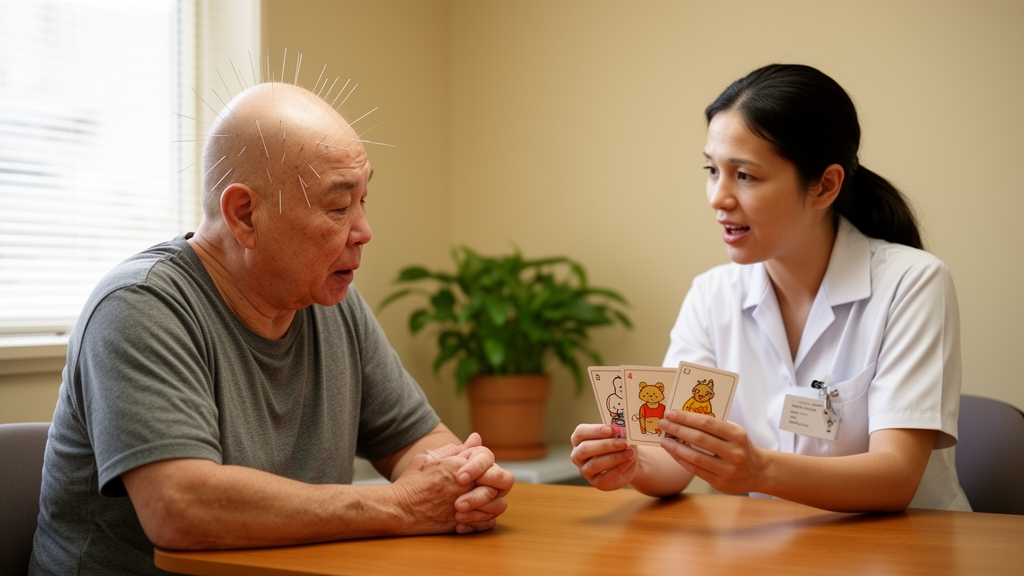
People recovering from stroke often struggle to name everyday objects, a condition known as post-stroke anomia, and a new randomized controlled trial reports that adding scalp acupuncture to standard speech-language therapy was associated with measurably greater naming recovery. The study, published in the journal Chinese Medicine, followed 85 patients with post-stroke anomia and combined clinical testing with diffusion tensor imaging, a magnetic resonance technique that probes the integrity of white matter fiber tracts in the brain. According to the research team, patients who received scalp acupuncture synchronously with speech-language therapy improved more on a standardized naming assessment than patients who received speech-language therapy alone, and their behavioral gains were accompanied by distinct changes in the topology and microstructure of the brain’s ventral and dorsal language networks.
Compared with the control group, the scalp acupuncture group showed significantly greater improvement from baseline to post-treatment in the naming total score, with a between-group difference reported at P = 0.009. Significant between-group differences in change scores also emerged for the object naming, sentence completion, and responsive speech sub-dimensions, as well as for the Boston Naming Test spontaneous naming score and the communication domain of the Stroke and Aphasia Quality of Life Scale, SAQOL-39. The authors note that no formal minimal clinically important difference has been established for the naming subtest, but they argue that the magnitude of change, together with the concurrent improvement in quality-of-life communication scores, suggests the benefit extended beyond test performance to functional communicative gains.
The imaging analysis focused on the ventral-dorsal brain network model, which divides language processing into a ventral semantic network and a dorsal phonological network.
The imaging results revealed a pattern the authors describe as distinct between-group differences in network topology. The scalp acupuncture group showed a significantly smaller change in the area under the curve for small-worldness, reported at P = 0.008, and in the normalized clustering coefficient, at P = 0.017, compared with controls. Conversely, the acupuncture group showed a significantly greater change in the area under the curve for the clustering coefficient, at P = 0.011, and for local efficiency, at P < 0.001. Within the acupuncture group, after adjustment for age, sex, education years, disease duration, stroke type, and aphasia type, the change in small-worldness was negatively correlated with the change in the naming total score, with r = -0.451 and P = 0.027. The authors interpret this pattern as suggesting that the therapy may reduce information isolation in the ventral-dorsal structural networks and enhance the efficiency of information transmission, although they frame this as an interpretation requiring further study.
White matter findings centered on four major fiber tracts. The acupuncture group exhibited significantly smaller changes in axial diffusivity in the left inferior fronto-occipital fasciculus, the left inferior longitudinal fasciculus, and the left uncinate fasciculus within the ventral semantic network, and in the left superior longitudinal fasciculus within the dorsal phonological network, all reported with Bonferroni correction. Similar between-group differences were observed for mean diffusivity and radial diffusivity in the left inferior fronto-occipital fasciculus, the left inferior longitudinal fasciculus, and the left superior longitudinal fasciculus. Notably, the change in axial diffusivity of the left uncinate fasciculus, reported at P = 0.003 with Bonferroni correction, was negatively correlated with the change in the naming total score within the acupuncture group, with r = -0.440 and P = 0.031. The uncinate fasciculus connects the anterior temporal lobe with the orbitofrontal cortex and has been implicated in lexical retrieval and top-down control during word selection, and the authors suggest that the observed decrease in axial diffusivity after intervention may reflect a structural remodeling phenomenon associated with naming improvement.
A first model including treatment assignment, baseline naming score, and clinical covariates explained 26.9 percent of the variance in naming improvement, and assignment to the acupuncture group remained associated with greater improvement, with an unstandardized coefficient of 12.931, a standardized beta of 0.378, and P = 0.005. Adding three theory-informed imaging measures, the left inferior fronto-occipital fasciculus axial diffusivity change, the left uncinate fasciculus axial diffusivity change, and the small-worldness change, raised the explained variance only to 29.2 percent, an increment that was not statistically significant, and none of the imaging changes was independently associated with naming improvement after adjustment. Sensitivity analyses excluding influential observations and using bias-corrected and accelerated bootstrap confidence intervals yielded consistent results. The authors therefore caution that the imaging measures should be interpreted as treatment-related correlates rather than validated predictors of recovery.
The study has several limitations that the authors acknowledge. The follow-up was limited to the immediate post-intervention assessment, so the long-term durability of the effect remains unknown. The control group had slightly lower baseline language scores despite randomization, and the neuroimaging analyses relied on a modest per-protocol sample with complete MRI data, with some baseline imaging metrics differing between groups. The regression analyses were exploratory, and the control condition did not include sham acupuncture, leaving participants and therapists unblinded to the intervention. Baseline fractional anisotropy also differed between groups in the left inferior fronto-occipital fasciculus, the left inferior longitudinal fasciculus, and the left uncinate fasciculus, and baseline clustering coefficient and local efficiency differed as well, which is why adjusted analyses were applied to those metrics.
Within those constraints, the trial offers a detailed portrait of what happens when an acupuncture-based adjunct is layered onto conventional language rehabilitation. The authors conclude that scalp acupuncture coupled with speech-language therapy was associated with greater naming recovery in patients with post-stroke anomia, and that the benefit was accompanied by changes in structural language-network topology and white matter integrity, particularly involving the left uncinate fasciculus and the left inferior fronto-occipital fasciculus. They suggest that the combined therapy may support naming recovery through both ventral-stream semantic retrieval and dorsal-stream phonological representation, and they call for larger studies with longer follow-up, theory-informed imaging measures, and independent validation to determine whether structural network measures can ultimately help explain individual differences in treatment response.
Subject of Research: A randomized controlled trial of scalp acupuncture combined with speech-language therapy for post-stroke anomia, with diffusion tensor imaging of structural language networks.
Article Title: Scalp acupuncture coupled with speech-language therapy modulates the ventral-dorsal structural brain network in patients with post-stroke anomia: a randomized clinical and DTI neuroimaging trial
Article References: Song, J., Nan, R., Ni, J., Chai, L., Zhang, L., Wang, M., Wang, N., Lin, B., & Huang, J. (2026). Scalp acupuncture coupled with speech-language therapy modulates the ventral-dorsal structural brain network in patients with post-stroke anomia: a randomized clinical and DTI neuroimaging trial. Chinese Medicine, 21(1), Article 226. https://doi.org/10.1186/s13020-026-01501-1
Image Credits: AI Generated
DOI: 10.1186/s13020-026-01501-1
Keywords: post-stroke anomia, scalp acupuncture, speech-language therapy, aphasia rehabilitation, diffusion tensor imaging, white matter integrity, uncinate fasciculus, small-worldness, randomized controlled trial, naming recovery, neuroplasticity, ventral-dorsal network
News Source: Cassandra Pierce. (October 28, 2026). Scalp Acupuncture Plus Speech Therapy Linked to Naming Gains and Brain Network Changes After Stroke. Scienmag.



