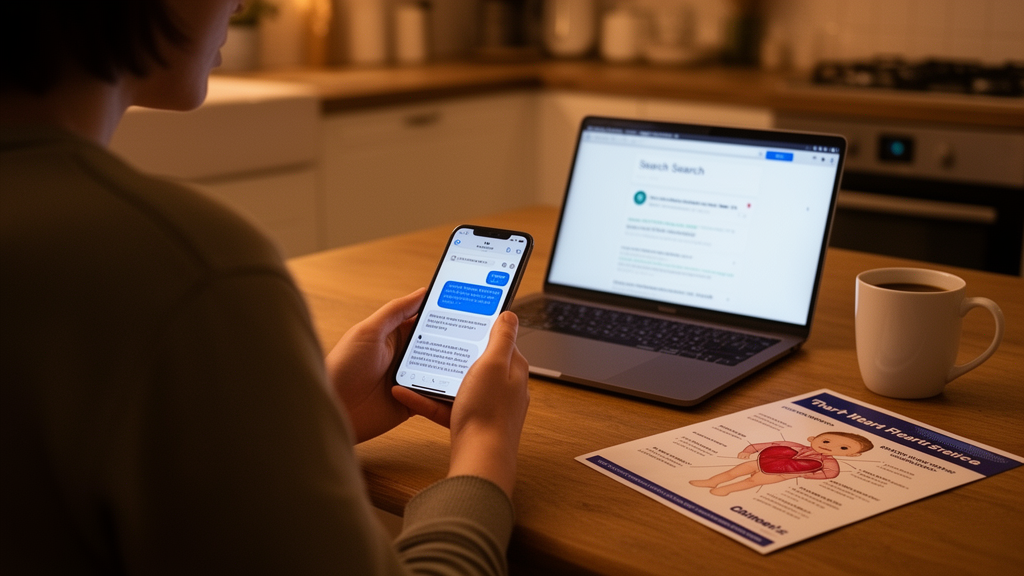
When parents of a child with tetralogy of Fallot turn to the internet for answers, they now face two very different kinds of machines: a conversational chatbot that writes its own explanation, and a search engine that increasingly answers with an AI-generated summary of its own. A new cross-sectional study published in Cardiology and Therapy put those two sources head to head, and the results are more nuanced than a simple winner. ChatGPT-5.5 responses scored higher on reviewer-rated accuracy and educational quality than Google search output, but they were also substantially longer and written at a far higher reading level, and neither finding says anything yet about whether parents actually understand or benefit from the answers.
Tetralogy of Fallot is the most common cyanotic congenital heart defect, characterized by a ventricular septal defect, an overriding aorta, right ventricular outflow tract obstruction, and secondary right ventricular hypertrophy. Congenital heart disease overall affects approximately nine per 1000 live births worldwide. Contemporary surgery has transformed the condition from a frequently fatal childhood disease into a chronic condition with high survival into adulthood, but repair does not restore a completely normal cardiovascular system. Patients remain at risk for pulmonary valve dysfunction, residual or recurrent outflow obstruction, right ventricular dilation or dysfunction, arrhythmias, and additional catheter-based or surgical interventions. That complexity creates a sustained need for clear, reliable education for patients and caregivers, who often participate directly in treatment decisions, medication administration, symptom recognition, follow-up planning, and care coordination across childhood.
The study, led by Shreyas V. Menon with Armaun D. Rouhi and Jason J. Han, set out to fill a specific gap: despite a growing literature on AI-generated patient education, evidence specific to congenital heart disease remained limited, and it was unclear whether conversational AI offers a meaningful educational advantage over the AI-generated information now embedded in routine online searching. The researchers identified 40 frequently asked caregiver questions about tetralogy of Fallot using Google’s “People Also Ask” feature, covering seven domains: disease basics, diagnosis, causes and genetics, treatment and surgery, pulmonary valve issues, prognosis, and living with the condition. Duplicate or substantially overlapping questions were removed, and wording was standardized without changing the intended meaning.
Each question was submitted to ChatGPT-5.5 and entered as a Google search query, generating 80 total responses arranged in 40 matched pairs. Google generated AI Overviews for 37 of the 40 questions; for the remaining three, the first organic, nonsponsored search-result excerpt was recorded, drawn from the websites of Mayo Clinic, Nationwide Children’s Hospital, and UCSF Health. Searches were performed in Incognito mode while logged out of a Google account to reduce personalization effects. ChatGPT responses were collected on July 27-29, 2026, using a standardized prompt asking the model to answer as if explaining to the parent of a child with tetralogy of Fallot, with accurate, evidence-based, patient-friendly language. Each question began a new conversation, and responses were collected once, without follow-up prompting, regeneration, or editing.
The readability results were striking. ChatGPT responses averaged 327.9 words compared with 192.5 words for Google search output, a mean paired difference of 135.4 words. ChatGPT responses scored a mean Flesch-Kincaid grade level of 23.67 versus 15.37 for Google, a difference of 8.30 grade levels, and a mean Flesch Reading Ease score of 17.27 versus 27.43, with lower scores indicating more difficult text. All paired comparisons were statistically significant at p < 0.001. Both platforms produced text well above the sixth-grade reading level commonly recommended for patient-education materials, though the authors caution that necessary medical terminology, including terms used to explain congenital heart anatomy and surgical procedures, may inflate calculated grade levels, and that readability formulas estimate linguistic complexity rather than measure comprehension directly.
On accuracy, two independent reviewers, both medical students at the time of assessment, scored all 80 responses on a 5-point scale assessing factual correctness and completeness, with platform identity concealed and responses presented in randomized order. ChatGPT responses received a median score of 5.0 (interquartile range 5.0-5.0) versus 4.5 (4.0-5.0) for Google, with mean scores of 4.95 and 4.40 respectively, a difference that was statistically significant with a rank-biserial correlation of 0.974. Interrater reliability, measured by quadratic-weighted Cohen’s kappa, was 0.47 across all 80 responses, with 97.5 percent agreement within one point; agreement was stronger for ChatGPT responses (kappa 0.48, 95.0 percent exact agreement) than for Google output (kappa 0.21, 65.0 percent exact agreement).
Educational quality showed the largest gap. A single reviewer scored responses using a modified version of the Ensuring Quality Information for Patients (EQIP) instrument, adapted to exclude printed-document and webpage publication characteristics that could not be evaluated from isolated response text. The retained criteria assessed content relevance, patient-centered communication, organization, explanation of medical terminology, presentation of risks and benefits, practical guidance, acknowledgment of uncertainty, appropriate recommendations for clinical follow-up, and avoidance of misleading statements. ChatGPT scored 86.44 percent on average versus 59.62 percent for Google, a mean paired difference of 26.82 percentage points with a Cohen’s dz of 1.99. The authors note, however, that ChatGPT’s longer responses provided more space to meet checklist criteria, and that ChatGPT received a standardized parent-oriented prompt while Google received each question verbatim, so response length and prompting differences may have contributed to the observed gap.
A sensitivity analysis restricted to the 37 questions for which Google generated an AI Overview produced similar results, with mean modified EQIP scores of 86.55 percent for ChatGPT versus 62.35 percent for Google AI Overview, a difference of 24.20 percentage points. The authors are explicit about what these numbers do not show: responses were evaluated using predefined scoring instruments rather than by caregivers, so higher reviewer-rated accuracy or EQIP scores should not be interpreted as evidence of improved caregiver comprehension, satisfaction, or clinical decision-making. The study also has other limitations. Responses were collected during a single time period, and because Google AI Overview and ChatGPT undergo continuous updates, their outputs may change over time. The platforms received different inputs, accuracy was assessed by two reviewers while EQIP scores came from a single reviewer with no interrater reliability estimate, and evaluations were limited to English-language responses and a single congenital heart lesion, limiting generalizability to multilingual populations, other pediatric cardiovascular conditions, and other specialties.
The findings sit within a broader and rapidly growing body of work on AI and patient education. Prior studies have evaluated ChatGPT-generated responses in orthopedic surgery, otolaryngology, and head and neck oncology, and in cardiovascular medicine, earlier research showed that ChatGPT-3.5 could improve the calculated readability of existing aortic stenosis patient-education materials when explicitly prompted to rewrite them at a lower reading level, though the resulting materials did not consistently meet recommended readability thresholds. A separate study of transcatheter aortic valve replacement found higher physician-assigned ratings for AI-generated responses than for hospital website materials across scientific accuracy, ease of understanding, and overall satisfaction, though patients did not evaluate the responses directly. The authors caution that comparisons across specialties should be interpreted cautiously because clinical topics, AI models, comparators, prompts, and assessment methods differ.
For now, the practical takeaway is a measured one. Under the study’s prompting conditions, ChatGPT-5.5 produced longer, more accurate, and more educationally complete answers to common caregiver questions about tetralogy of Fallot, but at a reading level that would challenge most lay readers, and Google’s own AI Overviews were not far behind on accuracy even as they fell short on educational-quality criteria. The authors conclude that AI-generated information may serve as a supplement to, rather than a replacement for, individualized counseling by healthcare professionals, and they call for future studies involving caregivers themselves to assess comprehension, usability, and the clinical relevance of AI-generated educational information. Until then, the most important question, whether either platform actually helps parents understand their child’s heart condition, remains unanswered.
Subject of Research: A comparison of ChatGPT-5.5 and Google search output for answering common caregiver questions about tetralogy of Fallot
Article Title: A Comparative Evaluation of ChatGPT and Google Search Output for Caregiver Education in Tetralogy of Fallot
Article References: Menon, S. V., Rouhi, A. D., & Han, J. J. (2026). A Comparative Evaluation of ChatGPT and Google Search Output for Caregiver Education in Tetralogy of Fallot. Cardiology and Therapy. https://doi.org/10.1007/s40119-026-00481-5
Image Credits: AI Generated
DOI: 10.1007/s40119-026-00481-5
Keywords: ChatGPT, Google AI Overview, tetralogy of Fallot, congenital heart disease, caregiver education, readability, accuracy, EQIP, Flesch-Kincaid, patient information, artificial intelligence, health literacy
News Source: Ophelia Keating. (October 28, 2026). ChatGPT Outperforms Google Search on Accuracy for Parent Questions About Tetralogy of Fallot. Scienmag.