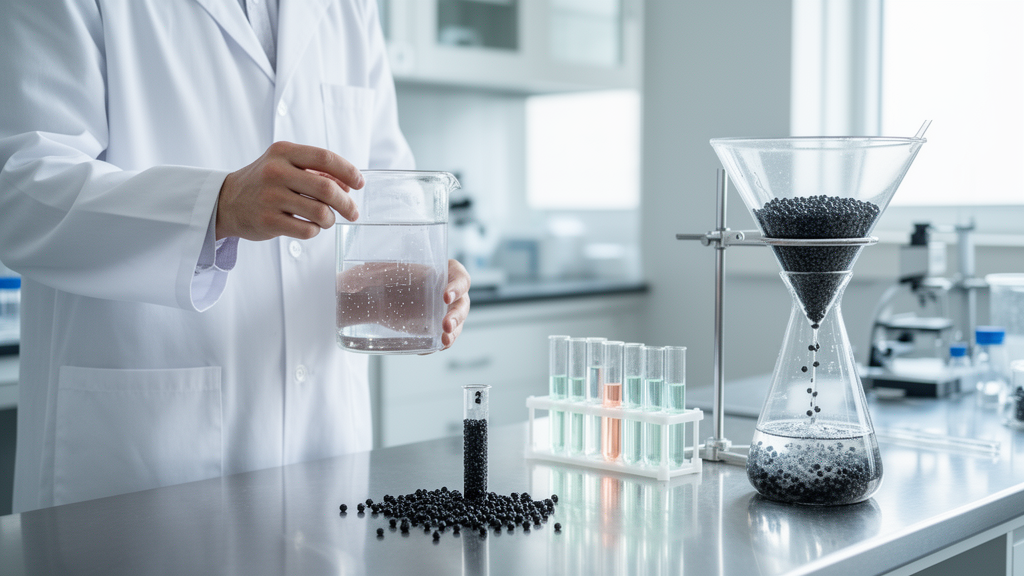
Chemists have built millimeter-scale magnetic carbon beads that can completely break down sulfamethoxazole, a widely used antibiotic that increasingly accumulates in rivers and lakes, within just 20 minutes. The new material, described in the journal Carbon Research, activates peroxymonosulfate (PMS) to generate a battery of reactive oxygen species, and it keeps its cobalt catalyst locked inside a porous carbon shell so that almost none of the metal escapes into the treated water.
The beads, named CoNC@cPAN/rGO-800, were made by combining 2-methylimidazole cobalt (ZIF-67), a metal–organic framework that serves as a ready-made source of cobalt active sites, with polyacrylonitrile (PAN) and graphene oxide (GO). The mixture was shaped into spheres by a liquid–liquid phase conversion method and then calcined in nitrogen at temperatures ranging from 600 to 900 degrees Celsius. The 800-degree version proved optimal. During calcination, the graphene oxide is reduced to reduced graphene oxide (rGO), the PAN forms a carbon skeleton, and the ZIF-67 shrinks inward, leaving hollow micropores distributed uniformly through the framework.
Scanning electron microscopy revealed a honeycomb-like interior of regular macropores and irregular micropores, a structure the researchers say helps distribute active sites throughout the bead. The cobalt particles inside measure roughly 47.68 ± 8.26 nanometers across, and energy-dispersive X-ray spectroscopy showed that carbon, nitrogen, oxygen and cobalt are evenly spread through the bead cross-section. The finished material has a specific surface area of 224.5 square meters per gram, an average pore size of 5.6 nanometers, and a mesopore proportion of 89.7 percent, which the authors argue favors mass transfer during PMS activation.
Spectroscopic analysis uncovered a layered architecture with functional consequences. X-ray diffraction and X-ray photoelectron spectroscopy confirmed cobalt nanoparticles carrying Co0, Co2+ and Co3+ states, while Raman and infrared signatures revealed cobalt oxide (Co3O4) concentrated in the bead core, with metallic cobalt dominating the shell. The researchers attribute this to graphene oxide supplying abundant oxygen atoms during calcination: oxygen escapes readily near the shell, forming metallic cobalt, but remains trapped in the hindered core, preserving the oxide. The rGO doping also raised the oxygen vacancy content of the material to 45.83 percent, compared with 30.35 percent in a bead made without graphene, because graphene readily traps oxygen atoms in oxides and promotes vacancy formation.
Catalytic tests showed why the design matters. Carbon beads made from PAN alone, or PAN with rGO, removed only about 10 percent of sulfamethoxazole in 30 minutes, demonstrating that rGO provides no benefit on its own. A cobalt-containing bead without graphene achieved 90 percent degradation in 25 minutes, while the full CoNC@cPAN/rGO-800 formulation, with roughly 21.0 weight percent cobalt, achieved complete degradation within 20 minutes. The authors conclude that rGO does not add active sites itself but optimizes the carbon framework to disperse cobalt more uniformly and lowers the material’s electronic impedance, smoothing electron transfer between the catalyst and PMS. Electrochemical impedance spectroscopy and linear sweep voltammetry supported this picture, showing the smallest charge-transfer resistance and highest current response for the graphene-doped beads.
The catalyst also tolerated a broad range of water chemistry. Complete degradation was achieved within 30 minutes across the pH range of 2 to 11, with the fastest performance under neutral and weakly alkaline conditions, where removal finished in 15 minutes. The researchers attribute the slower rates at pH 3 and pH 11 to the speciation of PMS and sulfamethoxazole, noting that deprotonated sulfamethoxazole reacts more readily than its protonated form. During a standard run at pH 7, the solution drifted only mildly, from 7.00 to 5.91 over 30 minutes, keeping the antibiotic mostly in its reactive deprotonated state. Humic acid and common inorganic anions such as chloride, nitrate, phosphate and sulfate caused only slight inhibition, although bicarbonate significantly suppressed degradation, hinting at which radicals matter most. The system also performed well in real campus lake and river water, both of which were weakly alkaline with low dissolved organic carbon.
Quenching experiments and electron paramagnetic resonance confirmed that hydroxyl radicals, sulfate radicals, superoxide radicals (O2·−) and singlet oxygen all participate in the degradation. Methanol, which scavenges sulfate radicals, cut removal from 100 percent to 31.1 percent, while tert-butanol, targeting hydroxyl radicals, reduced it to 58.4 percent, indicating sulfate radicals are the more potent oxidant. Probe-based quantification assigned contribution ratios of 36.3 percent to hydroxyl radicals, 27.3 percent to sulfate radicals, 19.5 percent to superoxide and 16.9 percent to singlet oxygen. The superoxide finding is the study’s central mechanistic claim: when dissolved oxygen was stripped from the solution by nitrogen bubbling, the superoxide EPR signal nearly vanished, confirming that the radical originates from dissolved oxygen rather than the catalyst itself.
The authors propose that superoxide forms when dissolved oxygen receives electrons from oxygen vacancies in the core Co3O4. Density functional theory calculations supported this: oxygen adsorbed on an oxygen-vacancy Co3O4 (110) surface lengthened from 1.21 to 1.28 angstroms, matching the characteristic bond length of superoxide, and Bader charge analysis showed 0.58 elementary charges transferring from the electron-rich vacancy to the oxygen molecule. The vacancies also bind PMS more strongly than the pristine surface, with an adsorption energy of −3.29 electronvolts versus −2.64, favoring cleavage of the PMS O–O bond. When superoxide dismutase was added to quench superoxide, steady-state concentrations of sulfate radicals, hydroxyl radicals and singlet oxygen all dropped, and nitrogen bubbling weakened their EPR signals, evidence that superoxide mediates the production of the other reactive species rather than acting alone.
Kinetic analysis revealed a two-phase degradation profile that ties the chemistry to the bead’s spatial structure. In the first three minutes, when PMS has only penetrated the shell, the rate constants of the graphene-doped and graphene-free beads were similar, reflecting direct PMS activation by shell cobalt sites. After that, the rate constant of CoNC@cPAN/rGO-800 jumped from 0.0929 to 0.2992, while the cobalt-only bead rose only from 0.0659 to 0.0929. Probe measurements showed superoxide concentration staying low in the first phase (0.046) and rising rapidly afterward (0.201), tracking the kinetic shift. The researchers speculate that as PMS diffuses inward, the abundant oxygen vacancies in the core Co3O4 begin generating superoxide, which activates PMS into additional sulfate and hydroxyl radicals and accelerates the reaction. The cobalt-only bead, with far less internal cobalt oxide, produced about 8.7 × 10⁻¹¹ millimolar superoxide, roughly half the 1.5 × 10⁻¹⁰ millimolar level of the doped beads, and showed no second-phase acceleration. Chelation experiments with sodium pyrophosphate ruled out an alternative explanation, showing that superoxide accelerates degradation by activating PMS rather than by recycling high-valent cobalt.
Durability results address the practical weakness of powder catalysts. After eight reuse cycles, the beads still removed 82.4 percent of sulfamethoxazole within 30 minutes, with the decline traced to a drop in oxygen vacancy content from 53.4 to 39.6 percent and in Co0 fraction from 11.0 to 6.5 percent. X-ray diffraction patterns before and after four cycles showed no obvious structural change. Cobalt leaching, measured by ICP-MS, peaked at only 0.28 milligrams per liter, equivalent to 2.8 milligrams of cobalt per gram of catalyst, far below the 9.23 milligrams per leached by calcined ZIF-67 powder, though the authors note the Chinese industrial discharge standard they cite was written for real wastewater systems and serves only as a rough reference. The beads are magnetic, with a saturation magnetization of 34.45 emu/g, allowing recovery with a magnet, and a packed column reactor achieved 100 percent degradation of a 10 milligrams-per-liter sulfamethoxazole solution across five flow-through test cycles at 1 milliliter per minute, with efficiency declining at higher flow rates as contact time shortened. Predicted toxicity assessment of the identified degradation intermediates using the ECOSAR model suggested most products are less acutely and chronically toxic than the parent antibiotic, largely because the amino group on the benzene ring and the sulfur–nitrogen bond are destroyed during degradation.
Subject of Research: Magnetic graphene-doped cobalt carbon beads that activate peroxymonosulfate to degrade the antibiotic sulfamethoxazole in water
Article Title: New magnetic carbon beads doped with graphene and cobalt to efficiently degrade sulfamethoxazole: superoxide radical acceleration strategy
Article References: Wang, J., Hu, Z., Zheng, Z., Wang, C., Sun, H., Du, Y., & Tang, X. (2026). New magnetic carbon beads doped with graphene and cobalt to efficiently degrade sulfamethoxazole: superoxide radical acceleration strategy. Carbon Research, 5(1), Article 61. https://doi.org/10.1007/s44246-026-00288-y
Image Credits: AI Generated
DOI: 10.1007/s44246-026-00288-y
Keywords: sulfamethoxazole, carbon beads, peroxymonosulfate, superoxide radical, oxygen vacancy, cobalt catalyst, graphene oxide, advanced oxidation, water treatment, antibiotic degradation, catalyst stability, magnetic recovery
News Source: Neil Sanderson. (October 28, 2026). Graphene-Doped Cobalt Carbon Beads Strip Antibiotic Pollutants from Water in Minutes. Scienmag.