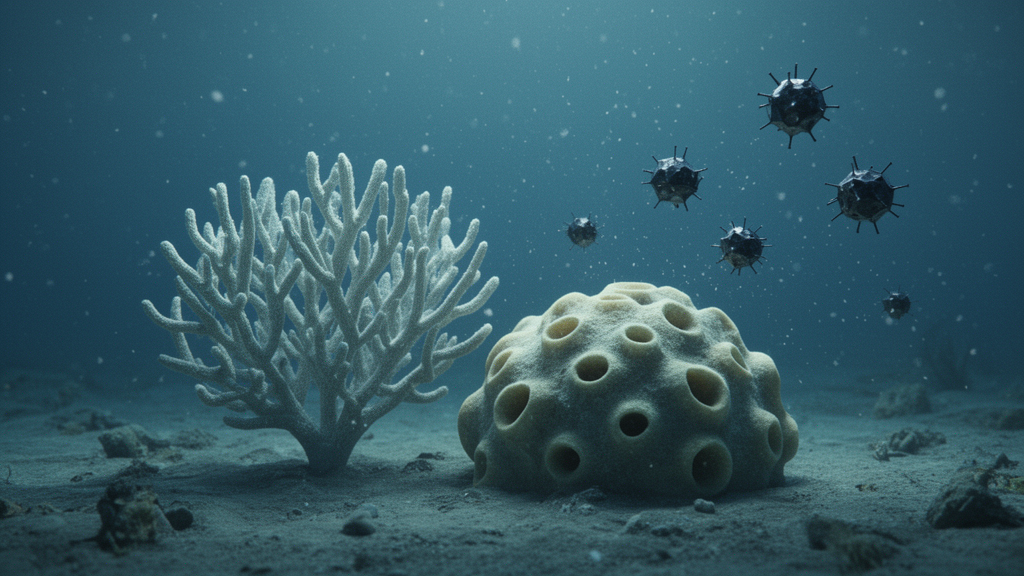
A virus first discovered in deep-sea carnivorous sponges has now been detected in a second animal phylum. Molecular screening of archived samples from the Northwest Atlantic has identified the carnivorous sponge-associated iridovirus, known as CaSpA-IV, in tissue specimens of the bubblegum coral Paragorgia arborea, a deep-sea octocoral common on the Canadian continental shelf.
CaSpA-IV was originally described in two species of cladorhizid sponges, Chondrocladia grandis and Cladorhiza oxeata, collected in the Gulf of Maine and Baffin Bay. These carnivorous sponges are unusual among sponges: rather than filtering bacteria and organic particles from water pumped through an aquiferous system, they use hooked spicules on their outer surface to trap small crustaceans, including vertically migrating planktonic copepods, which are then enveloped and digested by migrating cells. The virus had been molecularly detected in various anatomical regions of six C. grandis and two C. oxeata specimens, sampled between 537 and 852 metres depth at two geographically distant locations, making it one of the few iridoviruses reported from the phylum Porifera.
Iridoviruses are nucleocytoplasmic large DNA viruses with double-stranded genomes of roughly 100 to 200 kilobase pairs packaged inside icosahedral capsids measuring 120 to 350 nanometres. Two subfamilies are currently recognised: Alphairidovirinae, which primarily infects ectothermic vertebrates, and Betairidovirinae, documented mainly in invertebrates. Infections in aquatic animals such as crustaceans, fish, reef-building corals and bivalves have been reported and may lead to high mortality, population declines and shifts in community structure. Outbreaks have caused significant economic losses in aquaculture, with viruses from the Ranavirus, Megalocytivirus and Decapodiridovirus genera affecting the culture of amphibians, reptiles, fish and decapods, and may also threaten at-risk species including ecologically and culturally significant Pacific salmon.
Because iridoviruses can infect hosts through routes including consumption of infected organisms or contaminated water, and because some iridovirus species infect a wide range of hosts, the researchers hypothesised that CaSpA-IV might move through the deep-sea food web via copepods. The Chilo iridescent virus, for example, has been associated with more than 100 insect species, and the decapod iridescent virus 1 has been documented in multiple crustacean species and a cladoceran. Calanoid copepods dominate North Atlantic mesozooplankton communities; the widespread species Calanus finmarchicus overwinters along shelves and in deep basins, and a single interbreeding population may have existed in the North Atlantic for a long time, suggesting large-scale transport and connectivity. During diel and seasonal vertical migration, zooplankton can sink to deeper layers, where they may become prey for benthic organisms such as carnivorous sponges and corals.
To test whether CaSpA-IV occurs in these potential vectors and co-occurring hosts, the team screened 32 calanoid copepod samples collected across Newfoundland and Labrador coastal and shelf waters, 24 mucus swab and tissue samples from six individual deep-sea Paragorgia arborea colonies, and three seawater samples from the Gulf of Maine. The zooplankton material included 14 samples gathered in June 2024 from 14 locations in Bonne Bay, Newfoundland, using a 500-micrometre mesh net towed at approximately 30 metres depth, near the lower boundary of the euphotic zone. Eighteen further frozen samples from the Newfoundland and Labrador coastal and shelf region had been collected in 2021 and 2022 through Fisheries and Oceans Atlantic Zone Monitoring Program activities and a Trinity Bay ichthyoplankton survey. For DNA extraction, an average of five copepods visually assigned to the order Calanoida, ranging from 2 to 4 millimetres, were taken from each sample.
The coral and seawater samples had been collected during a 2017 cruise to the Gulf of Maine, within 120 to 130 kilometres of localities where CaSpA-IV-positive carnivorous sponges had been obtained in 2014. Mucus was collected from the coral exterior with sterile cotton swabs, and tissue fragments were harvested from six colony fragments of P. arborea; three reference water samples were taken within 350 metres of the corals at approximately 1 metre above the bottom, and 50-millilitre aliquots were passed through 0.22-micrometre syringe filters. DNA had been extracted previously for another study and stored at minus 80 degrees Celsius.
Detection relied on hemi-nested polymerase chain reactions with primers targeting the major capsid protein gene of CaSpA-IV and closely related viruses. A CaSpA-IV sample from the carnivorous sponge Chondrocladia grandis served as the positive control and DNase/RNase-free distilled water as the negative control. Samples were tested undiluted and, if negative, again after a 1:10 dilution. To exclude PCR inhibition as a cause of negative results, negative samples were spiked with an internal control plasmid containing a fragment of the major capsid protein gene and retested; only positive samples and samples yielding a positive result after spiking were included. Amplicons were purified and sequenced in both directions, and sequences were compared with the reference CaSpA-IV sequence by pairwise alignment.
The results were selective. Tissue samples from two P. arborea colonies, collected on June 13 and 15, 2017, tested positive for CaSpA-IV, while mucus swabs from the same colonies were negative, as were all copepod and seawater samples. Sequences from the positive specimens, designated 2011-8 (2) and 2009-24 (2), showed 100 percent identity with the reference CaSpA-IV major capsid protein gene sequence over the 445-nucleotide fragment examined. Specimen 2009-24 had been collected approximately 66 kilometres and specimen 2011-8 approximately 79 kilometres from the original virus discovery site. Notably, a third colony fragment, 2011-7, sampled at the same location and depth as 2011-8, tested negative.
The researchers caution that the detection does not establish true infection of coral tissues. The analysed fragments weighed less than 0.25 grams wet weight and contained numerous polyps along with skeletal components; because samples were lysed entirely during DNA extraction, it is impossible to determine whether the virus resided within coral cells or in the gastrovascular cavity of the polyps. Although tissue samples were rinsed three times with phosphate-buffered saline before extraction, the contents of the gastrovascular cavities were unlikely to have been thoroughly flushed, so the detected virus may represent material from consumed prey or the gastrovascular space rather than intracellular infection. For both colonies, the virus was identified in only one of three sampling replicates, which the authors note does not suggest a systemic infection. Targeted methods such as fluorescence in situ hybridisation would be needed to locate the virus precisely within coral tissues, and full-genome sequencing is required to determine whether the sponge and coral viruses belong to the same strain.
The absence of the virus in more than 100 screened calanoid copepods suggests it is not highly prevalent in these animals in North Atlantic waters, though low-level infection remains plausible and, combined with trophic transfer, could explain why the virus appeared in only two of six coral colonies and, in the earlier study, in eight of nine carnivorous sponges. The authors also highlight a temporal mismatch: the zooplankton were collected in 2021, 2022 and 2024, while the positive corals and sponges date from 2014 and 2017, so episodic infections in copepods could have been missed, or the predators may have consumed prey other than calanoid copepods. The three seawater samples, all negative, represent a very small volume, although a previous study found proteins homologous to predicted CaSpA-IV proteins in marine metagenomic data from Arctic deep-sea sediments, Mediterranean seawater and Bothnian Sea sediments. Because calanoid copepods cannot be definitively ruled out as a transmission vector given the limited sampling, the authors recommend screening larger numbers of copepods, sampling prey and consumers at the same time and place, searching greater volumes of seawater, and sequencing whole genomes of diverse CaSpA-IV variants to clarify transmission routes and the ecological impact of this virus across two invertebrate phyla in geographically distant benthic habitats.
Subject of Research: Ecological distribution and possible transmission routes of the carnivorous sponge-associated iridovirus CaSpA-IV, including its first detection in a cnidarian host
Article Title: Research on the ecology of the carnivorous sponge-associated iridovirus (CaSpA-IV) reveals its presence in the Cnidaria
Article References: Zaluzhnyi, V., Bélanger, D., Verhoeven, J. T. P., Weiler, B. A., Canuti, M., & Dufour, S. C. (2026). Research on the ecology of the carnivorous sponge-associated iridovirus (CaSpA-IV) reveals its presence in the Cnidaria. Discover Viruses, 3(1), Article 21. https://doi.org/10.1007/s44370-026-00057-w
Image Credits: AI Generated
DOI: 10.1007/s44370-026-00057-w
Keywords: CaSpA-IV, iridovirus, carnivorous sponges, Paragorgia arborea, deep-sea coral, calanoid copepods, Cnidaria, Gulf of Maine, transmission routes, major capsid protein gene, PCR screening, marine virology
News Source: Kristina Jarvis. (October 28, 2026). Deep-Sea Coral Detection Expands the Known Host Range of a Carnivorous Sponge Iridovirus. Scienmag.