Polylactide, the plant-derived plastic better known as PLA, has a stubborn weakness: it is stiff, brittle, and loses what little toughness it has when exposed to sunlight, heat and moisture. A new open-access study in Discover Polymers reports that two reactive polysiloxane additives, blended into PLA at just 1 to 5 percent by weight, more than doubled the material’s initial impact strength in selected formulations and, crucially, slowed the mechanical decay that sets in during accelerated weathering. After 250 hours of simulated outdoor exposure, PLA compounds containing the modifier MOD1 retained roughly 90 percent of their initial tensile strength, while unmodified PLA lost about half of it over the same period.
The work, carried out by Julia Głowacka, Roksana Konieczna, Daria Pakuła, Miłosz Frydrych, Bogna Sztorch and Robert E. Przekop, builds on the team’s earlier research into silicone-based toughening agents. The two modifiers, MOD1 and MOD2, share a polysiloxane backbone with hexane and reactive methacrylate functional groups, but differ in molecular weight and architecture. MOD1 has a molecular weight of 4184 grams per mole, MOD2 one of 2764 grams per mole. Because both carry methacrylate groups, they polymerize thermally during melt processing, forming crosslinked elastomeric micro-domains inside the PLA matrix rather than simply behaving as migratory low-molecular-weight plasticizers.
That distinction matters. Conventional plasticizers for PLA, such as polyethylene glycol, epoxidized soybean oil or citrate esters, can raise ductility initially but tend to leach out over time, leaving the material more brittle than before. Prior work cited in the study showed that PLA plasticized with acetyl tributyl citrate lost 57 percent of its elongation at break after 240 hours of accelerated aging, while PEG-plasticized PLA largely reverted to the brittleness of neat PLA. Reactive modifiers that chemically anchor themselves into the matrix offer a route around that failure mode, and the new results suggest the anchoring strategy pays off under weathering.
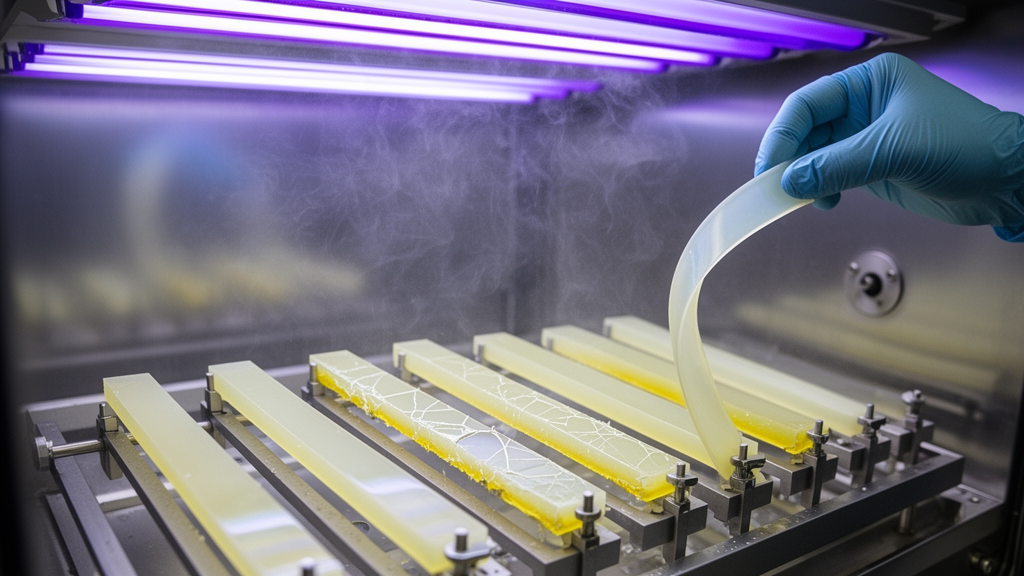
To test durability, the researchers followed the ISO 4892-3:2024 protocol in an ATLAS UV TEST chamber, exposing injection-molded specimens to 500 hours of alternating cycles: four hours of UV-B irradiation at 313 nanometers and 0.76 watts per square meter at 60 degrees Celsius, followed by four hours of condensation at 50 degrees Celsius in the dark. Samples were pulled at 0, 250 and 500 hours and subjected to tensile, flexural and unnotched Charpy impact testing, each on seven specimens per series, alongside differential scanning calorimetry, X-ray diffraction, infrared spectroscopy and optical and confocal microscopy.
The mechanical picture was consistent. Unmodified PLA began stiff and brittle, failing through unstable crack initiation and crazing. Adding either modifier produced progressively greater ductility with increasing loading, and impact resistance rose by more than 100 percent relative to neat PLA for selected formulations, attributed to the crosslinked elastomeric structures absorbing impact energy. The trade-off was expected: tensile strength, Young’s modulus and flexural strength all declined modestly with additive content, while flexural modulus stayed essentially unchanged. Differences between the two modifier systems were minor in the unaged state, but aging separated them sharply.
After 250 hours, tensile strength changes for PLA/MOD1 across the 1 to 5 percent range stayed within roughly 10 percent of initial values, whereas neat PLA dropped about 50 percent, then dropped a further 50 percent by 500 hours. Elongation at break fell for every material, yet most modified formulations still outperformed neat PLA at 250 hours, and the PLA/MOD1 series maintained that advantage through 500 hours. MOD2 told a different story: at 1 percent loading its tensile strength fell to about 25 megapascals, comparable to neat PLA, and its ductility advantage faded faster, which the authors link to its finer dispersion and greater initial segmental mobility. Shear-yielding deformation, which dominates in MOD2-toughened PLA, depends on adequate matrix mobility, and aging progressively restricts that mobility.
Impact toughness told a similar time-dependent tale. At 250 hours, the 1 to 2.5 percent PLA/MOD1 formulations still exceeded neat PLA in Charpy impact strength, while MOD2 formulations were merely comparable, a difference the researchers attribute to MOD1’s coarser, bimodal morphology enlarging the crack-tip process zone. By 500 hours, however, every sample, modified or not, had fallen below 10 kilojoules per square meter, losing the capacity to absorb impact energy effectively. Notably, within both modifier series, impact toughness declined more steeply with exposure time as modifier concentration increased, an inverse trend the study documents without fully resolving.
The structural explanation lies in secondary crystallization. X-ray diffraction showed neat PLA’s crystallinity climbing from 14 percent at the start to 38 percent at 250 hours and 36 percent at 500 hours, while DSC recorded an even starker rise from 1.9 percent to 42.7 percent for neat PLA, reaching 31.3 percent for PLA with 5 percent MOD1 and 36.6 percent with 5 percent MOD2. In aged samples the cold-crystallization peak vanished from first-heating DSC scans, confirming that crystallization had already occurred during exposure, and the cold-crystallization temperature shifted downward in second heating, a signature of chain scission producing shorter, more mobile chains. The authors conclude that the embrittlement coincides with this structural ordering, which reduces free volume and restricts chain motion.
Photochemistry separated the modifiers in the opposite direction. Differential FTIR spectra showed the largest changes in the carbonyl region between 1700 and 1750 wavenumbers, consistent with Norrish type I and II reactions and beta-scission acting on ester bonds rather than cleavage of side chains. Quantifying this via the carbonyl index, the change after 500 hours was 2.00 for neat PLA, 0.65 for PLA/MOD1 and just 0.24 for PLA/MOD2, marking MOD2, built on a dimethylsiloxane copolymer core, as the clear winner in photochemical stability. Yet that superior resistance to photo-oxidation did not translate into the best ductility retention, leading the authors to conclude that mechanical decay during aging is driven not only by photo-oxidative degradation but also by structural relaxation, crystallization and morphology-dependent deformation mechanisms, which the two modifier architectures influence through at least partly independent routes.
Surface analysis rounded out the picture. Confocal microscopy revealed composition-dependent, non-monotonic roughness evolution: PLA with 5 percent MOD1 showed a delayed rise in roughness after 500 hours, while PLA with 5 percent MOD2 roughened transiently at 250 hours and then partially smoothed. Even after 500 hours no cracks or yellowing appeared on any sample; the only visible change was a milky appearance attributed to increased crystallinity and light scattering. The authors are careful to frame the limits of the work: accelerated laboratory aging on laboratory-scale specimens does not fully reproduce service conditions, and because PLA’s glass transition sits near room temperature, plasticized formulations may still be compromised by environmental aging in real use. They call for validation of the most promising formulations under genuine outdoor exposure and extreme cyclic loading of thin-walled components. Even so, the study establishes that modifier architecture, not just additive chemistry, governs how long a toughened bioplastic stays tough.
Subject of Research: Toughening and aging resistance of polylactide using reactive polysiloxane modifiers under accelerated outdoor weathering
Article Title: Correlation between mechanical performance and structural evolution in PLA toughened with reactive polysiloxanes during accelerated aging
Article References: Głowacka, J., Konieczna, R., Pakuła, D., Frydrych, M., Sztorch, B., & Przekop, R. E. (2026). Correlation between mechanical performance and structural evolution in PLA toughened with reactive polysiloxanes during accelerated aging. Discover Polymers, 3(1), Article 29. https://doi.org/10.1007/s44347-026-00068-2
Image Credits: AI Generated
DOI: 10.1007/s44347-026-00068-2
Keywords: PLA, polysiloxane, toughening, accelerated aging, UV-B degradation, secondary crystallization, carbonyl index, bioplastics, polymers, impact strength, FTIR, DSC
News Source: Beatrice Stafford. (October 28, 2026). Silicone Additives Help Brittle PLA Survive Simulated Outdoor Aging. Scienmag.