


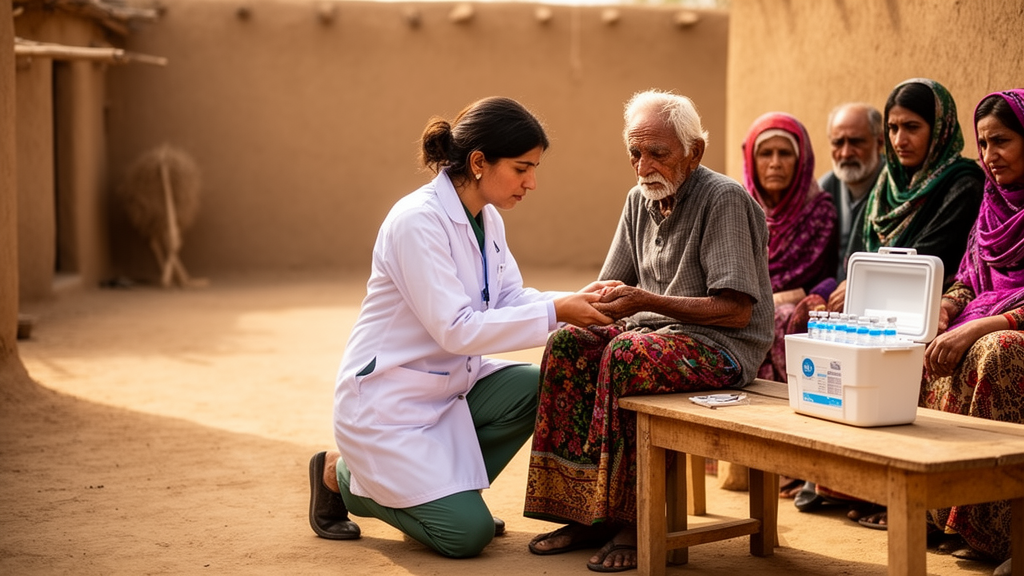
Pakistan presents one of global health’s most striking paradoxes. Few disease elimination or eradication programs have attracted as much international financing and political attention as the fight against polio, yet the country remains one of the last places in the world where wild poliovirus transmission has never been interrupted. In the same country, a far smaller leprosy program, sustained largely by civil-society organizations with a fraction of the resources and none of the political visibility, has cut the number of newly diagnosed leprosy cases by more than three-quarters since the start of this century. That contrast is the starting point for a comment article published in BMC Global and Public Health, in which researcher Anil Fastenau argues that Pakistan’s intensively financed polio eradication program has something to learn from one of its least financed disease-control efforts.
The author is careful to acknowledge the limits of the comparison. Polio and leprosy are not epidemiologically equivalent: polio is an acute viral infection prevented through population immunity, while leprosy is a chronic bacterial disease requiring early diagnosis, multidrug therapy, and disability prevention. Their trajectories cannot be compared as a natural experiment. Nevertheless, the article contends, their contrasting institutional histories raise an important question about what sustains disease control once the technical tools are in place. The global polio campaign has achieved extraordinary success, reducing wild poliovirus cases by more than 99 percent, yet persistent transmission of wild poliovirus in Pakistan shows that technical effectiveness alone is insufficient to finish the job.
Insecurity and cross-border transmission with Afghanistan matter, the article notes, but so does distrust. Pashto-speaking communities, who make up around 15 percent of Pakistan’s population, accounted for 81 percent of wild poliovirus type 1 cases over the past decade. Repeated vaccination campaigns can reach households without the institutions behind them becoming trusted. In marginalized communities, families may reasonably ask why the health system returns reliably with polio vaccine but remains absent when they need clean water, maternal care, nutrition, or treatment for a sick child. The article argues that vaccine hesitancy is often framed as a knowledge deficit to be corrected through communication, but that vaccine resistance can also reflect broader judgments about the trustworthiness and responsiveness of institutions, including whether communities feel heard and their concerns are taken seriously. Trust, in this framing, cannot be delivered in vaccination rounds.
Pakistan’s leprosy experience offers a different model. For decades, organizations such as the Marie Adelaide Leprosy Centre and Aid to Leprosy Patients have worked alongside government services to maintain early diagnosis and treatment despite declining political commitment. According to the article, they did more than distribute multidrug therapy. They built long-term relationships with patients and families, conducted community-based active case finding, managed complications, addressed stigma and disability, and remained accessible after treatment ended. Their legitimacy, the author writes, was accumulated through continuity and care rather than through campaigns or short-term projects.
From this history, the article draws three lessons for polio eradication. First, trust should be treated as infrastructure. Like surveillance systems, cold chains, and trained personnel, trust must be built before crises and maintained between campaigns, not assembled hastily when resistance emerges. Second, local civil-society organizations should be financed as institutions rather than used mainly as short-term delivery channels. Contracts that fund only mobilization or message dissemination, the author argues, rarely sustain the organizational memory, local leadership, and broader services through which trust develops. Third, disease eradication and elimination programs should respond to needs that communities themselves consider urgent. This does not mean diluting the focus on poliovirus: high-quality vaccination, surveillance, and rapid outbreak response remain essential. But in persistently underserved areas, polio activities should connect families with routine immunization, primary care, nutrition, and other services, not as temporary incentives but as evidence of a different relationship between communities and the health system.
The article also extends the argument to what eradication campaigns leave behind. Community engagement, it suggests, should not be treated as a temporary instrument for securing acceptance of the next vaccination round. Instead, it should strengthen institutions that communities can continue to use and hold accountable after transmission has been interrupted. Measuring doses delivered and households reached is necessary, the author writes, but programs should also assess whether referral pathways function, whether local organizations remain capable, and whether communities perceive services as responsive to their priorities. On that view, the final stage of eradication is not only about interrupting transmission but about what kind of health infrastructure remains standing once the campaign machinery winds down.
The comparison carries a warning for leprosy as well. The article notes that low national incidence can create complacency, erode clinical expertise, weaken surveillance, and prompt premature donor withdrawal, even though child cases, geographic clusters, and diagnostic delays continue to indicate ongoing transmission. Pakistan’s zero-leprosy roadmap therefore combines trusted civil-society networks with active case finding, contact screening, post-exposure prophylaxis, and digital surveillance. The lesson, the author concludes, is not to choose trust over technology, but to make trust the social infrastructure through which technology works.
Translating these observations into practice, the article sets out four practical considerations for polio eradication programs. First, treat trust as program infrastructure by investing in sustained community relationships between vaccination rounds rather than rebuilding engagement during each campaign. Second, strengthen and finance trusted local organizations as long-term partners, including their institutional capacity, rather than engaging them primarily for short-term mobilization or message delivery. Third, link polio activities with broader community health priorities, using referral pathways and connections to routine immunization, primary care, nutrition, maternal and child health, and other locally relevant services. Finally, expand program monitoring beyond vaccination outputs to include indicators of community trust, functioning referral pathways, institutional continuity, and perceived responsiveness to community priorities.
The author emphasizes that these measures would complement, not replace, high-quality vaccination, surveillance, and outbreak response, while helping to build the durable relationships required for eradication and its aftermath. The argument is presented as a comment piece grounded in Pakistan’s institutional experience rather than as a formal evaluation of intervention effectiveness, and it draws on the documented histories of the country’s leprosy and polio programs. Its central claim is captured in its closing image: the last mile of elimination or eradication may depend less on how often a program can knock on a family’s door than on whether the institution standing outside has earned the right to be trusted. For a country that has come closer than almost any other to ending polio without yet crossing the line, the article suggests that the missing ingredient may not be another vaccine vial but the patient, unglamorous work of building institutions that communities believe in.
Subject of Research: Lessons from Pakistan's leprosy control program for polio eradication
Article Title: What polio can learn from leprosy
Article References: Fastenau, A. (2026). What polio can learn from leprosy. BMC Global and Public Health, 4(1), Article 105. https://doi.org/10.1186/s44263-026-00339-x
Image Credits: AI Generated
DOI: 10.1186/s44263-026-00339-x
Keywords: polio, leprosy, Pakistan, disease eradication, vaccine hesitancy, community trust, civil society, public health, wild poliovirus, multidrug therapy, health systems, BMC Global and Public Health
News Source: Kristina Jarvis. (October 28, 2026). What Pakistan’s leprosy success can teach its polio eradication program. Scienmag.



